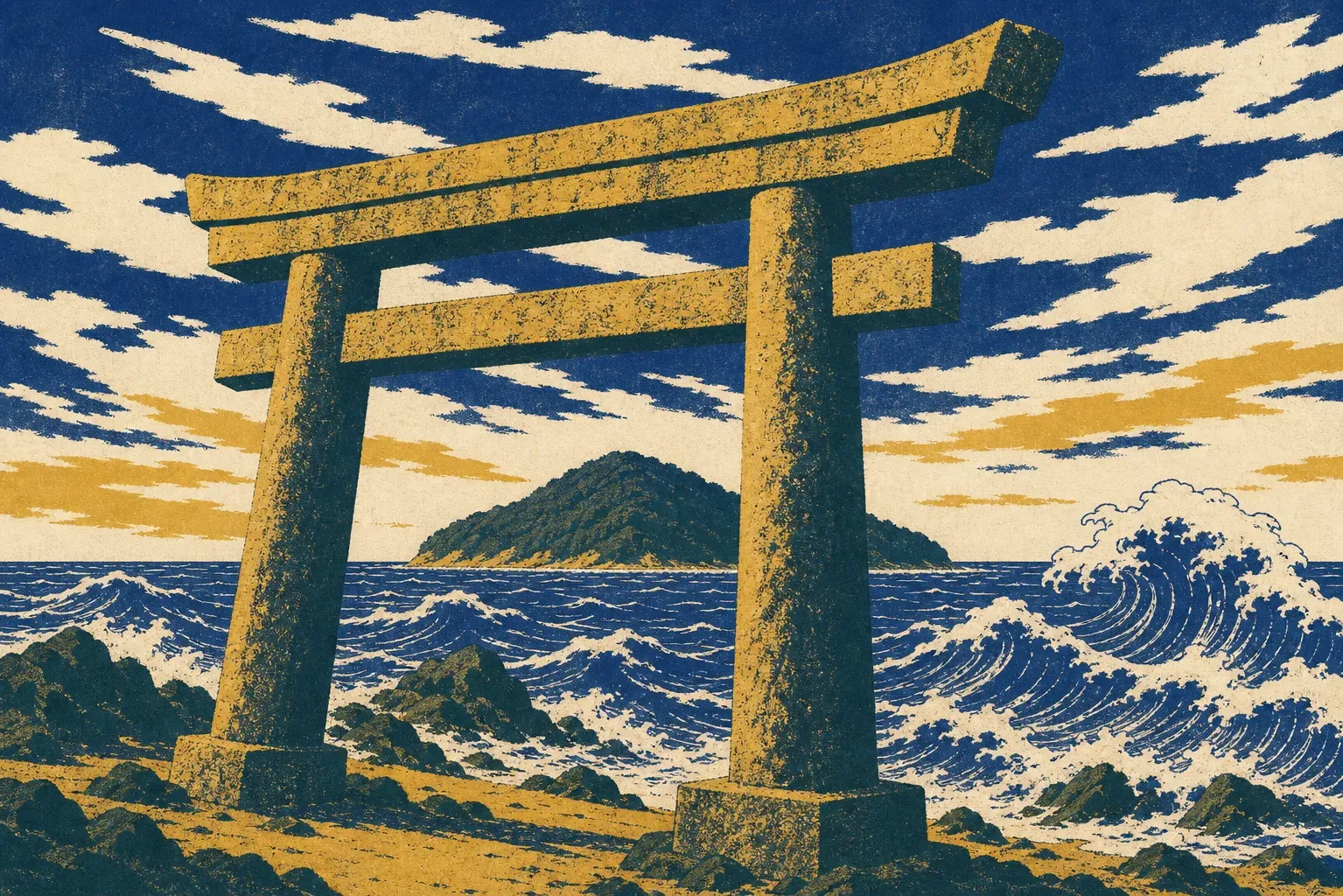
Okinoshima & Munakata Taisha
「神宿る島」宗像・沖ノ島と関連遺産群
- Hakata Station, Fukuoka (then JR Togo Station)
- ≈4 h from Tokyo
- Depends on route — see Access
- spring
Quick facts
- ≈4 h from Tokyo
- flight roughly 12,000-25,000 yen one way or shinkansen about 23,000 yen, plus about 1,000 yen local transport
- Depends on route — see Access
- spring · autumn (Miare Festival, October 1)
- Hakata Station, Fukuoka (then JR Togo Station)
- Oshima's fixed-route sightseeing buses were abolished on September 30, 2025; the island now runs the on-demand Noruto bus (300 yen per ride or a 1,000-yen day pass as of 2026), which must be booked by app or phone up to seven days ahead and does not operate December 31 through January 3, so either book it, rent a bicycle at the ferry terminal (1,500 yen as of 2026), or plan to walk.
- The Konominato-Oshima ferry runs only seven round trips a day with no seat reservations and cash-only ticket machines (570 yen one way as of 2026), and sailings are canceled in rough weather, especially November through March, so confirm the last return boat (around 18:00) before crossing.
- Munakata Taisha's autumn grand festival runs October 1-3, opening with the Miare-sai sea procession on the morning of the 1st, when about 100 decorated fishing boats escort the deities from Oshima into Konominato; it is the region's signature spectacle, but expect jammed roads, packed harbors, and disrupted boat operations all three days.
Overview
Why it's inscribed
Sixty kilometers off Kyushu sits a forested island where, for five hundred years, envoys and mariners bound for Korea landed to pray for safe passage and left offerings among the boulders. From the end of the 9th century, almost nobody came at all. The result is an archaeological time capsule: roughly 80,000 objects, collectively designated a National Treasure, left where they were placed between the 4th and 9th centuries. Bronze mirrors from China. Gold rings matching those in Silla tombs. Fragments of cut glass made in Sassanian Persia. Scholars call Okinoshima "the Shosoin of the Sea," and reading the changing offerings is reading the record of exchange between the Japanese archipelago, the Korean Peninsula, and the Asian continent during the centuries when a Japanese state was taking shape.
UNESCO inscribed the site in 2017 for that record, and for something rarer: the worship never stopped. When ritual on the island itself ended, devotion to the Three Female Deities of Munakata carried on at three worship sites strung across the strait, plus "distant worship" from Oshima and the Kyushu shore. The taboos that protected the island for a millennium still hold. You cannot go. That is precisely the point.
What you'll actually see
Hetsu-miya, Munakata Taisha
The mainland hub at Tashima in Munakata City, where nearly everyone starts. The Main Hall went up in 1578, rebuilt by chief priest Munakata Ujisada after a 1557 fire; the Worship Hall followed in 1590, funded by the general Kobayakawa Takakage. Both are Important Cultural Properties. Don't stop there. Behind the main halls stand the Dai-ni-gu and Dai-san-gu, two small sanctuaries given by Ise Jingu in 1973 after its 60th rebuilding cycle; pay respects at the main hall and at both of these and you have, technically, worshipped all three Munakata goddesses without leaving the grounds. Open 06:00 to 19:00, free, every day.
Takamiya Saijo
From the rear of Hetsu-miya, stone steps climb Mt. Munakata to an open-air ritual ground with no building at all, just a roped clearing among old trees. This is where the rituals performed today are said to descend from, a form of worship older than shrine architecture itself. It's a short climb, and most visitors skip it, which is a mistake; the clearing does more to explain Okinoshima than any signboard below. Behave as you would inside a shrine hall, and photograph quietly.
Shimpokan Museum
Inside the Hetsu-miya grounds, this is where the island's 80,000 National Treasure objects are shown in rotation, with exhibits changing roughly twice a year: bronze mirrors, gilt-bronze dragon heads, gold rings, horse trappings, Persian cut glass. Since you will never set foot on Okinoshima, this room is the closest you get to what the priests buried there. Whatever else you trim from the day, keep this. Admission 800 yen for adults as of 2026; open daily 09:00 to 16:30, last entry 16:00.
Nakatsu-miya, Munakata Taisha
On Oshima, about five minutes uphill from the ferry port, enshrining Tagitsuhime with an early-17th-century main hall. The charming oddity here is the Amanogawa, a stream named for the Milky Way that runs through the precinct with small shrines to Altair and Vega facing each other across it; the August 7 Star Festival built around them dates to the Kamakura period. Behind the shrine, a 970-meter path climbs to the Mt. Mitake summit, the island's original ritual site, with views across the Genkai Sea. Allow about an hour round trip.
Okitsu-miya Yohaisho
A modest distant-worship hall on Oshima's north coast, rebuilt in 1933 on a spot where worship toward the sacred island is documented by at least the mid-18th century — a stone monument on the steps carries the date 1749. It exists for exactly one purpose: praying toward Okinoshima, which floats on the horizon in clear weather. This is the emotional center of the whole property, and it is entirely hostage to visibility, so check the forecast before you cross. The hall is an active place of prayer, not a lookout platform. Roughly a 25 to 30 minute walk from the port, or a short hop on the island's on-demand bus.
Okinoshima, from a distance
The sacred island itself, staffed by a single Shinto priest at a time, drawn from Munakata Taisha's priesthood and rotating on roughly ten-day shifts. Even that priest must strip and purify himself in the sea before landing. Nothing may be removed, not even driftwood; what is seen there must never be spoken of; women may not land at all. An annual festival that admitted about 200 men by lottery was discontinued in 2018, the year after inscription, and the shrine has said it will not open the island to tourism. Landing without permission is a criminal offense. Oshima's fishermen are regarded as the island's real guardians.
Shimbaru-Nuyama mounded tomb group
In neighboring Fukutsu City, 41 remarkably intact burial mounds of the Munakata clan, built in the 5th and 6th centuries on a plateau that once overlooked a sea lagoon: five keyhole-shaped, 35 round, one rectangular. An iron adze from Tomb 7 matches finds from Okinoshima, tying the clan directly to the island rituals. You can walk freely among the mounds, though entering them is prohibited. On Tomb 21 stand the Hyakuto Itabi, a dozen-plus stone monuments linked by legend to the dead of the Mongol invasions. Treat it as a separate outing from Fukuma Station.
Worth knowing
See the mainland sites in the right order: the free Uminomichi Munakatakan museum first (its 3D theater is the only way anyone gets "onto" Okinoshima; closed Mondays), then Hetsu-miya, then the Shimpokan. Last entry at the Shimpokan is 16:00 sharp, and arriving at 16:15 after a slow lunch is the most common way this trip goes wrong. Half a day covers the mainland cluster; adding Oshima makes it a full day, so decide by mid-morning. Since the payoff of the crossing is actually seeing Okinoshima from the Yohaisho or Mt. Mitake, check visibility before committing; on a gray day the island simply is not there. At the Yohaisho, keep voices down and let anyone praying finish before you photograph. Never ask a boat operator to take you closer to Okinoshima; it is private shrine land and unauthorized landing is a criminal offense. Shimbaru-Nuyama sits in a different city, Fukutsu, off a different station, so give it its own half-day rather than tacking it onto the end. In late February, and again in late October, it pairs well with Miyajidake Shrine's Path of Light, when the setting sun aligns with the shrine approach.
Highlights
Hetsu-miya (Munakata Taisha main shrine) with 16th-century shrine architecture
Shimpokan Museum holding some 80,000 excavated votive treasures from Okinoshima, including gold rings and continental artifacts
25-minute ferry from Konominato port to Oshima Island and Nakatsu-miya shrine
Okitsu-miya Yohaisho on Oshima, the distant-worship spot with views toward forbidden Okinoshima
Shimbaru-Nuyama Mounded Tomb Group of the ancient Munakata clan (5th-6th centuries)
Miare Festival sea procession in early October
Getting there from Tokyo
Fly Haneda to Fukuoka (about 2h) or take the Tokaido/Sanyo Shinkansen Nozomi to Hakata (about 5h); then JR Kagoshima Main Line local/rapid train from Hakata to Togo Station (30-40 min, 660 yen). From Togo take a Nishitetsu bus bound for Konominato via Munakata Taisha to the Munakata Taisha-mae stop (about 10-12 min, 260 yen), then a 1-2 minute walk to Hetsu-miya. For Oshima, continue by bus to Konominato port and take the 25-minute ferry. Okinoshima itself cannot be visited.
Where to base & what to eat
Where to base
Togo / Akama, Munakata City
Business hotels beside JR Togo Station (Hotel AZ Fukuoka Munakata) are the cheapest base and put you in position for the first Konominato bus and the early ferry, but the trade-off is a plain suburban station town with little to do after dark.
Oshima island
A night in a family minshuku like Tsuwase or a villa at Munakata Oshima Resort buys you the Okitsu-miya Yohaisho at dawn with no ferry anxiety, at the cost of seven boats a day, weather cancellations, minimal English, and almost no dinner options outside your lodging.
Mercure Fukuoka Munakata Resort & Spa (Tano)
The area's one resort choice, with the Genkai Satsuki Onsen's open-air baths about ten minutes by car from Hetsu-miya, but it is effectively car-or-taxi only.
Hakata / Fukuoka City
The widest choice of hotels and restaurants, 30 to 40 minutes by train to Togo (660 yen as of 2026), but you burn over two hours a day commuting and cannot comfortably use the earliest or last Oshima sailings.
What to eat
Kanezaki wild tora-fugu (tiger pufferfish)
Landed at Kanezaki port and in season December through March; the annual winter fugu fair (January 19 to March 1 in 2026) puts fugu sashimi, hotpot, and karaage on menus across Munakata-area restaurants, and Kanokoyuri does a dedicated wild-fugu kaiseki.
Munakata anago (conger eel)
Fukuoka Prefecture's biggest conger catch, kept live in tanks, in season May to November with a July-September peak; try anago-meshi or anago-chazuke at Michi-no-Eki Munakata, the fish-market roadside station where the co-op sells the morning's catch (09:00-17:00, closed the 4th Monday).
Gen-chan aji (line-caught horse mackerel)
Branded Genkai Sea horse mackerel, minimum 26 cm and never touched by hand before preparation; the year-round backbone of local sashimi. On Oshima, the fisherman-run Kaihomaru shokudo serves sashimi set meals from the day's catch.
Amanatsu uni-don and akamoku on Oshima
Sayoshima, the fisheries co-op shop in front of the Oshima ferry terminal (09:00-16:00, closed Tuesdays), has sold a seasonal bowl of island sea urchin with island natsumikan citrus; its akamoku seaweed is the island's signature take-home.
Himemochi
The shrine-visit sweet at Munakata Chayu, the rest-house beside Hetsu-miya built on the site of the old Kiganden; open 10:00-15:00 daily, and the natural souvenir to carry out of the grounds.
Official links
Fares, hours and closures change with little notice. These are the operators' and authorities' own pages — worth a look close to your travel dates.
Related stories
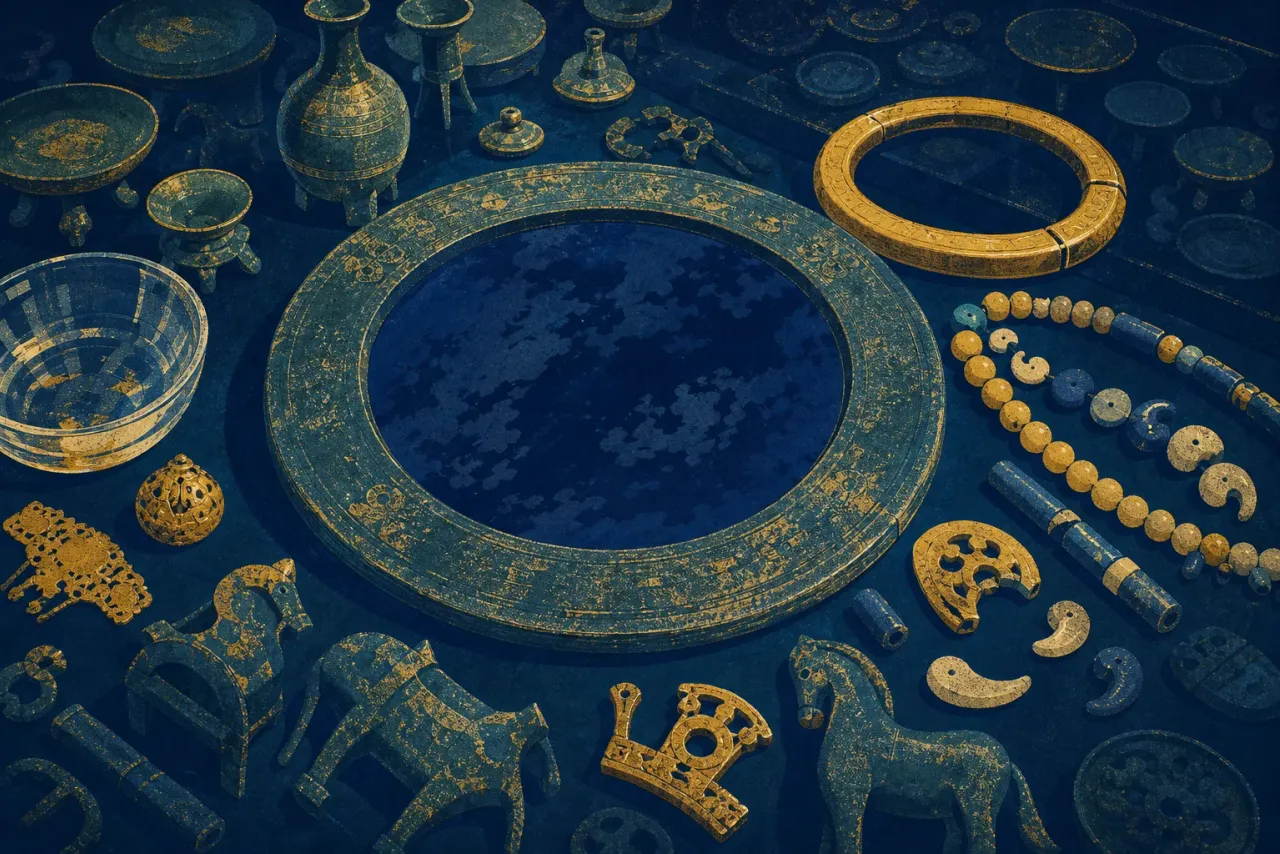
Eighty thousand offerings and an island no one may describe
No one may land on Okinoshima, and no one who has may say what they saw. What UNESCO actually protected off the Fukuoka coast, and where the rest of us can meet its 80,000 treasures.
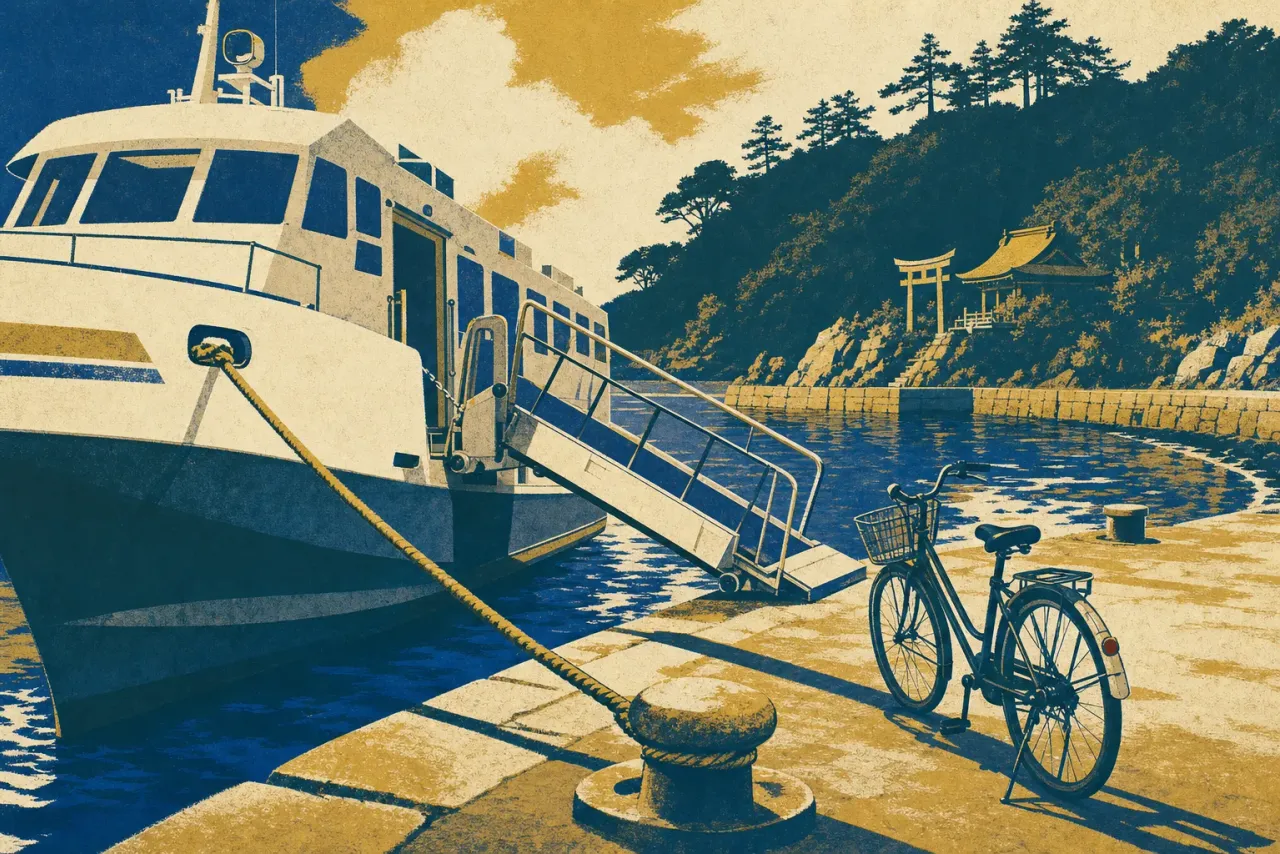
Seven boats a day: planning the Munakata and Oshima World Heritage run
Oshima's loop bus is gone, the ferry runs seven times a day, and the treasure museum shuts its doors at 16:00. A working plan for the Munakata World Heritage day trip from Fukuoka.
Sources
- https://whc.unesco.org/en/list/1535/
- https://www.okinoshima-heritage.jp/en/
- https://www.japan.travel/en/world-heritage/sacred-island-of-okinoshima-and-associated-sites-in-the-munakata-region/
- https://en.wikipedia.org/wiki/Okinoshima_(Fukuoka)
- https://www.japan-guide.com/e/e4840.html
- https://www.okinoshima-heritage.jp/en/know/hetsumiya.html
- https://www.okinoshima-heritage.jp/know/yohaisho.html
- https://www.okinoshima-heritage.jp/know/shimbaru.html