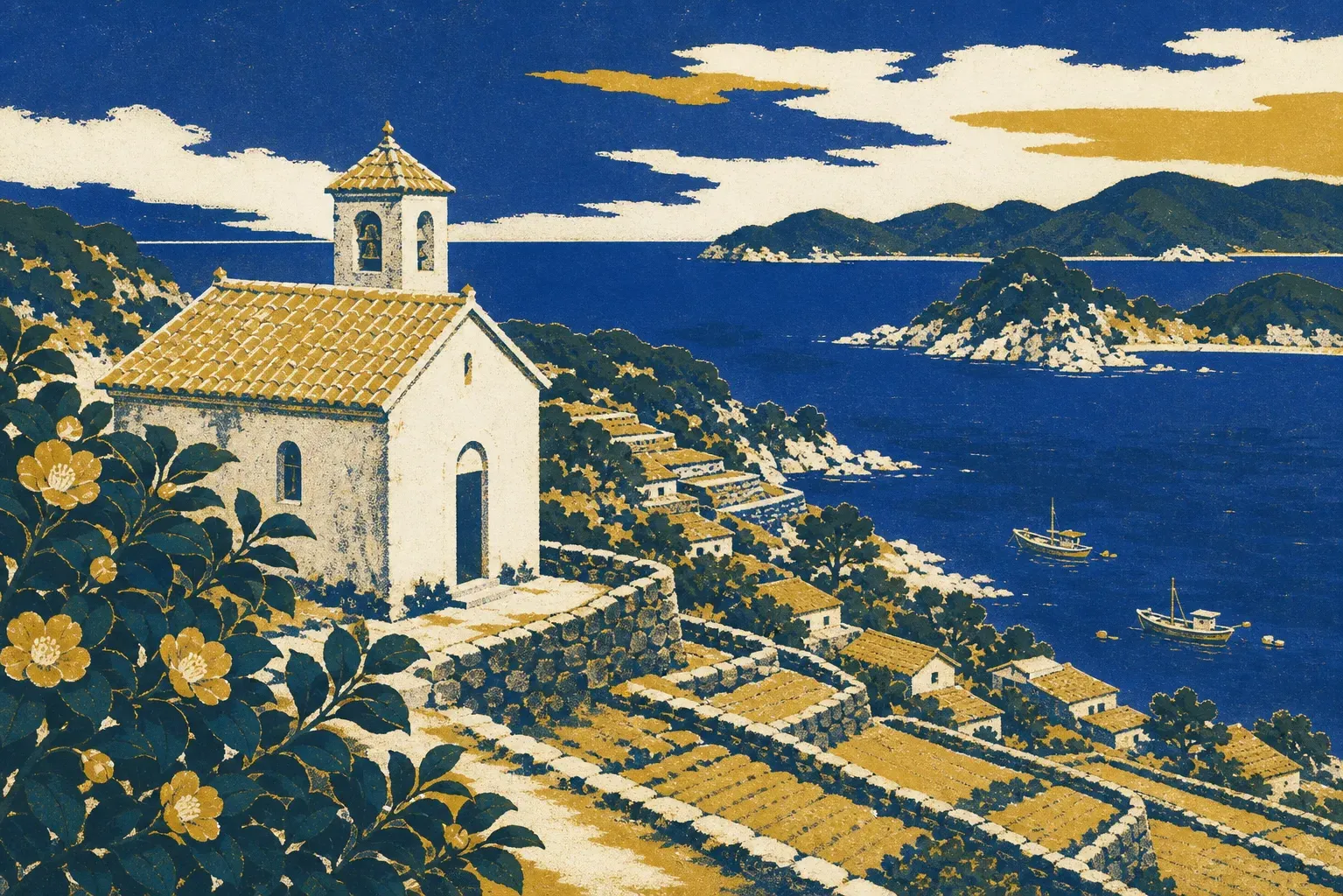
Hidden Christian Sites (Nagasaki & Amakusa)
長崎と天草地方の潜伏キリシタン関連遺産
- Nagasaki Station / Nagasaki Airport
- ≈4 h from Tokyo
- Depends on route — see Access
- spring
Quick facts
- ≈4 h from Tokyo
- flights roughly 15,000–40,000 yen one way; rail about 26,000 yen
- Depends on route — see Access
- spring · autumn
- Nagasaki Station / Nagasaki Airport
- Eight of the twelve component churches (Sakitsu, Shitsu, Ono, Kuroshima, Former Nokubi, Kashiragashima, Former Gorin and Egami) require advance notice: web bookings at kyoukaigun.jp close two days before your visit, and requests after that cutoff go by email or by phone to the Nagasaki Churches Information Center on +81-95-823-7650 (10:00-17:00).
- The former Shitsu Aid Center in Sotome is open daily except December 29 to January 3, 9:00-17:00 Monday through Saturday and 11:00-17:00 on Sundays, with last entry at 16:30; listings that still show a Monday closure predate the April 2025 change.
- Direct buses between JR Nagasaki Station and Sotome (about 1 hour 15 minutes to Shitsu Bunkamura) run only in the morning and evening; at other times you change at Sakura-no-Sato Terminal, so check the timetable before building an afternoon around a single ride.
- Egami Church on Naru Island has announced temporary closure days for August 2026, so confirm open dates at kyoukaigun.jp before paying for the ferry crossing.
- Sakitsu village is running traffic guidance and restrictions for tourist vehicles from August 11 to 15, 2026 (Obon), so expect diverted parking and delays if driving in Amakusa that week.
- A notice dated July 29, 2026 lists dates and times when visits will not be accepted at Shitsu, Kashiragashima and Tabira churches; check the notices page at kyoukaigun.jp when you book.
Overview
Why it's inscribed
Japan banned Christianity in 1614 and enforced that ban for two and a half centuries. What UNESCO recognized in 2018 is what happened in between: farming and fishing communities along the Nagasaki coast kept a version of Catholicism alive with no priests, no sacraments, no church buildings. They registered as Buddhist parishioners for cover and baptized their own infants with water carried from a forbidden islet. Over generations their prayers fused with mountain worship and ancestor rites into a religion that existed nowhere else on earth.
The twelve components tell that story in three acts. Hara Castle, where a rebellion of over 30,000 ended in annihilation in 1638, explains why the crackdown became total. The villages of Hirado, Sotome, Amakusa and the outer islands show where and how the faith survived. Ōura Cathedral supplies the ending: in March 1865, villagers from Urakami walked into the new French mission church and quietly told the priest that they shared his religion, after 250 years underground.
One thing to get straight before you go. The photogenic churches were all built after the ban lifted in 1873; they are the epilogue, not the subject. The inscription honors the hidden centuries themselves. Those survive as terraced fields and an empty castle hill, and as one islet nobody may set foot on.
What you'll actually see
Ōura Cathedral
Japan's oldest standing church, built in 1864 by French missionaries for Nagasaki's foreign settlement and dedicated to the 26 Christians executed in the city in 1597. This is where the story turns: on March 17, 1865, a group from nearby Urakami approached Fr. Bernard Petitjean and revealed that their villages had kept the faith all along. Admission is 1,000 yen as of 2026 and includes the adjoining Christian Museum, whose captions are mostly Japanese-only, so get your background first at the Churches Information Center on Dejima Wharf. Plan on 60 to 90 minutes. No advance notice needed.
Shitsu and Ono villages, Sotome
The most doable excursion from Nagasaki city. Fr. Marc Marie de Rotz built Shitsu Church in 1882 for a community that had hidden on this coast precisely because the Ōmura domain barely policed it, then added Ono Church, a chapel of ease, in 1893. Study Ono's walls: rubble basalt set in mortar, a technique found in no other church in Japan. Its interior is permanently closed; attendants open the windows so you can look in, and in rain or rough weather they may not open them at all. Shitsu remains a working parish. The Shitsu Aid Center (700 yen as of 2026) preserves the vocational school where local women learned weaving and bread-making under de Rotz; the nearby de Rotz Memorial Museum fills in the rest of his story for 310 yen.
Remains of Hara Castle
A grassy headland in Minamishimabara where the 1637–38 Shimabara–Amakusa rebellion ended with more than 30,000 rebels killed, the castle razed, and the dead buried inside the grounds so the site could never be fortified again. There is little to see, and that is the point; this field is why the ban became absolute and the hiding began. No notice needed. Pair it with the Shimabara Peninsula's onsen towns rather than treating it as a detour.
Sakitsu Village, Amakusa
A working fishing village in Kumamoto Prefecture where Gothic-fronted Sakitsu Church (1934) rises straight out of the harbor houses. Fr. Halbout ran out of money mid-construction, so the building is concrete in front, wood behind, with a tatami floor inside. It stands deliberately on the site of the village headman's house, where residents were once forced to tread on images of Christ to prove they had renounced the faith. Wander the narrow alleys locals call tōya, and eat the local sea urchin. Book through Kyushu Sanko Tourism, not the Nagasaki center.
Kasuga Village and the Hirado sacred places
On Hirado's northwest coast, Kasuga is a living village of terraced rice fields whose believers, priestless after Xavier's 1550 visit faded into memory, folded their faith into worship of 536-meter Mt. Yasumandake, the highest peak in the Hirado area. Baptismal water came from Nakaenoshima, an offshore islet where martyrs died; landing is prohibited, so you view it from shore, which feels appropriate. Come early for morning light on the terraces, and never photograph residents. No advance notice required for any of it.
The Gotō island churches
Four components scatter across the Gotō chain, and they reward the effort most. Kashiragashima Church (1910–19) is the prefecture's only stone church, its sandstone quarried on the island itself. Egami Church on Naru Island (1918), white with pale blue window frames beneath giant tabu trees, is widely considered the most beautiful of the region's wooden churches. Former Gorin Church on Hisaka, an 1881 building relocated in 1931, hides a rib-vaulted ceiling at the end of a 500-meter unpaved walk. Nozaki Island has no residents at all anymore, just deer and the brick Former Nokubi Church (1908). Allow three to four days, not one.
Worth knowing
Eight of the twelve components sit behind an advance-notice system, because these are functioning churches, not attractions. Web applications close two days before your visit and open up to six months ahead; after the cutoff, you email or phone the Nagasaki Churches Information Center. Two exceptions trip people constantly: Sakitsu is booked through Kyushu Sanko Tourism, and Nozaki Island through the Ojika Island Tourism Association. Ōura, Hara Castle, and the Hirado sites need no notice at all.
Inside any church, photography is prohibited. Full stop, archdiocese rule. Stay out of the chancel and keep your voice down. Cover your shoulders, and remove shoes where the tatami begins. The person greeting you is usually a parish volunteer rather than staff, which is why no-shows genuinely matter; cancel if plans change.
Nearly every church closes from 12:00 to 13:00, and several shut by mid-afternoon, so build your days around mornings. Two common mix-ups: Tabira Church on Hirado and Urakami Cathedral in Nagasaki are both worth visiting, and neither is part of the inscription (Tabira, confusingly, still uses the same advance-notice system). The prefecture's 130-odd other churches need no notice; walk in respectfully, but don't phone them ahead.
Highlights
Remains of Hara Castle (Minami-Shimabara) — battleground of the 1637–38 Shimabara-Amakusa Rebellion
Kasuga Village and sacred sites on Hirado Island, with the Ikitsuki Island museum nearby
Shitsu and Ono churches in the Sotome region north of Nagasaki City
Churches of the Goto Islands: Egami Church, Former Gorin Church, Kashiragashima Church, Former Nokubi Church
Sakitsu Village in Amakusa (Kumamoto) with its fishing-village church
Getting there from Tokyo
Fly Haneda to Nagasaki Airport (about 1h55), then airport limousine bus to central Nagasaki (about 45 min) for Oura Cathedral. By rail: Tokaido/Sanyo Shinkansen to Hakata (about 5h), JR Relay Kamome to Takeo-Onsen, then Nishi Kyushu Shinkansen Kamome to Nagasaki (about 1h50 combined). Outlying components (Hirado, Goto Islands, Amakusa) need extra ferries or buses, and a rental car is recommended; many churches require advance notice to visit.
Where to base & what to eat
Where to base
Central Nagasaki City (Shianbashi / Dejima / Nagasaki Station)
The only base with real hotel depth, a tram stop five minutes' walk from Ōura Cathedral, and the Churches Information Center at Dejima Wharf; the honest catch is that apart from Sotome, no other component works as a day trip from here.
Gotō Islands (Fukue and Nakadōri / Shin-Kamigotō)
Minshuku and small ryokan among four of the twelve components in the least-touristed corner of the inscription, but rooms are scarce, church hours short, and the ferries that connect everything cancel in wind, so pre-book lodging and church notices together.
Hirado (around Hirado Sanbashi)
Onsen ryokan that put you inside the Kasuga Village component for the morning light on the terraces, though nothing beyond central Hirado is reachable without a rental car and Nagasaki city is about two hours each way.
Amakusa (Shimoda Onsen, west Shimoshima)
Traditional hot-spring ryokan a short drive from Sakitsu, with sea urchin dinners and year-round dolphin watching; in practice this is a separate Kumamoto trip, reached from Kumamoto rather than Nagasaki, and a car is effectively mandatory.
What to eat
Chanpon
Nagasaki's defining noodle dish, pork, seafood and vegetables simmered with noodles in a rich broth; eat it in Shinchi Chinatown, Japan's oldest, a short tram ride from Ōura Cathedral, and order sara udon (the crisp-noodle version) at the same table.
Castella (kasutera)
The honeyed sponge cake Portuguese missionaries brought in the 16th century, which makes it the single most on-theme souvenir of this particular World Heritage trip; sold in boxed loaves all over the city.
Toruko (Turkish) rice
Pilaf, spaghetti, breaded pork cutlet and curry sauce on one plate; the classic address is Tsuru-chan at 2-47 Aburaya-machi, founded 1925 and billed as Kyushu's oldest coffee shop.
Shippoku ryōri
Nagasaki's round-table banquet cuisine blending Japanese, Chinese and Portuguese-Dutch cooking; Ryōtei Kagetsu in Maruyama, a teahouse since 1642, serves it but requires a phone reservation at least a day ahead (095-822-0191) and usually closes Tuesdays.
Gotō udon
Thin noodles hand-stretched with camellia oil by a centuries-old island method, eaten jigoku-daki style straight from the pot; the natural reward for making it out to the island churches, with udon-making workshops bookable locally.
Official links
Fares, hours and closures change with little notice. These are the operators' and authorities' own pages — worth a look close to your travel dates.
Related stories
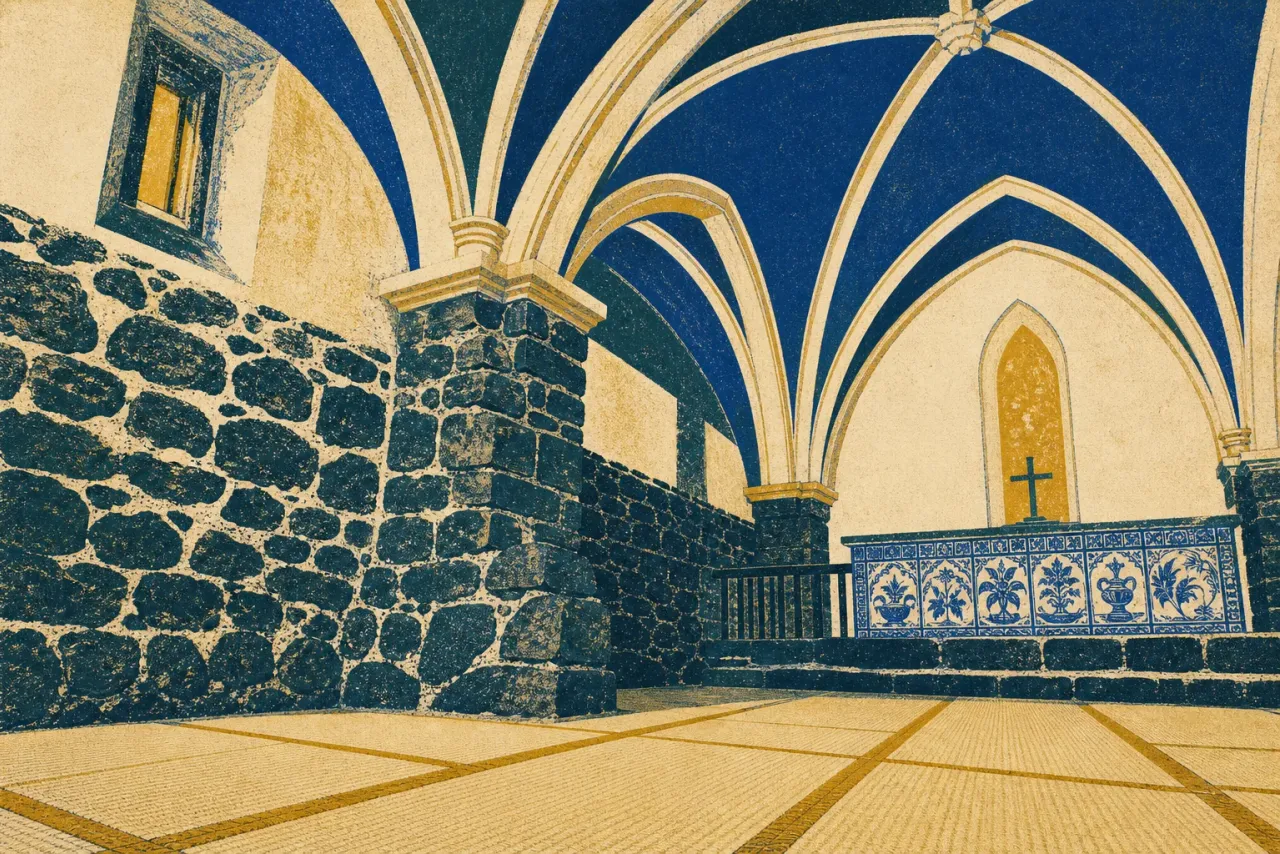
Basalt, Rib Vaults and Arita Tiles: How to Read a Nagasaki Church
The Hidden Christian Sites were inscribed for a faith that built nothing at all. Learning to read the churches that came afterward — basalt rubble, island sandstone, tatami under Gothic vaults — is how the story comes into focus.
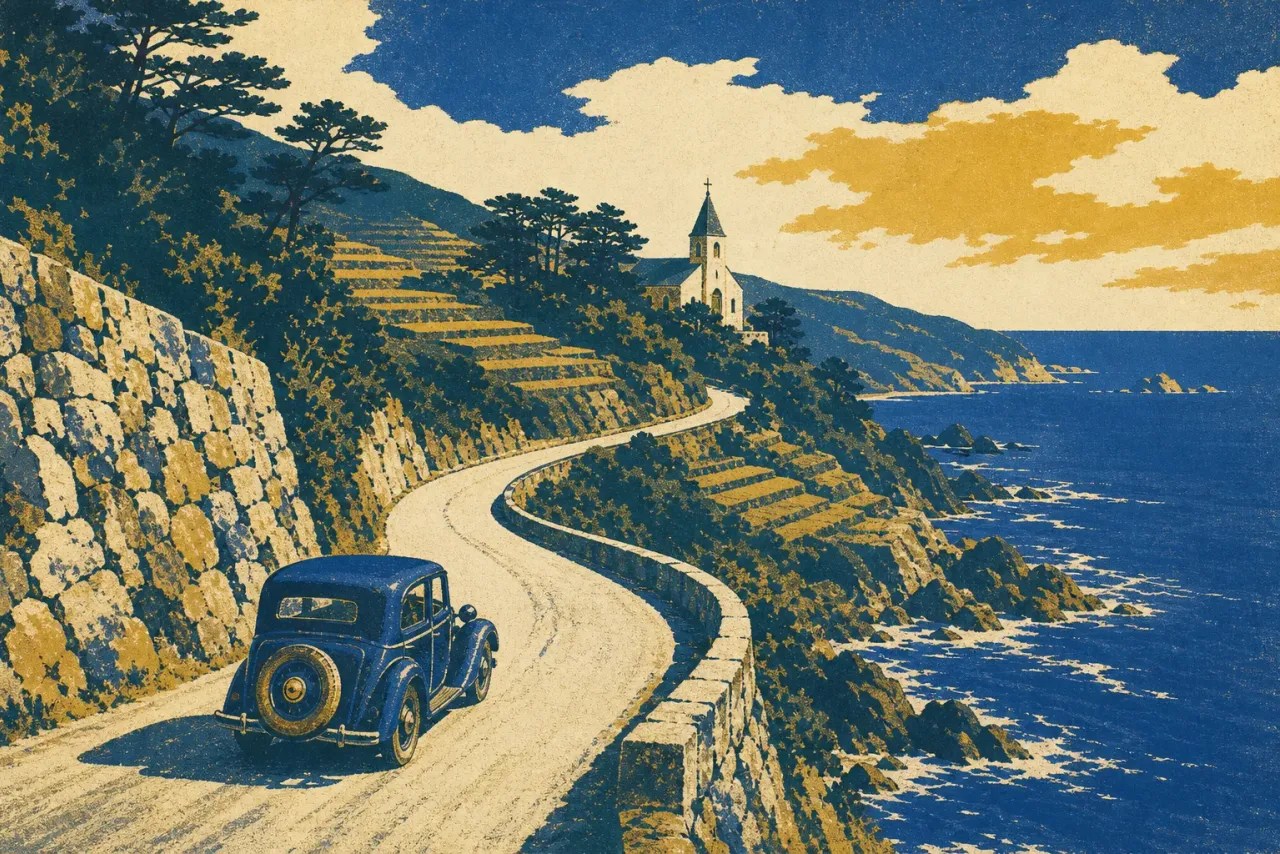
Half a Day, One Cathedral, One Coast Road: Nagasaki's Hidden Christian Sites for the Short-Stay Visitor
Only one of the twelve inscribed sites sits in Nagasaki city itself, and most of the rest require advance notice. Here is the one-day version that actually works: Ōura Cathedral in the morning, the Sotome coast in the afternoon, one web form filed two days out.