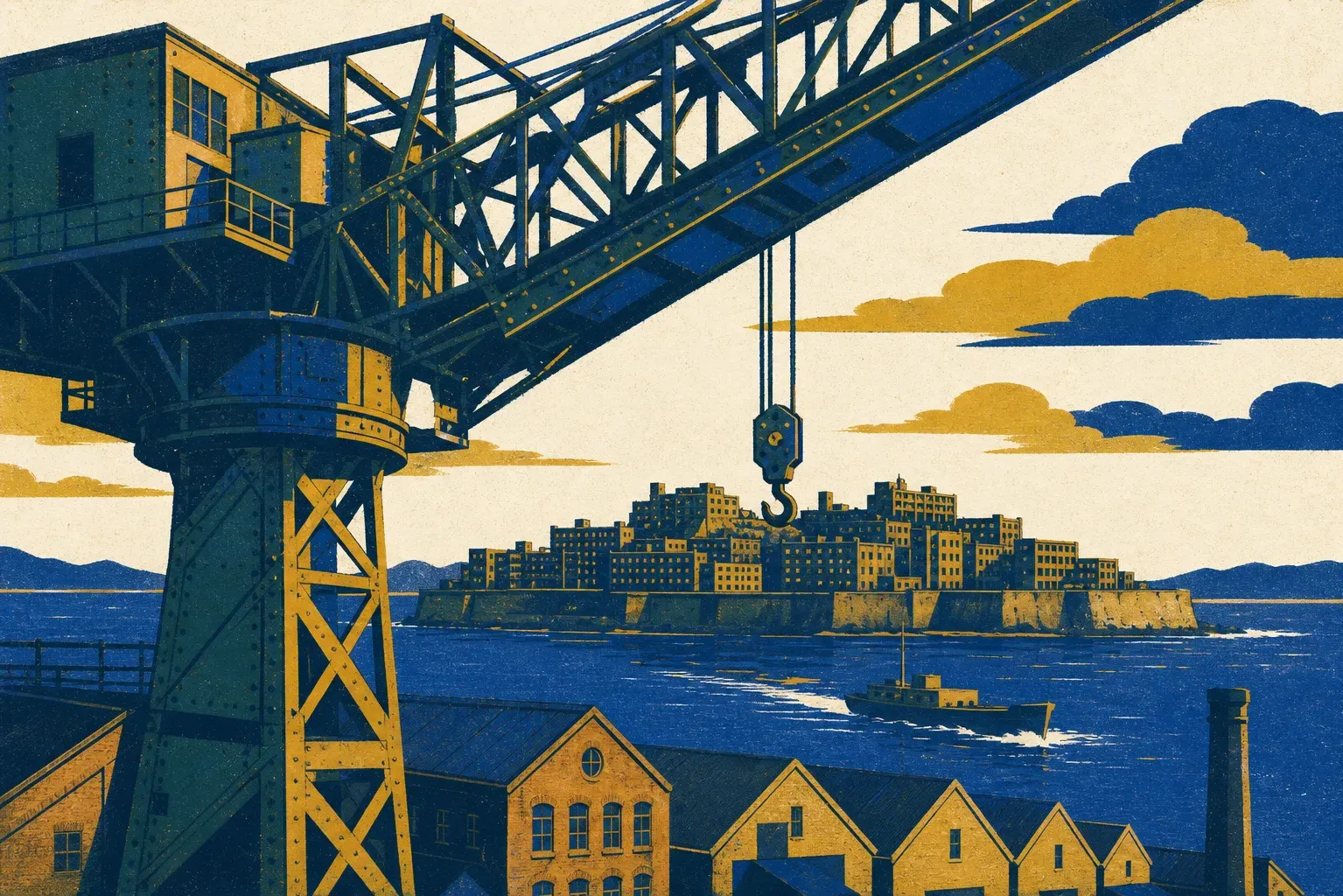
Meiji Industrial Revolution Sites (Gunkanjima & more)
明治日本の産業革命遺産 製鉄・製鋼、造船、石炭産業
- Nagasaki Station / Nagasaki Port (for the Nagasaki-area components)
- ≈3.5–4.5 h from Tokyo
- Depends on route — see Access
- spring
Quick facts
- ≈3.5–4.5 h from Tokyo
- flight roughly 15,000-30,000 yen one way; rail about 25,000 yen; Gunkanjima cruise about 4,000-5,000 yen extra
- Depends on route — see Access
- spring · autumn
- Nagasaki Station / Nagasaki Port (for the Nagasaki-area components)
- Gunkanjima landings succeed on fewer than 160 days a year and the go/no-go call comes only 30 minutes before departure, so book the cruise for your first morning in Nagasaki and hold a backup slot for day two.
- Check-in and boarding are separate addresses for two of the main Gunkanjima operators: Gunkanjima Concierge passengers report first to the Gunkanjima Digital Museum in Matsugae-chō (095-895-9300) and are then sent to Tokiwa Pier to board, and Gunkanjima Cruise checks passengers in at its office at 11-22 Motofunamachi, not at the pier. Only Yamasa Kaiun boards where it checks you in, at window 7 of the Nagasaki Port Ferry Terminal.
- Every Gunkanjima landing tour requires an advance reservation and a signed waiver, and the island facility fee (650 yen per adult, 320 yen for students and children as of 2026) is collected separately from the fare. Payment differs by operator: Gunkanjima Cruise takes cash only at boarding, while Yamasa Kaiun accepts VISA, Mastercard, American Express and JCB but only for settlement on the day.
- The Gunkanjima Digital Museum (1,800 yen as of 2026) is closed for maintenance September 2-4, 2026, and has irregular closing days year-round, so confirm before heading to Matsugae-chō.
Overview
Why it's inscribed
In 1853, Commodore Perry's ships forced open a country with no steam engines, no Western shipyards, and no blast furnaces. By 1910, Japan was building ocean-going ships and running Asia's first integrated steelworks. These 23 sites, spread across eight areas from Iwate down to Kagoshima, record that transformation, the fastest industrialization any nation has managed.
The story runs in three acts, and it helps to hold them in mind as you travel. First came trial and error: feudal domains in Hagi, Saga, and Kagoshima reverse-engineered Western furnaces and ships from Dutch textbooks, with no foreign engineers to correct them. Most of those experiments half-worked or failed outright, and the failures are part of what's inscribed. Then Japan bought the real thing, importing machinery and hiring foreign engineers, with merchants like Thomas Glover brokering in Nagasaki. Finally came industrialization at full scale, Japanese-run and Japanese-financed: Mitsubishi's Nagasaki shipyard and Mitsui's Miike coal complex, capped by the state-run Imperial Steel Works, which opened at Yawata in 1901.
What makes the listing unusual is that parts of it still earn a living. The Yawata Repair Shop of 1900 operates inside an active Nippon Steel plant; the 1909 cantilever crane in Nagasaki still lifts for Mitsubishi. That working status is exactly why several components can only be admired from across the water.
What you'll actually see
Glover House and Office
Thomas Glover supplied capital and connections for much of Nagasaki's early industry, and his 1863 house on the Minamiyamate hillside is the oldest surviving Western-style building in Japan. Japanese carpenter Koyama Hidenoshin built it Western on the outside and Japanese in its bones, and that mix is the whole inscription in miniature. The house anchors Glover Garden (1,300 yen as of 2026, open from 8:00 with late closings many evenings), whose terraces give the standard view over the Mitsubishi shipyard below.
Hashima (Gunkanjima) Coal Mine
Fifteen kilometers from central Nagasaki, a sea wall encloses a rock 480 meters long and 150 wide. Coal came up here from 1870, eventually from undersea seams, and by 1959 the island held 5,259 people, reportedly the highest population density ever recorded. Mitsubishi built Japan's first large reinforced-concrete building on it in 1916, the seven-story Block 30 apartment house, engineered against typhoons. The last residents left in April 1974. Visitors now walk a 220-meter boardwalk on the southern tip; over 95 percent of the island stays off-limits. One operator, Gunkanjima Cruise, also lands at Takashima Coal Mine en route, a second component in the same morning.
Mitsubishi Giant Cantilever Crane
The 1909 crane still swings loads at the working shipyard, alongside three other inscribed structures: the No. 3 Dry Dock (1905), the Former Pattern Shop (1898), and the Senshōkaku guest house (1904). None can be entered or approached. Watch them from Glover Garden's terraces or from Mt. Inasa, whose observation deck also serves the night panorama Nagasaki bills at ten million dollars; a harbor cruise gets you closest. A live shipyard holding four World Heritage structures is the point, not an inconvenience. This is heritage that never stopped.
Miike Coal Mine and Misumi West Port
West across Kyushu in Ōmuta, Miike shows what the third act looked like on land: the 1901 headframe at Miyanohara Pit, the extensive 1908 buildings at Manda Pit, plus the coal railway and port that moved the output. Mitsui worked Miike with convict labor until 1930, and 458 miners died in the 1963 coal-dust explosion, history worth carrying as you look up at the headframes. Farther south in Kumamoto, Misumi West Port survives exactly as Dutch engineer A. Rouwenhorst Mulder built it in the 1880s, a 756-meter stone quayside abandoned by 1903 and therefore never modernized.
Former Shūseikan
In Kagoshima, the Shimazu lords ran their industrial experiments inside Sengan-en, a garden the family laid out in 1658. The 1865 Machine Factory, now home to the Shōko Shūseikan museum, is the survivor to see, together with the Spinning Engineers' Residence of 1867 and the remains of the clan's reverberatory furnace. The juxtaposition is the draw here: foundry ruins a short stroll from a 17th-century lord's garden. Verify current hours and 2026 ticket prices on the Sengan-en site before traveling; they could not be confirmed at research time.
Hagi Castle Town and Shōkasonjuku Academy
Hagi holds five components, and they read as the prologue: the reverberatory furnace, the Ebisugahana shipyard, and the Ōhitayama tatara ironworks are what a feudal domain could manage from Dutch books alone. The castle town around them escaped later industrialization, which makes Hagi the one area where the 1850s streetscape is still legible. Don't skip Shōkasonjuku Academy, the tiny private school where Yoshida Shōin taught young men who went on to run the Meiji government. It is a modest wooden building, and the modesty is the point.
Worth knowing
Book the landing cruise for your first morning in Nagasaki, never your last, and see the Gunkanjima Digital Museum before you sail: the boardwalk shows you sealed apartment blocks at a distance, while the museum covers the 95 percent you cannot enter. Spring and autumn give the best landing odds; June and July rain, late-summer typhoons, and winter's north winds all breach the operators' wind-and-wave limits regularly. Wear flat shoes with grip, because you step from a moving boat onto an exposed pier, and expect to sign a waiver in Japanese.
One more thing, and it matters. Korean and Chinese laborers were forced to work at several of these sites during the war years, a fact UNESCO required Japan to present and which a 2021 committee report found still inadequately told. Guides' framing can be partial, so read independently before you go. Treat Hashima as a place where people lived hard lives, some against their will, rather than a backdrop for ruin photography.
Highlights
Hashima Island (Gunkanjima) coal mine ruins, reached by boat tour from Nagasaki Port
Glover House and the Mitsubishi Nagasaki Shipyard sites (Kosuge Slip Dock, Giant Cantilever Crane)
Hagi area: Shokasonjuku Academy, Hagi Reverberatory Furnace and Ebisugahana Shipyard (Yamaguchi)
Shuseikan industrial complex in Kagoshima
Nirayama Reverberatory Furnaces (Shizuoka) and Hashino Iron Mining Site (Iwate)
Miike Coal Mine (Omuta/Arao) and the Imperial Steel Works at Yawata (Kitakyushu)
Getting there from Tokyo
For the flagship Nagasaki components: fly Haneda to Nagasaki Airport (about 2h) then limousine bus to Nagasaki Station (about 45 min); or Tokaido/Sanyo Shinkansen Nozomi to Hakata (about 5h), Relay Kamome limited express to Takeo-Onsen, cross-platform transfer to the Nishi-Kyushu Shinkansen Kamome to Nagasaki (about 1.5h total from Hakata). Gunkanjima is visited on a licensed cruise from Nagasaki Port (landing is weather-dependent). Other areas (Hagi, Kagoshima, Yawata, Nirayama) require separate trips.
Where to base & what to eat
Where to base
Nagasaki Station / Ōhato waterfront
Three minutes by tram from the ferry terminal, which matters for a 09:00 cruise check-in, though the hotels are functional business chains rather than anywhere with character.
Minamiyamate / Ōura (Glover Garden hillside)
Small hotels and guesthouses among the old Western residences, with harbor views and Glover Garden on foot; the trade-off is steep stepped streets with luggage and a tram ride down to the piers each morning.
Hagi, Yamaguchi
The most atmospheric overnight in the whole property, with ryokan inside a castle town that escaped later industrialization; the trade-off is that Hagi sits far from the Kyushu sites and needs its own dedicated trip.
What to eat
Champon
Nagasaki's defining noodle dish, first served in the late 19th century at Shikairō, founded 1899 and still trading in Matsugae-chō near Glover Garden; the noodles boil directly in the pork-and-chicken-bone soup, which is what separates it from everything else in Japan.
Sara udon
Champon's sibling, the same pork-and-seafood topping poured over crisp fried noodles; the lighter order on a humid afternoon, and on nearly every menu in Shinchi Chinatown.
Castella
Portuguese sponge cake Japanized with mizuame syrup and coarse sugar crystals at the base; the three historic makers, Fukusaya (founded 1624), Shōōken (1681), and Bunmeidō (1900), all still bake in the city center, and a box is the definitive souvenir.
Shippoku ryōri
Nagasaki's banquet cuisine of Japanese, Chinese, and Portuguese courses shared from a round red-lacquer table; a reservation-and-dinner affair in the Shianbashi quarter, not a walk-in lunch.
Official links
Fares, hours and closures change with little notice. These are the operators' and authorities' own pages — worth a look close to your travel dates.
Related stories
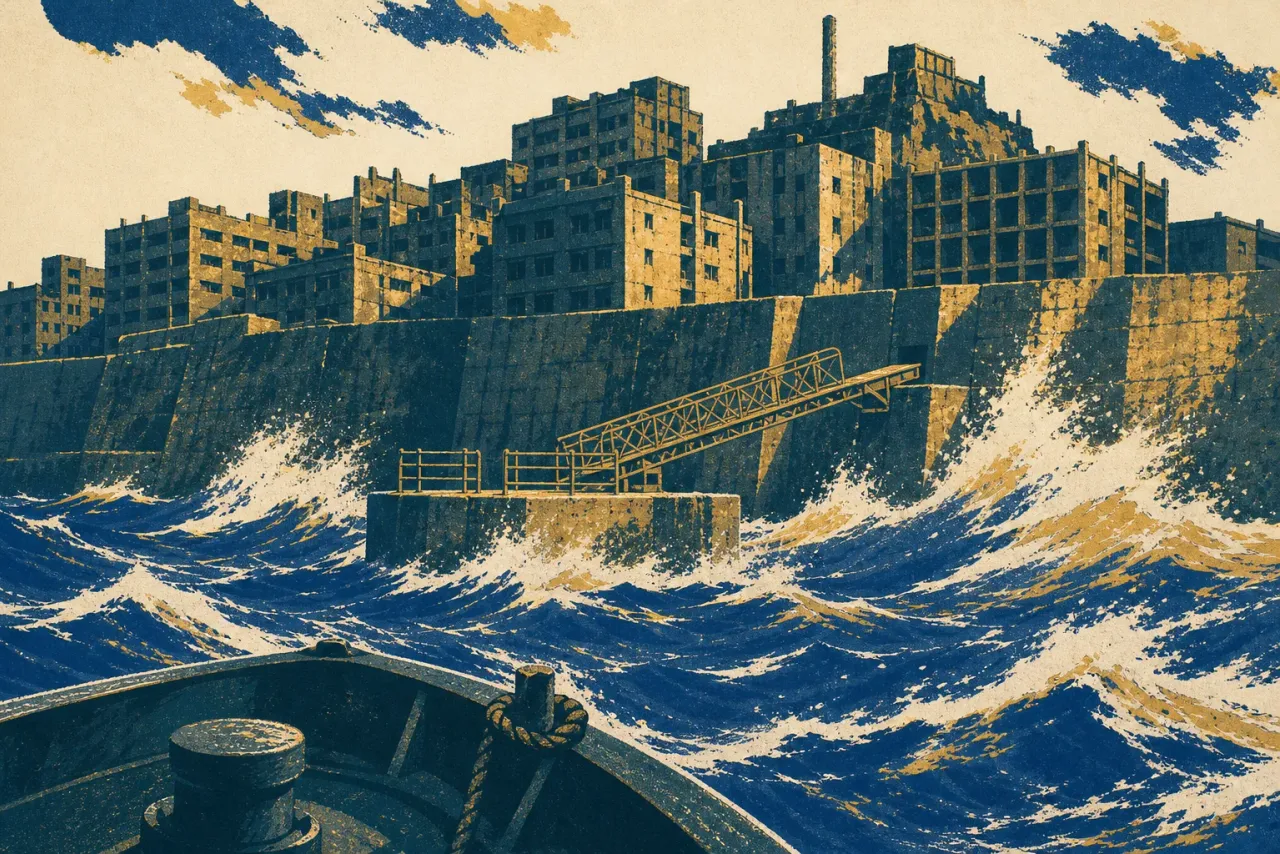
Fewer than 160 days a year: how to actually land on Gunkanjima
Sea conditions veto Gunkanjima landings more often than they allow them. Here is how to book the right operator, the right pier, and the right day so the odds work in your favor.
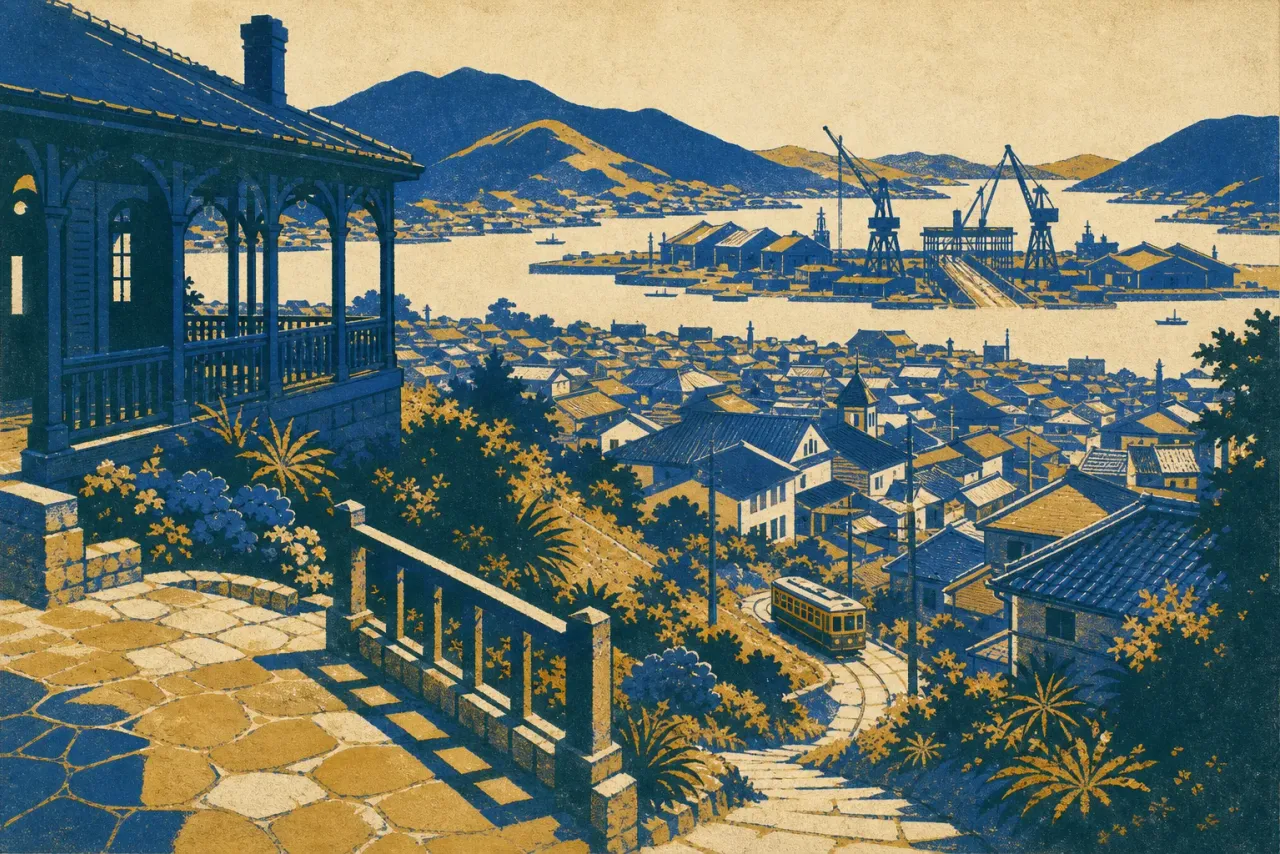
The ruin you can't enter, the city you can: reading Meiji Nagasaki from the hillside
Gunkanjima is one component of twenty-three. A day on foot and by tram through Glover Garden, Chinatown, and Mt. Inasa explains the inscription better than the famous ruin does.
Sources
- https://whc.unesco.org/en/list/1484/
- https://www.japan.travel/en/world-heritage/sites-of-japans-meiji-industrial-revolution-iron-and-steel-shipbuilding-and/
- https://www.japansmeijiindustrialrevolution.com/en/
- https://en.wikipedia.org/wiki/Hashima_Island
- https://www.japan-guide.com/e/e2018_nishikyushu.html