Eighty thousand offerings and an island no one may describe
The most widely traveled object in Fukuoka Prefecture is a fragment of cut glass. It was made in Sassanian Persia, carried across the entire breadth of Asia by land and sea, and then, at the end of that journey, taken 60 kilometers out into the Genkai Sea and set down on an island called Okinoshima as a gift to a goddess. It stayed there for well over a thousand years. Nobody took it. Almost nobody even saw it.
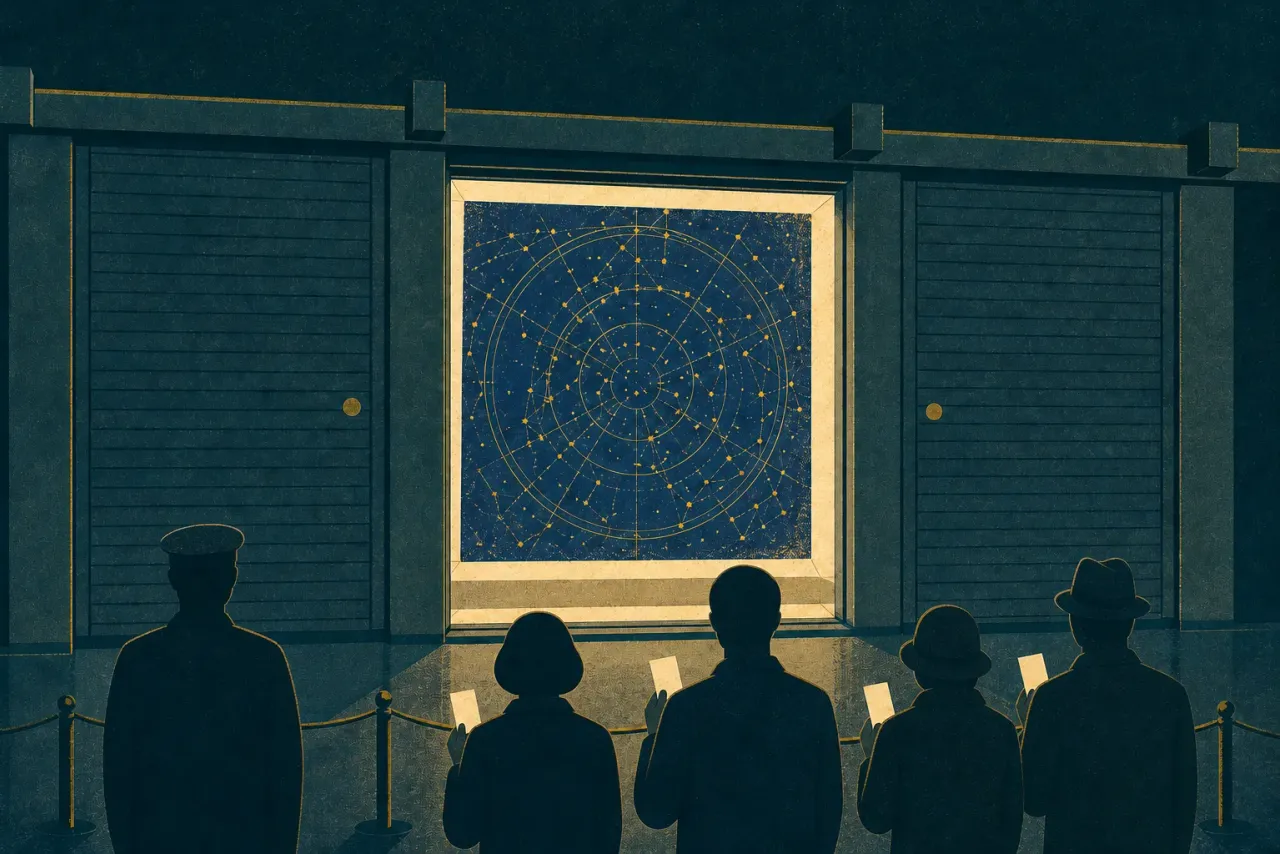
Today that glass appears, some seasons, in a case at the Shimpokan, the treasure hall inside Munakata Taisha's mainland shrine, where 800 yen (as of 2026) buys the closest look at Okinoshima that anyone without a priest's robes will ever get. The island itself, inscribed on the World Heritage list in July 2017, is closed. Not closed to tour groups, or closed except by appointment. Closed. Landing without the shrine's permission is a criminal offense, and Munakata Taisha has said plainly that it will not open the island to tourism. Which raises a fair question: what exactly did UNESCO protect, and what is there for the rest of us to see?
The property is mostly water
Start with a number buried in the nomination file. The inscribed property covers 98.93 hectares across eight components, but the buffer zone runs to 79,363 hectares, and nearly all of it is open sea. That ratio is the whole thesis. The protected thing is not really an island; it is a route. From the fourth century onward, ships crossing between the Japanese archipelago, the Korean Peninsula, and the Asian continent passed through the strait where Okinoshima rises from the water, wrapped in primeval forest, 60 kilometers from the Kyushu coast. Crossings were dangerous. People prayed. For five centuries, from the latter half of the fourth century until the end of the ninth, envoys and mariners left offerings on the island's rocks to secure safe passage.
UNESCO inscribed the site under criteria (ii) and (iii): the offerings document an age of intense East Asian exchange, and the island preserves a living tradition of worshipping a sacred island. What makes archaeologists lose their composure is that the ritual sites survived virtually intact. Because nobody looted them, the offerings lay where they were placed, in datable sequence, ritual by ritual. Where on the island the ceremonies were held changed over those five hundred years, and so did what counted as a fitting gift; the deposits record every shift. You are looking at a continuous archive of how worship itself evolved. Almost nowhere else on earth does that exist.
Eighty thousand objects, two rotations a year
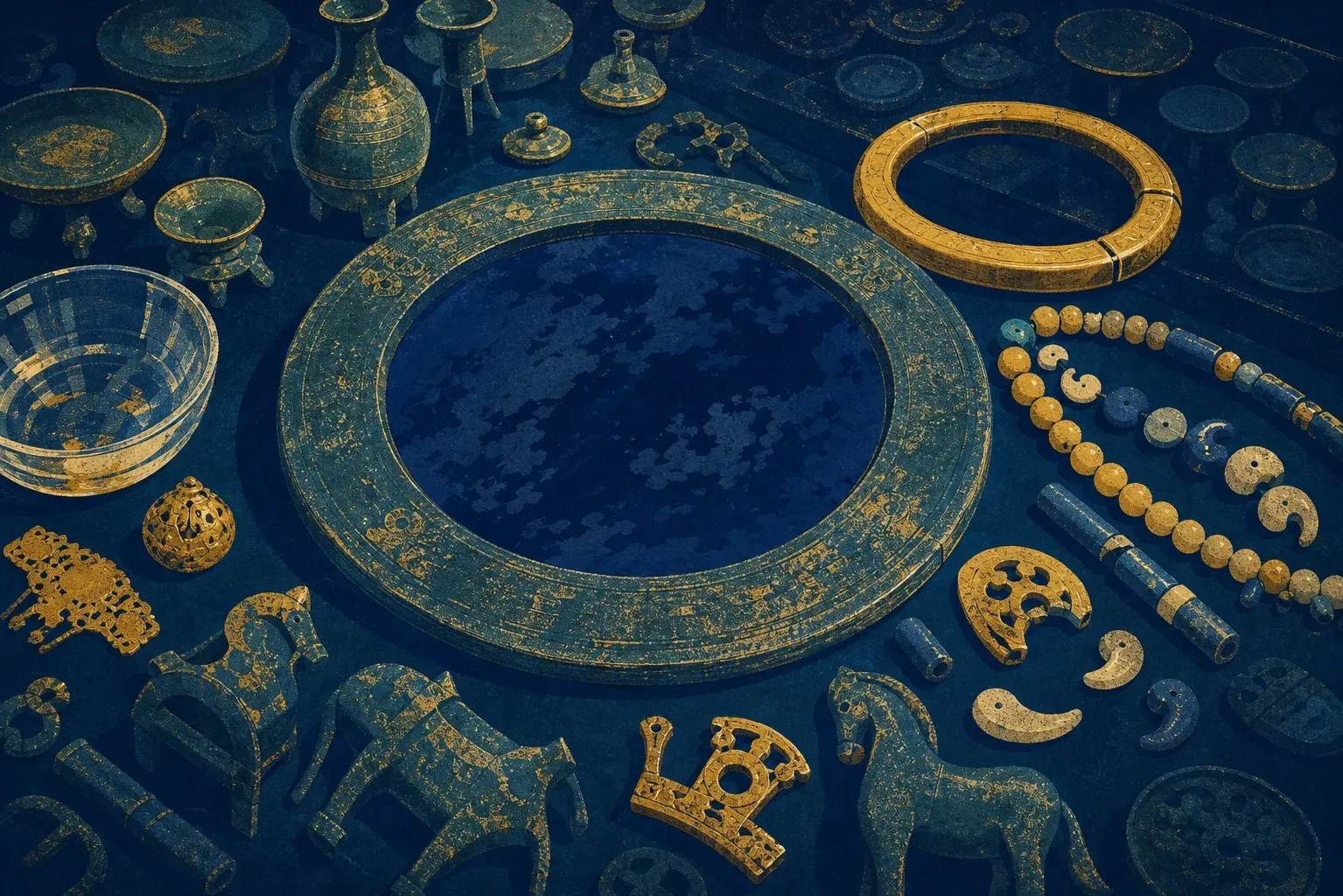
Excavations recovered roughly 80,000 objects, and the entire lot is designated a single National Treasure; small wonder the site's nickname is the Shosoin of the sea. The inventory reads like a customs ledger for early East Asia. Bronze mirrors and gilt-bronze dragon-head finials from China. Gold rings and horse trappings with close parallels in Silla tombs in Korea. That Persian glass. Miniature votive objects made for no human use at all.
The Shimpokan displays these in rotation, with exhibits changing about twice a year, from 09:00 to 16:30, last entry 16:00, inside the grounds of Hetsu-miya in Munakata City. My advice runs against the usual pacing of a shrine visit: give the museum more time than the sanctuary. The buildings can be admired in twenty minutes. The cases are where the World Heritage story actually lives, and on a quiet weekday you may have a gold ring with cousins in the tombs of Silla nearly to yourself.
The rules are the monument
Here is the part that puzzles first-time visitors: the restrictions are not an inconvenience bolted onto the site. They are, formally, part of it. The official statement of authenticity credits the taboos with maintaining the island's aura as a sacred place. Consider what they involve. Anyone who lands must first strip and immerse himself in the sea, the serving priest included, every time. Nothing may be removed, not a pebble, not a fallen branch; Edo-period stories promise divine retribution for anyone who tries. No one may speak of what he has seen or heard there, and locals still call Okinoshima the island whose name cannot be spoken. Women may not land at all. One priest at a time keeps the daily rites going, rotating off the island roughly every ten days and living there alone in between, and security cameras now back up prohibitions that ran on faith alone for fifteen centuries.
For a long time there was one narrow exception. Every May 27, around 200 men chosen by lottery could land for a festival. Munakata Taisha discontinued it in 2018, one year after inscription. The listing that might have cracked the island open sealed it instead, and the shrine appears entirely at peace with that.
A building whose whole purpose is a sightline
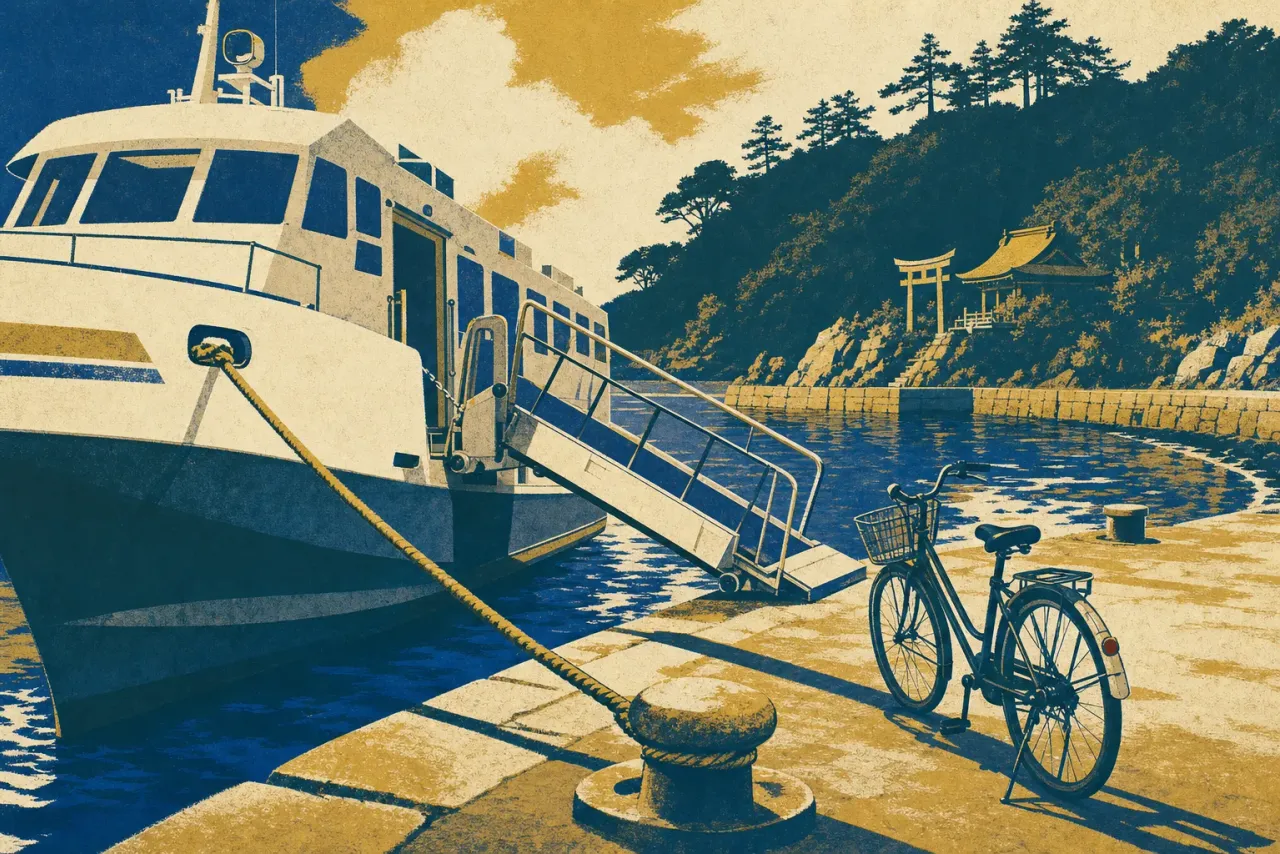
What exists in place of access is worth traveling for on its own terms. On the north shore of Oshima, an inhabited island 25 minutes by ferry from Konominato port, stands Okitsu-miya Yohaisho: a modest hall on a coastal terrace whose entire architectural function is to face Okinoshima, far out across open water. A stone monument on the steps is dated 1749, which puts worship on this spot by at least the middle of the 18th century; the hall standing there now was rebuilt in 1933. On a clear day the forbidden island sits right on the horizon, a faint blue silhouette, and you grasp at a glance what "distant worship" means. On a hazy day you see gray water, and the hall keeps facing it anyway, which is rather the point.
Back on the mainland, Hetsu-miya carries the continuity in timber. Its Main Hall was rebuilt in 1578 by the chief priest Munakata Ujisada after a fire; the Worship Hall in front of it went up in 1590, built by the warlord Kobayakawa Takakage. Both are Important Cultural Properties, and both exist because powerful people in the 16th century still thought a sea cult already more than a thousand years old worth their money. Behind them, a short climb leads to Takamiya Saijo, an open ritual ground with no building whatsoever, where rites descended from the Okinoshima ceremonies are still performed under the sky.
The people who ran this cult left their own monument too. At Shimbaru-Nuyama in neighboring Fukutsu City, the burial mounds of the Munakata clan stand on a plateau that once overlooked a lagoon. An iron adze excavated from Tomb 7 matches finds from Okinoshima, a physical thread tying the chiefs in these graves to the offerings out at sea. You can walk freely among the mounds, which, after all the prohibitions, feels almost startling.
Plan the Oshima leg around the weather, not the calendar. The whole reward of the Yohaisho is a sightline, and from November through March the Genkai Sea cancels crossings on short notice, so spend your clearest day on the island and save the gray one for the glass cases. Oshima's fishermen, whom the heritage council calls Okinoshima's true guardians, still offer the largest fish of every catch to the goddess and will not take so much as a drifting pine branch from her water. The rest of us get the museum and the horizon, and on the right day, that is enough.
Sources
- https://whc.unesco.org/en/list/1535/
- https://www.okinoshima-heritage.jp/en/
- https://www.japan.travel/en/world-heritage/sacred-island-of-okinoshima-and-associated-sites-in-the-munakata-region/
- https://en.wikipedia.org/wiki/Okinoshima_(Fukuoka)
- https://www.japan-guide.com/e/e4840.html
- https://www.okinoshima-heritage.jp/en/know/hetsumiya.html