Basalt, Rib Vaults and Arita Tiles: How to Read a Nagasaki Church
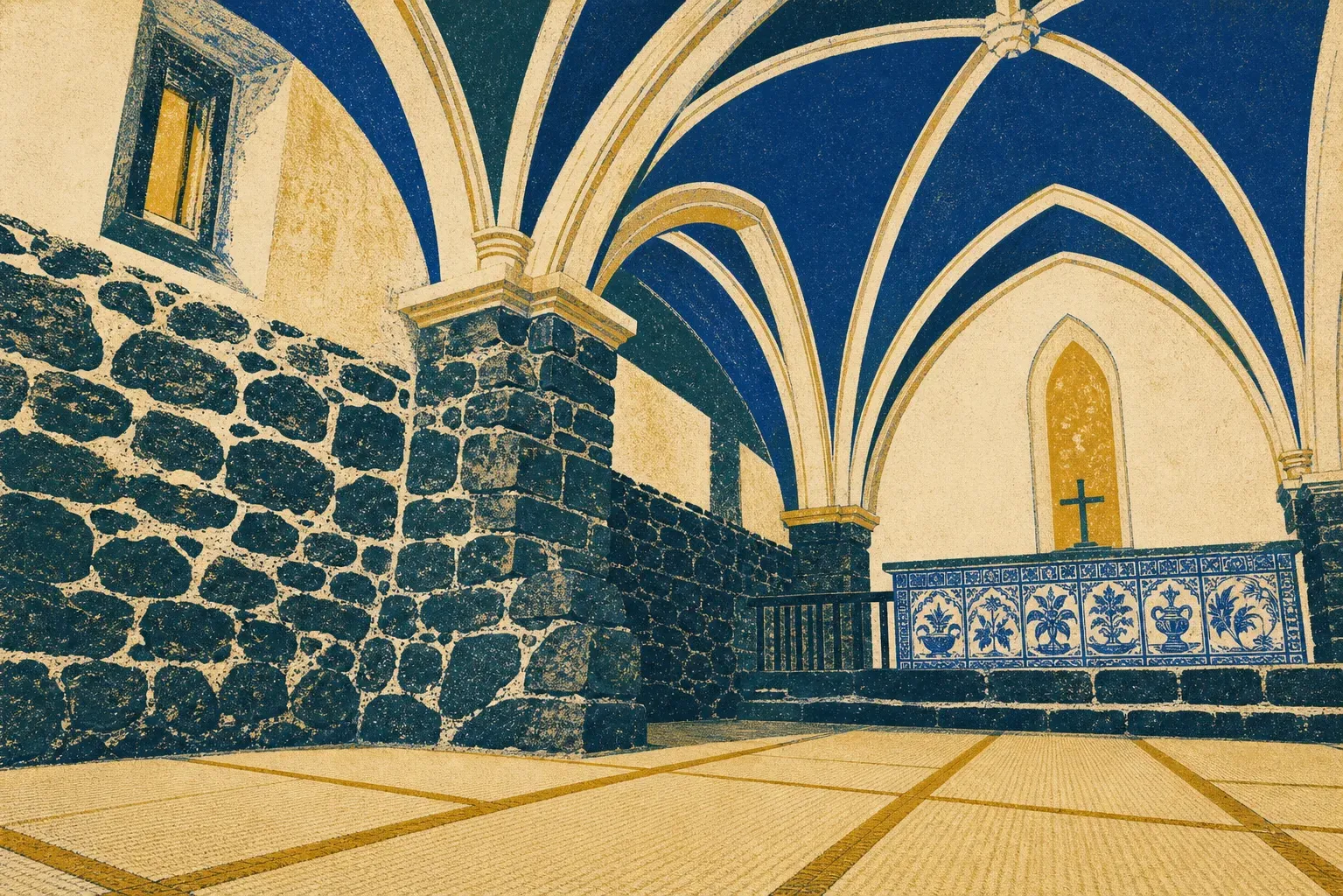
Ono Church will not let you in. The building, finished in 1893, is judged too fragile for visitors to walk through, so an attendant opens the windows and you lean in from outside. In rain or rough weather, even that may not happen. Mass is said here once a year. The whole stop might take twenty minutes, and you should spend most of it looking at the wall: rough lumps of basalt set in mortar, a construction used in no other church in Japan. Visitors arrive at the Hidden Christian Sites of the Nagasaki Region expecting World Heritage grandeur and find this instead, a scatter of small rural chapels and a grassed-over castle field. One component is an island nobody is permitted to land on at all. The confusion is reasonable. It is also the key to the entire inscription.
UNESCO listed these twelve places in 2018 under criterion (iii) alone: exceptional testimony to a cultural tradition. Not architectural achievement. The tradition in question produced no architecture whatsoever. After the shogunate banned Christianity in 1614, communities along this coast kept a version of Catholicism alive for roughly 250 years with no priests, no sacraments and no church buildings, folding the faith invisibly into Buddhist temple registration and Shinto village life. Everything on the list is either evidence of that concealment or evidence of its ending. The churches, every one built after the ban fell, are the epilogue. Read them that way and the small buildings get very large.
The emptiest sites carry the most weight
Hara Castle, on the Shimabara Peninsula, is stone foundations, grass and wind. In the winter of 1637–38, more than 30,000 rebels, mostly Christian peasants taxed past endurance, made their last stand inside its walls and were annihilated. The victors razed the castle and buried the dead within the grounds so the site could never be reused. That mass grave under the turf explains everything else here: after Shimabara, the crackdown became total, and the hiding began in earnest.
Kasuga Village, on the northwest coast of Hirado Island, is the other place where there is officially nothing to see. Francis Xavier reached Hirado in 1550; once the missionaries were gone, the faith slowly merged with the island's older mountain worship, centered on 536-meter Mt. Yasumandake, the highest peak in the Hirado district, addressed as Oyama-sama. Offshore sits Nakaenoshima, an uninhabited islet where believers were martyred and from which, through the hidden centuries, communities drew their baptismal water. Landing is prohibited. You stand on the shore and look, which turns out to be the correct posture for this entire World Heritage site.
Two hands built almost everything
Once the ban lifted in 1873, church-building fell largely to two men. Fr. Marc Marie de Rotz (1840–1914) of the Paris Foreign Missions Society raised Shitsu Church in the Sotome hills in 1881–82, and it remains an active parish today. Down the coast he built Ono in 1893, with that basalt-rubble wall now known simply as the de Rotz wall. He was as much engineer and social worker as priest: his 1883 aid center at Shitsu, where village women learned weaving, bread-making and literacy, survives as a small museum.
The other hands belonged to Tetsukawa Yosuke, a Japanese master carpenter. His brick Former Nokubi Church went up on Nozaki Island in 1908; his wooden Egami Church on Naru Island, completed in 1918 with a tiered tile roof and pale blue window frames, is widely considered the most beautiful of them all.
Materials are the tell everywhere. Kuroshima Church (1902, Fr. Joseph Marmand) rests on column bases of Kuroshima granite, and its sanctuary floor is laid with Arita porcelain tiles. Kashiragashima Church rose between 1910 and 1919 from sandstone cut on its own island, the only stone church in Nagasaki Prefecture. These were poor fishing settlements; what the ground offered is what the walls became.
Sakitsu Church, in the Amakusa fishing village of the same name, is the plainest lesson in reading these buildings. Built in 1934 to Fr. Augustin Halbout's design, it was planned as a reinforced-concrete Gothic church; the money ran out partway through, and the rear half was finished in wood. Inside, the floor is tatami, and you take your shoes off. The site matters more than the style. The church stands where the village headman's house once stood, the very spot where residents were made to perform e-fumi, treading on images of Christ and Mary to prove they were not what they were. Kashiragashima's church likewise occupies a former community leader's home. These congregations built their epilogues directly on top of the stages of their humiliation.
Some churches outlived their reasons. Former Gorin Church on Hisaka Island began life in 1881 as Hamawaki Church and was carried to its present cove in 1931. Locals saved it from demolition in 1985, and today its plain wooden shell hides a three-aisled chancel under a rib-vaulted ceiling, reached by a 500-meter walk on an unpaved road; no services are held, since the working parish is the modern church next door. Nozaki Island kept its brick church but lost its people. The last six families of Nokubi left in 1971, and the congregation now is wild deer.
Visiting without being turned away
Eight of the twelve components require advance notice, because these are functioning churches, not attractions (the web form at kyoukaigun.jp closes two days before your date), and two book through separate operators: Sakitsu via Kyushu Sanko Tourism, Nozaki Island via the Ojika Island Tourism Association. Ōura Cathedral, Hara Castle and the Kasuga sites need none.
Interior photography is banned everywhere, a blanket policy of the Catholic Archdiocese of Nagasaki, and the chancel is off limits; Kuroshima pauses visits for its Thursday church school, 15:30 to 16:30, and in any case admits visitors only 9:00 to 12:00 and 13:00 to 16:00, an hour earlier than the Sotome and Gotō churches.
Geography dictates the itinerary. Only Ōura Cathedral and the Sotome pair work as day trips from Nagasaki City; Hirado, Kuroshima via its Sasebo ferry, Amakusa and the Gotō Islands each demand their own overnight, and the four island churches realistically take three or four days. Outside the city, rent a car — the buses serve residents, not sights.
It was at Ōura, on March 17, 1865, that hidden Christians from Urakami approached Fr. Bernard Petitjean and revealed two and a half centuries of secret faith. On Kuroshima, every one of the island's hidden Christians returned to Catholicism in 1872, a year before the edict boards came down, and their descendants eventually laid those Arita tiles; about 80 percent of residents are Catholic today. Other communities never came back; the kakure kirishitan kept the hidden-era rites, priestless, and never rejoined. The churches mark where the hiding ended, not where it happened.
If that distinction interests you more than rib vaults do, give a morning to Kasuga. It needs no booking, charges nothing, and closes never. Walk up through the terraced fields early, while the light is still low, and look out at Nakaenoshima. The holiest water in this whole story came from an island you will spend your entire visit unable to touch.