Ogasawara Islands (Bonin Islands)
小笠原諸島
- Takeshiba Passenger Ship Terminal, Tokyo (JR Hamamatsucho Station)
- ≈24.5 h from Tokyo
- Depends on route — see Access
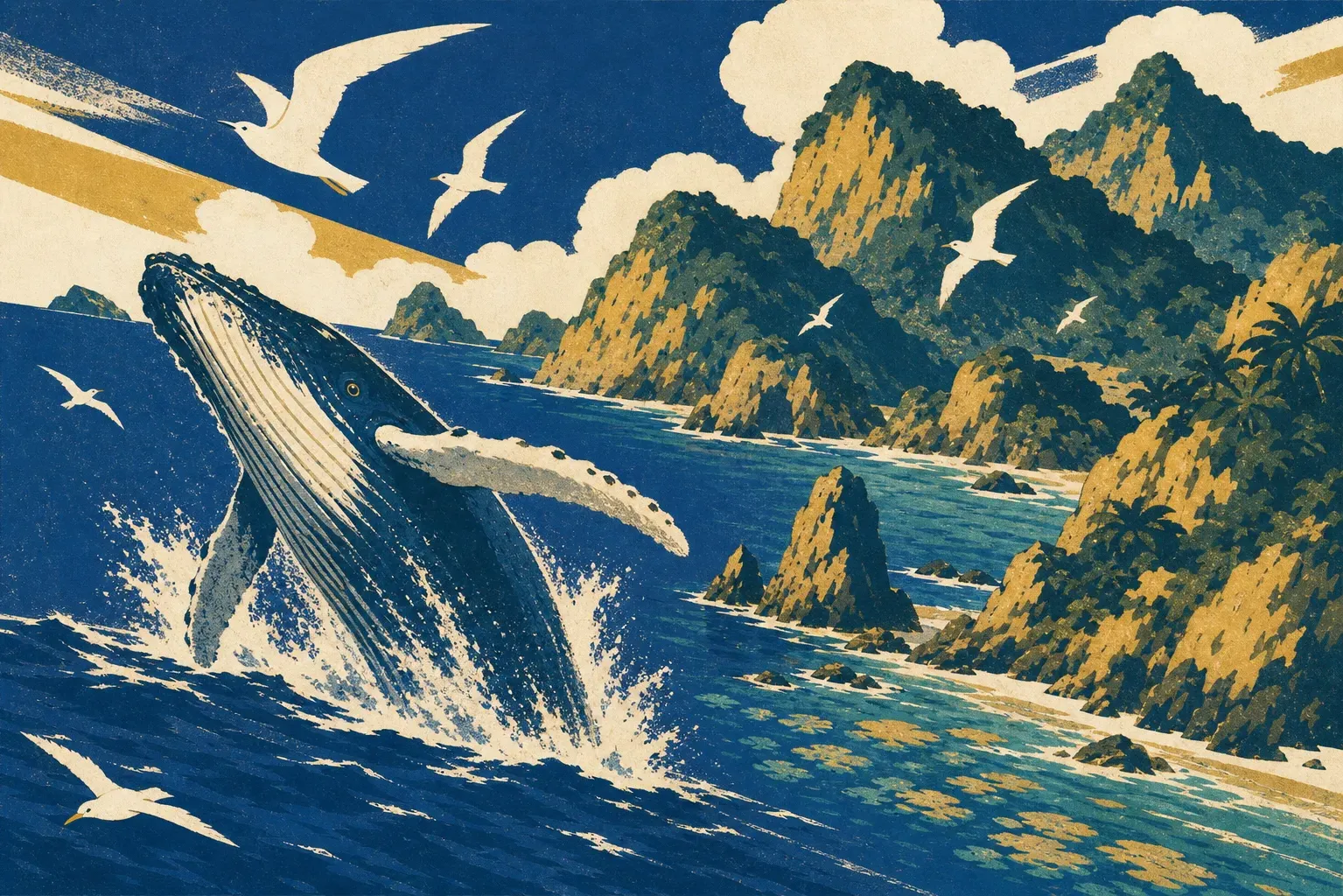
- Late December to May for humpback whales (peak February-April)
Quick facts
- ≈24.5 h from Tokyo
- Ferry fare varies by class and season; book via operator Ogasawara Kaiun (ogasawarakaiun.co.jp)
- Depends on route — see Access
- Late December to May for humpback whales (peak February-April) · July to September for sperm whales, sea turtles and diving · Year-round mild subtropical climate
- Takeshiba Passenger Ship Terminal, Tokyo (JR Hamamatsucho Station)
- Reserve your room before your ferry seat: the village's official order is accommodation first, then the Ogasawara-maru ticket (on sale two months before departure, with peak dates announced separately), then guides and rentals, because the ship leaves you ashore for three nights and there is no walk-up option.
- The Ogasawara Visitor Center and the Ogasawara World Heritage Centre open only on days the Ogasawara-maru is in port. On the standard three-night trip that covers your whole stay, but anyone staying through a sailing loses both, along with many Chichijima restaurants, which close while the ship is away. Check the tourism association's live restaurant-status spreadsheet the morning you land.
- Book Minamijima and Heart Rock tours before you sail. Landing on Minamijima is legal only in the company of a Tokyo Metropolitan certified nature guide wearing the official armband, with a maximum of 15 visitors per guide, booked through an operator displaying the Minamijima use-rule compliance sticker; the Heart Rock route needs a guide holding a forest-entry permit. The former daily visitor cap, per-group time limit and seasonal island closure were all removed in June 2023, but peak-season tours still fill early.
Overview
Why it's inscribed
Ogasawara went onto the World Heritage list in June 2011 as a natural site, and the argument made for it was about process, not scenery. These are true oceanic islands, roughly 1,000 km south of Tokyo, never once connected to a continent. Everything alive here arrived by accident, carried in by a bird or blown in on the wind or rafted across on driftwood. Then it adapted, and it is still adapting. That ongoing change is the inscribed value.
Land snails carry the case. About 100 species live in the archipelago, roughly 94% of them found nowhere else, and biologists are still describing new ones. Mandarina snails are the textbook example: populations that took to the trees and populations that stayed on the ground evolved measurably different shell shapes. The dry sclerophyll forest on Anijima was named specifically in the heritage documentation.
The property is a serial one, taking in the Mukojima, Chichijima and Hahajima island groups plus part of the Volcano Islands, marine zones included. UNESCO's List entry puts the inscribed area at 7,939 hectares; Japanese tourism material rounds that to some 30 islands and about 8,000 hectares.
What you'll actually see
Omura, Chichijima
The ferry ties up at Futami Port and Omura is right there, home to most of the island's 2,043 residents, on a landmass of 23.45 km² that tops out at 326 m. Almost everything a visitor needs is within a ten-minute walk: the tour-boat piers, the shops, the post office ATM. Two exhibition halls are worth an afternoon. The Ogasawara Visitor Center (free, 08:30 to 17:00) covers natural and settlement history; the Ogasawara World Heritage Centre in Nishimachi, open since May 2017, handles the snails and the endemic plants, 09:00 to 17:00. Both admit visitors only while the ship is in port, which on the standard cycle covers a full three-night stay. Stay longer than one cycle and they shut behind you.
Minamijima
Twenty minutes by boat from Chichijima, uninhabited, and the strangest ground in the archipelago: submerged karst, drowned limestone where you walk between dolines and across lapies sharp enough to shred a sandal. Seabirds nest here. Sea turtles leave tracks up the beach in nesting season. Behind the sand lie semi-fossil Hirobeso shells, from a snail that died out 1,000 to 2,000 years ago; they are designated natural monuments, so photograph them and leave them exactly where they are. You may only land alongside a Tokyo Metropolitan certified nature guide wearing the official armband, and one guide can take no more than 15 people ashore.
Anijima, seen from Miyanohama
Miyanohama Beach on Chichijima's north shore has the easiest good coral snorkeling on the island, and when you lift your head you are looking straight across the channel at Anijima. That slope of low hard-leaved trees is one of the specific reasons the islands were inscribed, a forest type with no real parallel. There is no landing and no tour; the view is the whole of it. Go early, before the day boats stir up the shallows.
Mt. Chuo and Mt. Mikazuki
Two lookouts doing different jobs. Mt. Chuo, 319 m and about ten minutes' walk, gives the full 360-degree read of Chichijima, which is the fastest way to grasp how small and how steep this island is. The Mt. Mikazuki lookout by the weather station, around 200 m up, is the sunset spot, and from February to April it doubles as a whale platform: humpbacks pass close enough to watch from land, no boat and no seasickness involved. Asahidaira, further out, is for stars.
Sennin-iwa (Heart Rock)
The cliff called Sennin-iwa, known in English as Heart Rock, looks out over Ennen Bay. Getting there means crossing a Forest Ecosystem Protection Area, so a guide holding a forest-entry permit is a legal requirement rather than a suggestion, and you cannot walk it independently. It is a long, exposed day on steep ground. Buy your lunch in Omura before you set off, because nothing is sold anywhere along the route.
Hahajima
Two hours south on the Hahajima-maru, 397 residents, and a noticeably different trip. Mt. Chibusa's forest trails can be walked without a guide, which after several days of permits feels like a release; the Hahajima meguro, a white-eye found essentially nowhere but this island, works the canopy along the way. Kofuji is Japan's southernmost "Mt. Fuji," small enough to climb before breakfast and the local spot for the New Year sunrise. Three anti-aircraft guns from the war still sit in the jungle where they were left.
Worth knowing
Chichijima runs on the ship's timetable rather than the calendar. Restaurant hours are written in relation to it: one place closes the day before the ship arrives, another the day after it sails, several shut entirely while it is away. The tourism association publishes a live spreadsheet of who is open, so check it the morning you land and then reserve dinner, because kitchens here seat roughly 15 to 50 people. Outside Omura there is no restaurant at all, which makes buying a bento the first act of every tour day.
Cash matters more than you expect. Lodgings and guides often don't take cards, and the post office ATM is the backstop.
Before you board in Tokyo, check your shoe soles and your bag for seeds and insects. That is a stated rule under the Ogasawara Country Code, and it works only if you actually do it. Take nothing living or geological home and keep to marked trails. Camping is banned across the islands.
The Chichijima clinic (04998-2-3800) opens 09:00 to 11:00 Monday to Friday, plus Wednesday afternoons from 13:30 to 15:30. Hahajima has its own clinic (04998-3-2115); check its hours once you are on the island. Either way, bring the medication you need.
Highlights
Humpback whale watching (winter-spring) and sperm whales in summer
Swimming with wild dolphins from Chichijima (Futami Port area)
Endemic wildlife: Bonin flying fox and unique island flora on guided eco-tours
Diving and snorkeling in crystal-clear subtropical water
Hahajima's Mt. Chibusa forest hikes among endemic species
Exceptional stargazing with almost no light pollution
Getting there from Tokyo
Ogasawara-maru ferry from Takeshiba Passenger Ship Terminal (7-min walk from JR Hamamatsucho Station) to Futami Port, Chichijima — 24 hours at sea, sailing roughly once a week. No airport exists; a visit realistically requires about 6 days round trip. Hahajima is a further ~2-hour ferry (Hahajima-maru) from Chichijima.
Where to base & what to eat
Where to base
Omura, Chichijima
The right base for a first visit, since the restaurants, shops, ATM, both exhibition halls and the tour-boat piers are all within a walk, though it is also the busiest corner of the island and the small minshuku fill first.
Miyanohama / Kiyose / Okumura, Chichijima
North-side B&Bs a short bike or bus ride from Omura, close to Miyanohama's coral and the view over to Anijima, but you will be commuting for dinner on a bus that runs only about hourly.
Sakaiura / Ougiura / Komagari / Kominato, Chichijima
The quiet southern and eastern coves near Kopepe and Kominato beaches, genuinely secluded by island standards, so book a place that serves meals because nowhere outside Omura sells food.
Hahajima
A nature-first second base with 397 residents, the unguided Mt. Chibusa trail and the endemic Hahajima meguro, reached only by the weather-dependent two-hour Hahajima-maru on same-day tickets, so any night here has to be slotted between the 07:30 morning sailing and the early-afternoon one.
What to eat
Shima-zushi (island sushi)
The islands' signature dish, and the obvious place to eat it is 島寿司 Shima Sushi in Omura, 10:00 to 14:00 with 16 seats and bento to go, closed while the Ogasawara-maru is away from port.
Sea-turtle stew (kame-nikomi)
A settler-era island tradition, legally managed and listed among Chichijima's specialty ingredients alongside island tomato and island lemon. It turns up at the local-cuisine places in Omura rather than on every menu, so ask when you reserve. Worth understanding as food culture rather than novelty, and easy to skip if it isn't for you.
A tour-day bento
The most important meal you will buy, because no restaurant exists outside Omura; アイランド・デリ Island Deli opens at 8:00 for takeout, お弁当トキちゃん Toki-chan from 11:00 (closed weekends), and Bonina, Komo and Auberge Sato pack boxed lunches for tour and ship-departure days.
Ogasawara rum and passion-fruit liqueur
Sugarcane rum at 40% ABV, a trade traced back to the Western and Pacific Islander settlers of 1830, from about ¥1,800 for 720 ml as of 2026; the 12% passion-fruit liqueur blends the same rum with local juice, from about ¥2,000 for 720 ml as of 2026. Both are made on Hahajima.
Island lemon, passion fruit and island tomato
The subtropical produce behind most of what you will taste and carry home, from juice and sweets to the liqueur, sold in the Omura shops alongside Ogasawara coffee and local sea salt; buy on a ship day, when the shops are reliably open.
Official links
Fares, hours and closures change with little notice. These are the operators' and authorities' own pages — worth a look close to your travel dates.
Related stories
Six Days, One Ship: How to Actually Plan a Trip to the Ogasawara Islands
One ferry, once every six days, a 24-hour crossing. The rotation is fixed, which means the itinerary mostly writes itself once you know the timetable, the booking order and the bento rule.
An evolutionary laboratory you can snorkel: what the Ogasawara Islands are actually protecting
No temple, no castle, no single framed view. Ogasawara was inscribed for a process still running: land snails at 94 percent endemism, forests with no continental equivalent, and rules that make sense the moment you understand why.