An evolutionary laboratory you can snorkel: what the Ogasawara Islands are actually protecting
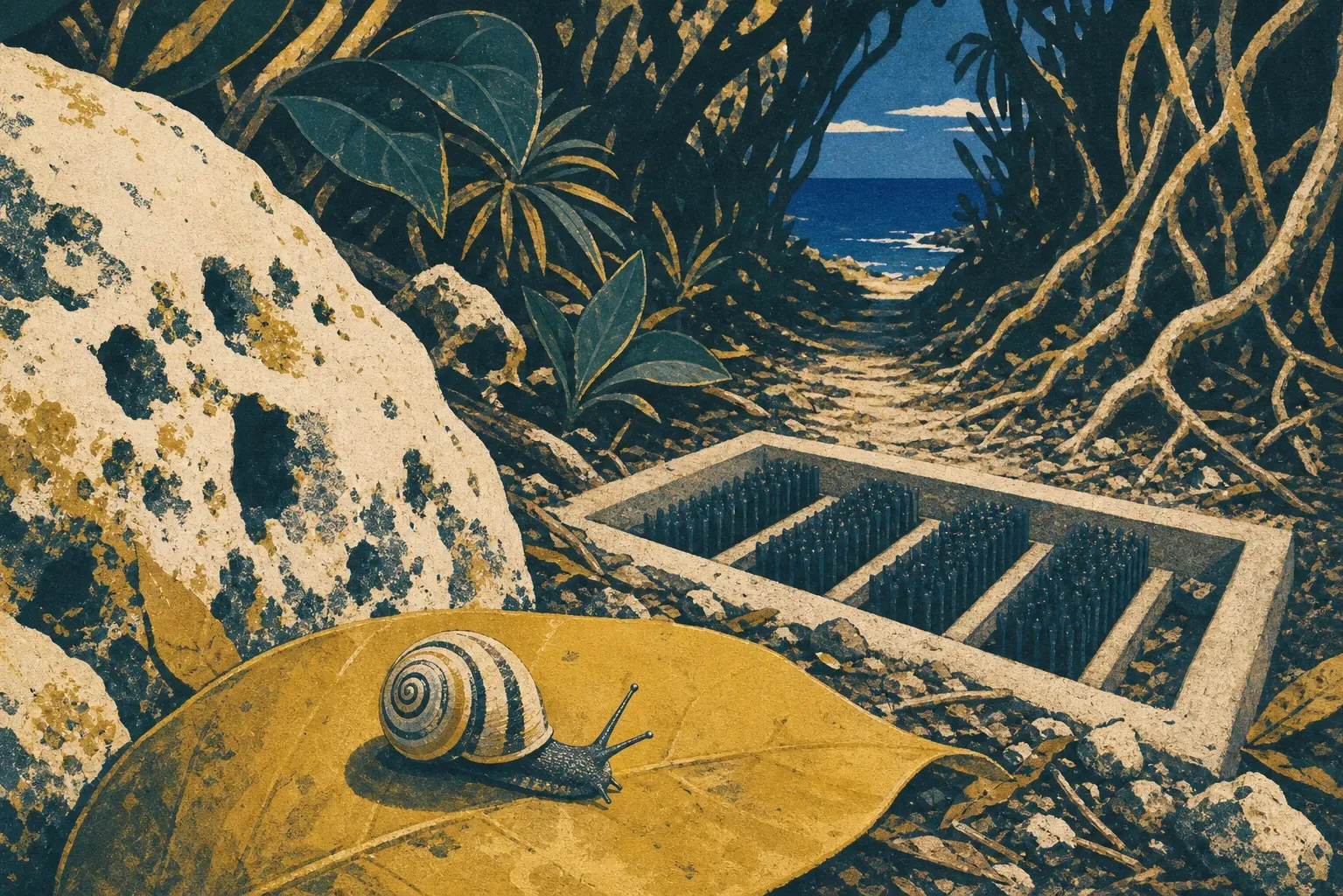
Before the Ogasawara-maru pulls away from Takeshiba Pier in Tokyo, you're asked to check the soles of your shoes. Brush out the grit. Shake the seed heads from your bag and your pant cuffs. It can feel like theater right up to the moment the geography sinks in: the crossing runs about 1,000 km and takes a full 24 hours, and nothing alive at the far end got there except by accident — carried on a bird, pushed by a current, rafted in on driftwood. A burr in your boot tread is a competitor that skipped the queue.
The islands were inscribed in June 2011 as natural heritage, and they have no temple, no castle, no single framed view a poster could sell. Japan's own Ogasawara World Heritage Centre calls them an evolutionary laboratory, and that phrase, not the scenery, is the inscription. The property, inscribed as List entry 1362, covers 7,939 hectares across the archipelago and holds 441 documented native plant taxa; Japanese tourism material rounds the same ground to some 30 islands and about 8,000 hectares.
Everything alive here arrived by accident
These are true oceanic islands. No land bridge, no continental shelf connection, not once. That single fact separates Ogasawara from Okinawa, which sits on drowned continental crust and inherited much of its wildlife wholesale from Asia. Ogasawara inherited nothing. It assembled itself from whatever survived a thousand kilometers of open water, then spent a very long time changing. The climate pushed the results further sideways: an annual mean near 23°C, but a seasonal swing of about 10°C, wider than you'd expect at this latitude.
The evidence the inscription rests on is small and easy to walk straight past. Land snails. Around 100 species, roughly 94 percent of them found nowhere else on the planet, with new ones still being described. The genus Mandarina is the textbook case: populations that took to living in trees evolved measurably different shell shapes from populations that stayed on the ground, on the same islands, within sight of one another. That is adaptive radiation at a scale you could hold in your palm.
Plants tell the same story in another register. The dry forests here resemble the laurel forests of Southeast Asia but lack the oaks and chestnuts that dominate the continent, which leaves a composition with no equivalent anywhere. Botanists can point to lineages caught mid-sentence: herbaceous ancestors turning woody, species drifting toward separate male and female plants. Anijima's dry sclerophyll forest is named specifically in the heritage documentation. You can see it from Miyanohama Beach on Chichijima, across a narrow channel of very clear water. You cannot go there.
Why a guide has to hold your hand on Minamijima
Once the inscription makes sense, the rulebook stops feeling arbitrary. Ogasawara National Park was designated on October 16, 1972: 6,629 hectares of land, of which 4,934 hectares are Special Protection Zones, the strictest category Japanese law offers. Fourteen marine park districts totaling 779.6 hectares were added on November 12, 2009. Over that sits the Ogasawara Country Code, which asks you to carry your trash out, keep to marked trails, remove nothing living or dead, and camp nowhere on the islands at all.
What makes the place unusual is that the conservation work is happening in front of you rather than behind glass. The red-headed wood pigeon fell to roughly 40 birds; zoo breeding (about 60 held) plus the capture and relocation of feral cats brought it back. The Ogasawara greenfinch is down to roughly 100 birds in total, with captive breeding started in 2021. Goats were eradicated from Anijima in 2010. Mandarina snails are bred at Tokyo zoos and released on trial to Tsutsuji-jima. The endemic orchid Calanthe hoshii grows behind fencing built to exclude rats and giant African snails. Rodent control is done by helicopter-dispersed bait.
Minamijima sits about 20 minutes by boat off Chichijima and shows why the guiding rules exist. Its limestone is submerged karst: sinkhole dolines and lapies, the jagged fluted rock that ruins ankles. Seabirds nest there. So do sea turtles, and their tracks are visible on the beach in season. Scattered in the sand are semi-fossil shells of the Hirobeso snail, a species that went extinct 1,000 to 2,000 years ago and is now designated a natural monument. Photograph them. Pocketing one is theft of a monument. You cannot land without a Tokyo Metropolitan certified nature guide beside you, wearing the official armband, and a single guide may bring at most 15 visitors ashore. Book through an operator displaying the Minamijima use-rule compliance sticker. Older guidebooks and blogs still quote a daily headcount cap, a per-group time limit and a seasonal closure of the island; the village abolished all three in June 2023, and the guide requirement is what carries the protection now.
Heart Rock, the cliff overlooking Ennen Bay, lies inside a Forest Ecosystem Protection Area, which means your guide needs a forest-entry permit and you legally cannot walk it alone. Mt. Chibusa on Hahajima, by contrast, is yours to climb unguided, and it's where you'll hear the Hahajima meguro, a white-eye that lives on that island and nowhere else. At sea the restraint is self-imposed: whale-watching operators here wrote their own approach-distance rules in 1988, when this became the first place in Japan to run whale-watching as ecotourism. Humpbacks pass December to May.
Working around a ship that comes every six days
The booking order the village publishes is not advice, it's the only sequence that works: accommodation first, then the ferry, then guides and rentals. Ferry tickets go on sale two months before departure, rooms are few, and the ship leaves you ashore for three nights whatever you have or haven't arranged. Guided tours fill in peak season before anyone lands.
That same six-day rhythm decides what you can learn. The Ogasawara World Heritage Centre (09:00–17:00) and the Ogasawara Visitor Center (free, 08:30–17:00) both open only while the Ogasawara-maru is in port, which on a standard trip means all three of your island days. If you have one hour, spend it at the Heritage Centre rather than the Visitor Center, because it explains why you're being told what you can't do.
Then buy a bento in Omura, because there is nowhere else on Chichijima to buy food, and carry it over the hill to Miyanohama. Sit on the sand and look across the channel at Anijima: dry sclerophyll forest that grows nowhere else on earth, goat-free since 2010. There is no landing for you. Looking is as close as anyone gets.