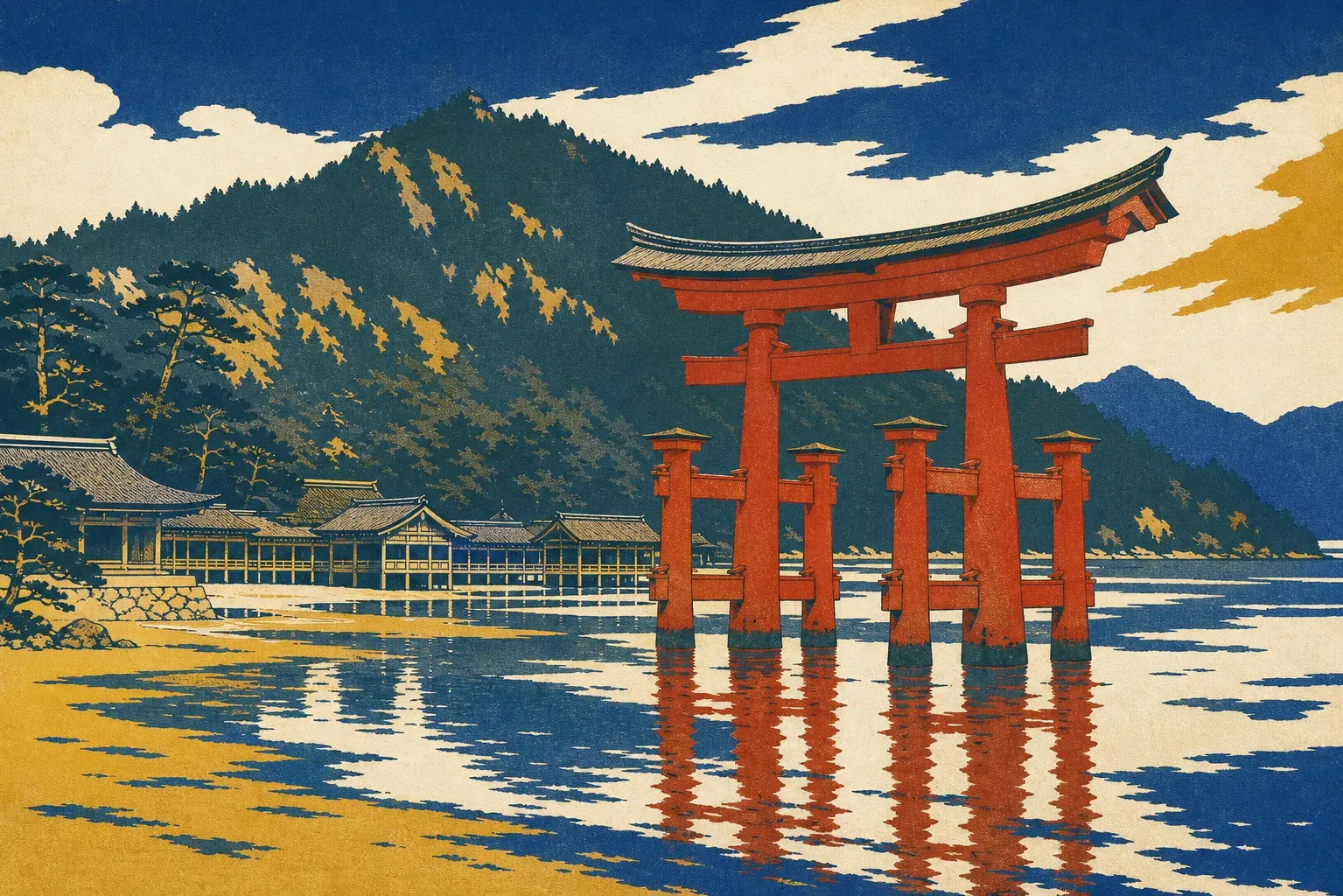
Miyajima / Itsukushima Shrine
厳島神社
- Hiroshima Station (via Miyajimaguchi Station and ferry)
- ≈5–5.5 h from Tokyo
- Depends on route — see Access
- Spring (late March-April, cherry blossoms)
Quick facts
- ≈5–5.5 h from Tokyo
- roughly 19,500-20,500 yen one way (Nozomi about 19,000-20,000 yen, local train about 420 yen, ferry 200 yen plus the 100-yen Miyajima visitor tax on the way over)
- Depends on route — see Access
- Spring (late March-April, cherry blossoms) · Autumn (mid-November, maple foliage in Momijidani Park) · Check tide tables: high tide for the floating torii, low tide to walk out to it
- Hiroshima Station (via Miyajimaguchi Station and ferry)
- The Five-Storied Pagoda beside Senjokaku is covered in scaffolding for roof re-shingling until November 20, 2027 per Itsukushima Shrine's construction schedule — the classic pagoda photo is off the table until then, though the Great Torii itself is fully visible.
- Structural reinforcement of the East Corridor, the covered walkway you enter the shrine through, has been under way since April 2024 and is scheduled to finish in December 2026; expect hoarding and restricted sightlines on part of the approach.
- Every visitor pays a 100-yen Miyajima Visitor Tax on top of the 200-yen one-way ferry fare, so the first crossing costs 300 yen; the tax is bundled into regular tickets, but Japan Rail Pass holders ride the JR ferry free and must buy a separate 100-yen tax ticket at the Miyajimaguchi terminal.
Overview
Why it's inscribed
Most shrines stand on land. Itsukushima stands in the sea, on pilings over a tidal flat, and that inversion is the whole idea. For centuries the island itself was treated as sacred ground, too holy to build on, so when Taira no Kiyomori, the most powerful man in twelfth-century Japan, rebuilt the shrine in 1168, he pushed it out over the water instead, laying out its halls and covered walkways in the style of a Heian aristocrat's palace. Twice a day the tide comes in and the complex appears to float. Twice a day it recedes and leaves the buildings standing on wet sand. UNESCO inscribed the shrine in 1996, calling it "the physical manifestation of humankind's worship of nature," and the listed property pointedly includes the sea in front, because without the water the architecture makes no sense. What you see today is not the 1168 original. Fires in 1207 and 1223 and a typhoon in 1325 took their toll, and the current main sanctuary is a 1571 rebuild. But every reconstruction copied the Heian design with unusual fidelity, which is precisely what the inscription honors: eight and a half centuries of people deciding, over and over, that this improbable building belonged exactly where it was.
What you'll actually see
The Great Torii
You'll spot it from the ferry before you land: a vermilion gate 16.6 meters tall, its main camphor-wood pillars 9.9 meters around. Nothing anchors it. The gate rests on the seabed under its own weight, steadied by four auxiliary pillars in the Ryobu style adopted back in 1547. The current gate, erected in 1875, is the ninth on the spot. At high tide it seems to rise straight out of the sea; at low tide you can walk across the flats and stand beneath the crossbeam. Its 2019–2022 renovation is long done, so the gate is fully visible.
The East and West Corridors
The shrine is essentially a network of roofed boardwalks, roughly 260 meters of them in total — the East Corridor runs 47 bays, the West Corridor 61, each about four meters wide — and both are designated National Treasures. They link the pavilions a meter or so above the water, and the floorboards are laid with visible gaps. That's not age. The gaps let a high tide or storm surge push water up between the boards instead of lifting the floor off its posts. Walk slowly and look down as often as out; the sea moving under your feet is half the experience. One caveat for 2026: the East Corridor, which is how you enter, has been under structural reinforcement since April 2024, with completion scheduled for December 2026, so part of the approach is working construction rather than clean sightlines.
The Honden
The main sanctuary sits at the heart of a complex of 37 buildings, with 19 more in the outer shrine. It enshrines the three Munakata goddesses, sea deities invoked for protection against shipwreck and war, which is fitting for a building that lives with saltwater under its floor. What stands today is warlord Mori Motonari's 1571 reconstruction, a National Treasure since 1952. It reads as a palace rather than a fortress: low rooflines, long sightlines, everything oriented toward the torii out in the bay.
The stages
In front of the Honden, the raised Takabutai is counted among the three most famous stages in Japan; gagaku court music and dance are performed on it more than a dozen times a year. Off to one side stands a Noh stage built in 1680, the only one in Japan that rests on the sea. Near it, the arched Sori-bashi bridge, rebuilt in 1557, closes out the over-water ensemble. If a rehearsal or performance is on, stop. Nothing else on the island sounds like it.
Senjokaku and the Five-Storied Pagoda
On the rise just above the shrine exit sits Hokoku Shrine, known as Senjokaku, a cavernous wooden hall that costs 100 yen as of 2026 and closes early, at 4:30 p.m. The five-storied pagoda beside it is normally the vertical in every Miyajima photo, but through November 20, 2027 it's wrapped in scaffolding while its cypress-bark roof is re-shingled. Go for the hall itself, not the pagoda shot, and you won't leave disappointed.
Mount Misen
The island has been sacred since the shrine's founding in 593, but the 535-meter peak behind it became a religious mountain later, when Kūkai opened it for Shingon practice in 806. It turns a two-hour visit into a full day. The ropeway from Momijidani runs roughly 9:00 to 16:00, with the last descent around 16:30 (about 2,000 yen round trip as of 2026, though posted fares vary, so check on site), followed by a 30-minute ridge hike to the summit observatory. Three free trails climb it in 1.5 to 2 hours. Daisho-in temple, at the foot of one of them, charges nothing and is open roughly 8:00 to 17:00; it's the island's most underrated hour.
Worth knowing
Check the Miyajima Tourist Association tide table before you fix your schedule, not after. The torii floats only around high tide and the walk out to it works only around low tide, and since tides shift roughly every six hours, a morning-to-evening stay can catch both. The shrine opens at 6:30 every morning; midday is when the bulk of three million annual visitors arrives, so the early hours are startlingly calm. Wear flat shoes — the shrine itself warns that heels get stuck in the gapped floorboards. The deer roam free and are practiced thieves; don't feed them, and keep paper maps zipped away. Staying past dusk changes everything: the torii is illuminated until around 23:00, and evening boat cruises past the gate run 25 to 30 minutes for about 2,000 yen for adults and 1,000 yen for children as of 2026, with six sailings between 17:55 and 21:15. Book at least two hours before departure through your ryokan, the tourist office, or the operator's site; there is no walk-up boarding. Kangensai, the shrine's great boat festival with gagaku musicians afloat in the bay, falls on July 30 in 2026. The shrine alone takes 30 to 60 minutes; with Omotesando and Misen, give it the day.
Highlights
The great vermilion Otorii gate, floating at high tide and walkable at low tide
The main Honsha shrine complex with corridors and pavilions built over the sea
The Noh stage over the water, one of Japan's three most famous stages, with gagaku performances
Mt. Misen (ropeway and hiking trails, primeval forest and summit views over the Seto Inland Sea)
Momijidani Park (spectacular autumn foliage)
The five-storied pagoda and Senjokaku (Toyokuni Shrine) on the hill beside the shrine
Getting there from Tokyo
Tokaido/Sanyo Shinkansen (Nozomi) Tokyo to Hiroshima (about 4 hours), JR Sanyo Line from Hiroshima Station to Miyajimaguchi Station (about 30 minutes), ferry from Miyajimaguchi pier to Miyajima (about 10 minutes), then a 10-minute waterfront walk to the shrine
Where to base & what to eat
Where to base
Miyajima Island (Momijidani / shrine district)
Historic ryokan like Iwaso (est. 1854) and the remodeled Kinsuikan are expensive and dinner-included by necessity, but they buy you the island after the day-trippers leave, the 6:30 shrine opening, and the illuminated torii.
Miyajimaguchi (mainland ferry town)
Mid-range hotels such as Aki Grand Hotel & Spa cost far less than island ryokan and put you on the first ferry, at the price of watching the evening illumination from across the channel.
Hiroshima city
The best value and the widest choice of hotels and restaurants, and the natural base for pairing Miyajima with the Peace Memorial, but you're about 40 minutes from the ferry pier each way.
What to eat
Anago-meshi (conger eel over rice)
The island's signature dish, lighter than freshwater unagi; the originator, Anagomeshi Ueno (est. 1901), fronts JR Miyajimaguchi Station, and its dining hall is walk-in only with real queues. The wooden-box bento can be reserved by phone and collected, which is the way around the line, and Mametanuki serves anago-meshi on the island.
Grilled Hiroshima oysters
Hiroshima Bay is Japan's largest oyster producer; Yakigaki no Hayashi on Omotesando, which claims to be the first shop in Japan to sell grilled oysters, cooks large three-year-grown specimens in the shell, and elsewhere on the street they come fried, raw, and over rice.
Momiji manju
Maple-leaf-shaped sponge cakes filled with bean paste, custard, chocolate, or cheese, sold warm all along Omotesando; the deep-fried age-momiji on a stick is the street-food move.
Official links
Fares, hours and closures change with little notice. These are the operators' and authorities' own pages — worth a look close to your travel dates.
Related stories
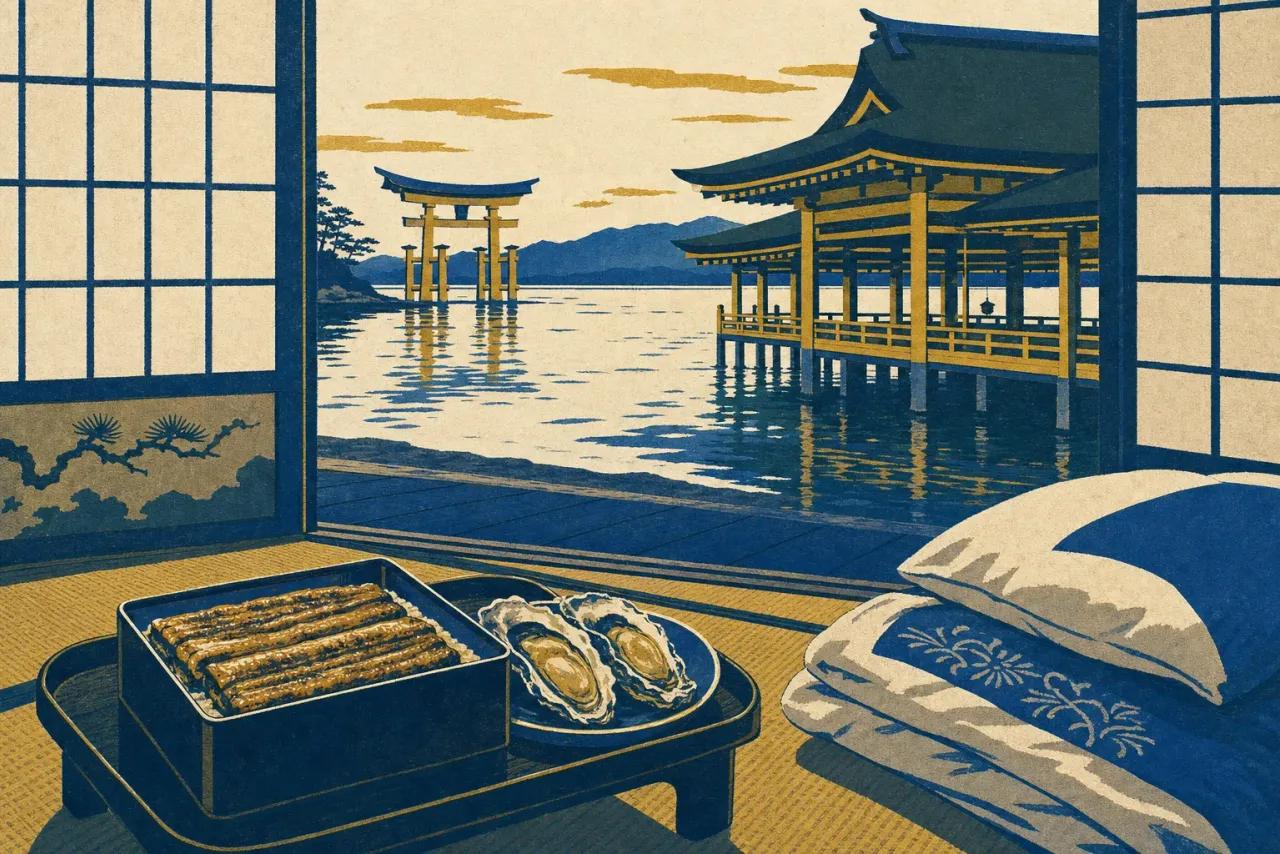
Eel, oysters, and a night on the sacred island: the case for sleeping on Miyajima
The island's most famous eel restaurant sits on the wrong side of the water, and the best hours belong to overnight guests. On the Ueno ekiben, grilled Hiroshima oysters, and what a ryokan rate actually buys.
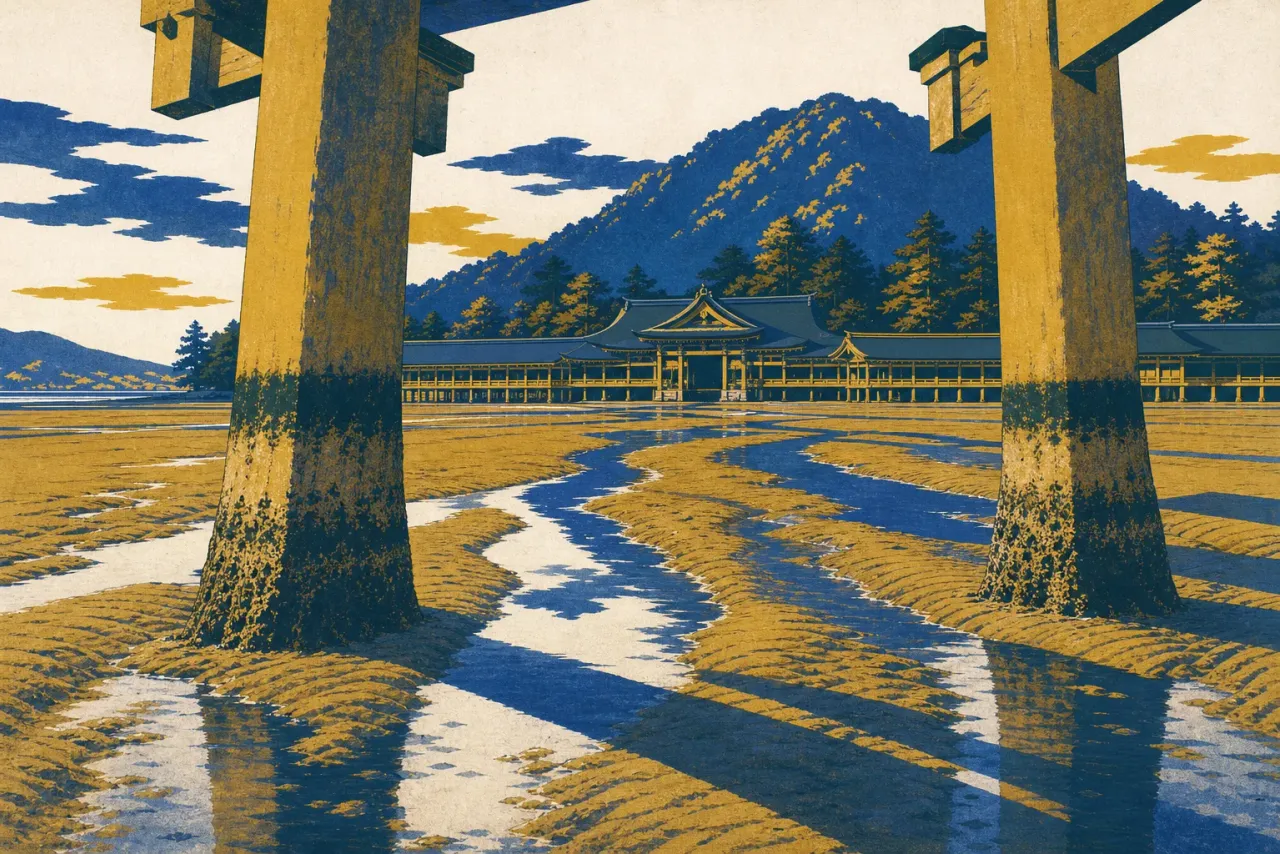
Timing the tide: a first-timer's perfect day on Miyajima
The floating torii and the walk-out-to-it mudflats are the same place six hours apart. How to build one well-planned day around the tide table, the 6:30 shrine opening, Mt. Misen, and the night illumination.
Nearby & combine with
Sources
- https://whc.unesco.org/en/list/776/
- https://www.japan.travel/en/world-heritage/itsukushima-shinto-shrine/
- https://www.itsukushimajinja.jp/jp/construction.html
- https://www.miyajima.or.jp/sightseeing/ss_ootorii.html
- https://www.miyajima.or.jp/sightseeing/ss_itsukushima.html
- https://www.jr-miyajimaferry.co.jp/fare/
- https://www.aqua-net-h.co.jp/sanpai/