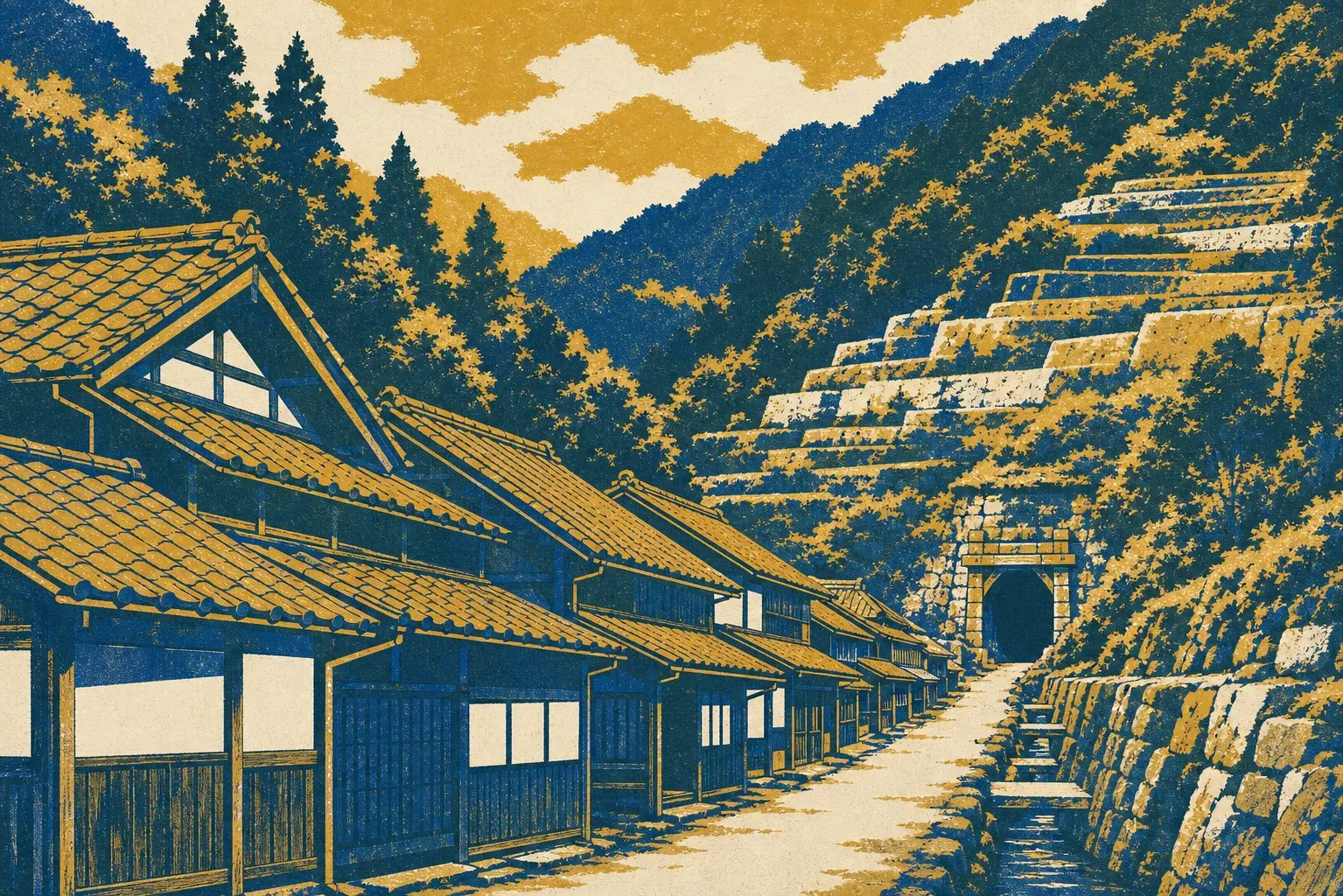
Iwami Ginzan Silver Mine
石見銀山遺跡とその文化的景観
- Odashi Station, Oda City (via Izumo Airport / Izumoshi Station)
- ≈5–6 h from Tokyo
- Depends on route — see Access
- Spring (Apr-May) for fresh greenery
Quick facts
- ≈5–6 h from Tokyo
- flight roughly 15,000-35,000 yen one way plus about 2,300 yen in local trains and buses each way (airport bus about 850 yen, JR about 800 yen, Iwami Kotsu bus 640-760 yen depending on the stop)
- Depends on route — see Access
- Spring (Apr-May) for fresh greenery · Autumn (Oct-Nov) for foliage · Avoid mid-winter: the region gets heavy snowfall
- Odashi Station, Oda City (via Izumo Airport / Izumoshi Station)
- The paid exhibition rooms at the Iwami Ginzan World Heritage Center are closed for renewal from October 2026 through March 2027 ahead of the 2027 anniversaries, so do your background reading before arriving; the tourist information desk, restrooms, and hands-on programs continue.
- Ōkubo Mabu can only be entered on a reserved guided tour (Fridays through Sundays and holidays, plus Golden Week and Obon, March 1 to November 30, 2026; about 2 hours; ¥4,500 adults, ¥3,500 elementary and junior-high students, no preschoolers). 2026 reservations opened January 13, and a departure with no bookings five days out may be cancelled, so book early — but if a confirmed departure still has seats you can join it right up to the day. Tours meet at the World Heritage Center.
- The trail section between Gorō-bashi and the Sakane-guchi checkpoint site is closed due to rockfall and landslide risk with no announced reopening date, so check the World Heritage Center website before planning a walking route through that stretch.
- Ginzan Cart fares were revised on April 1, 2026 to a by-section system running ¥200 to ¥700 one way; the cart still cannot be reserved, seats six, and does not run Wednesdays.
Overview
Why it's inscribed
At its peak in the early 1600s this one forested valley produced around 38 tonnes of silver a year. Japan as a whole was turning out roughly 200 tonnes, about a third of all the silver in the world, and Iwami was the engine of it. The product traded internationally as "Soma silver," circulating as currency across East Asia and paying for commerce with Ming China, Portugal, and the Netherlands. The refining technique behind it, a cupellation method called haifuki-ho, arrived from Korea in 1533 and spread from here through the rest of Japan.
What earned the 2007 listing, though, is not just output. It is how the mining was done. Iwami was worked underground, by hand, at small scale: roughly 1,000 shafts, called mabu, honeycomb the mountain rather than one open pit. Timber for fuel and pit props was cut on a managed rotation, so the slopes were never stripped bare. The woods covering the valley today are part of what is protected, a mining landscape that never became a scar.
The inscription also covers a system rather than a single spot: the mine, the town that administered it, three mountain fortresses, two silver-transport roads, and the coastal ports that shipped the metal out. The whole thing stretches about 20 kilometers and ends at the sea in Yunotsu.
What you'll actually see
Ōmori Ginzan townscape
A three-kilometer strip of wooden merchant houses and former samurai residences running up the valley from the Daikansho, the old Tokugawa magistrate's office that now houses the Iwami Ginzan Museum. This is a living town of a few hundred people, not an open-air museum; residents accepted limits on altering their own homes to keep the streetscape intact. Walk slowly. The pleasure is in small things, like the way the street narrows as it climbs toward the mine. Gungendo, the lifestyle brand founded here, occupies several restored merchant houses along the way and is the most reliable place in town for lunch.
Kumagai Family Residence
The Kumagai were the richest merchants in Ōmori, with hands in silver dealing, sake brewing, and official contracting, and their house is now an Important Cultural Property. It has the best interior on the street. Admission is ¥600 for adults as of 2026, open 9:30 to 17:00 with last entry at 16:30, closed Tuesdays (or the following day when Tuesday is a holiday). If you pay to enter only one building on the main strip, make it this one; the town otherwise reveals little of what life behind the facades looked like.
Rakan-ji and the 500 arhats
Cross the arched stone bridge and you face three caves cut into the rock. The central one holds a stone Shaka triad; the two flanking it hold 250 arhat figures each, 500 in all, carved over 25 years, from 1741 to 1766, under the monk Getsukai Jōin. A hall was built in 1764 to shelter them. They were made to memorialize miners who died underground, and the tradition is to search the carved faces for someone you have lost. It is a short, quiet stop that explains the human cost of everything else you will see.
Ryūgenji Mabu
The one tunnel you can enter on your own, documented in operation by 1715. Inside, hand-chisel marks cover the walls; this is what "1,000 shafts dug by hand" actually looks like at eye level. Admission is ¥500 for adults as of 2026 (the price rose from ¥410 in April 2024, and many English pages have not caught up). The exit drops you onto a forest path, about 40 minutes back down to town. Note that the entrance itself sits a 40-minute uphill walk from the Ōmori bus stop.
Ōkubo Mabu
The serious tunnel, open only on guided tours of about two hours: Fridays through Sundays and holidays, March to November, ¥4,500 for adults as of 2026, 20 people per departure, helmets and boots provided, meeting at the World Heritage Center. Inside you trace the geology, more chisel marks, and Meiji-era evidence of cart rails, including surviving iron dog spikes. In winter the mine moonlights as an aging cellar for stollen. Children below elementary-school age cannot join.
Yunotsu and Okidomari
The story ends at the sea, and skipping it means seeing only half the site. Yunotsu is the only hot-spring town in Japan inscribed as World Heritage: a wooden streetscape spanning Edo through Taishō, with free-flowing mineral water at the public bathhouses Yakushiyu and Motoyu. Nearby Okidomari is the narrow, once-fortified inlet where silver ships moored; the hanaguri-iwa mooring stones are still visible in the rock. A 12-kilometer trail links the mine to Okidomari, and walking it is the single best way to understand why a whole valley-to-coast system got listed.
Worth knowing
Ōmori adopted a residents' charter the year it was inscribed, and the street stays calm because people actually live there. Never enter a building that is not clearly open to visitors, and stay on the paths; mamushi pit vipers are active in the undergrowth from spring through autumn. Manage your expectations too. There is no headframe or open pit, and visitors who skip the interpretation often leave underwhelmed, which matters doubly while the World Heritage Center's exhibition rooms are closed for renewal until March 2027. Watch the calendar: the Kumagai house closes Tuesdays, the Center closes the last Tuesday of each month, and the Ginzan Cart shuttle sits out Wednesdays, cannot be reserved, and switched to by-section fares (¥200 to ¥700 one way) in April 2026. Wet roads can shut down the bicycle rentals, so have a walking plan for rain. Half a day covers the town plus Ryūgenji Mabu honestly; a full day adds Rakan-ji and the Kumagai interior; Yunotsu deserves an overnight. Carry cash and water, since small businesses rarely take cards and the historic district has no convenience store. Pay admission at the Center, Ryūgenji Mabu, and the Kumagai house, and the third will hand you a commemorative card.
Highlights
Ryugenji Mabu mine shaft (hand-dug tunnel from 1715 that visitors can walk through)
Omori historic mining town with samurai and merchant houses (Kumagai family residence)
Rakan-ji Temple and its Gohyaku Rakan (500 carved stone disciples, 250 in each of two flanking caves)
Yunotsu hot-spring port town (onsen and inscribed port area)
Okidomari port and the old silver transport routes to the coast
Iwami Ginzan World Heritage Center exhibitions
Getting there from Tokyo
Fly Haneda to Izumo Airport (about 1h25m), airport bus to Izumoshi Station, JR San-in Line local/limited express to Odashi Station (about 30-40 min), then Iwami Kotsu bus about 25-30 min to Omori (buses are infrequent - check timetables or use rental car/taxi)
Where to base & what to eat
Where to base
Ōmori (inside the World Heritage town)
Takyo Abeke, a 1789 official's residence restored over 13 years by Gungendo's Tomi Matsuba, gives you the street at dawn and after dark when day-trippers are gone; the catch is a handful of expensive rooms that book out far ahead, with nothing to eat once the shops close.
Yunotsu Onsen
The port town is itself one of the 14 inscribed components, so soaking at Yakushiyu or Motoyu counts as sightseeing; it sits 20 to 30 minutes from Ōmori with sparse buses, and evenings mean your ryokan's dinner or nothing.
Ōda City center, near Ōdashi Station
Business hotels with no atmosphere whatsoever, but you sit on the JR San'in Line at the head of the thin Ōmori bus route, which makes it the sensible base for anyone traveling without a car.
Mt. Sanbe highlands / Sanbe Onsen
Hot-spring and mountain lodging inside Daisen-Oki National Park, with hiking, dark skies, and the Buried Forest museum's preserved standing ancient trees; you need a car, and it is really a second, different trip rather than more mining.
What to eat
Ō-anago (large conger eel)
Ōda lands close to half of Shimane's conger catch, and the local fish run 50 cm and up, fattier and firmer than the small eels Tokyo sushi houses prefer; try anago sushi at Michi-no-Eki Road Ginzan or conger kaiseki at Kaneko Ryokan, with peak fat running summer into autumn.
Sanbe soba
Pale, smooth buckwheat noodles from the Sanbe highlands, milled mainly from the kernel core and protected by a national Geographical Indication since 2020; a revived native landrace supplies some shops, and the fields flower from mid-September, though listed restaurants close irregularly, so check the tourism association's Sanbe Soba Map before a special trip.
Satoyama Omusubi Set at Gungendo
The signature rice-ball lunch at the lifestyle brand's café inside a restored Ōmori merchant house, effectively the one reliable sit-down meal in the historic district; hours are short, so plan the day around it rather than hoping to wander in.
Official links
Fares, hours and closures change with little notice. These are the operators' and authorities' own pages — worth a look close to your travel dates.
Related stories
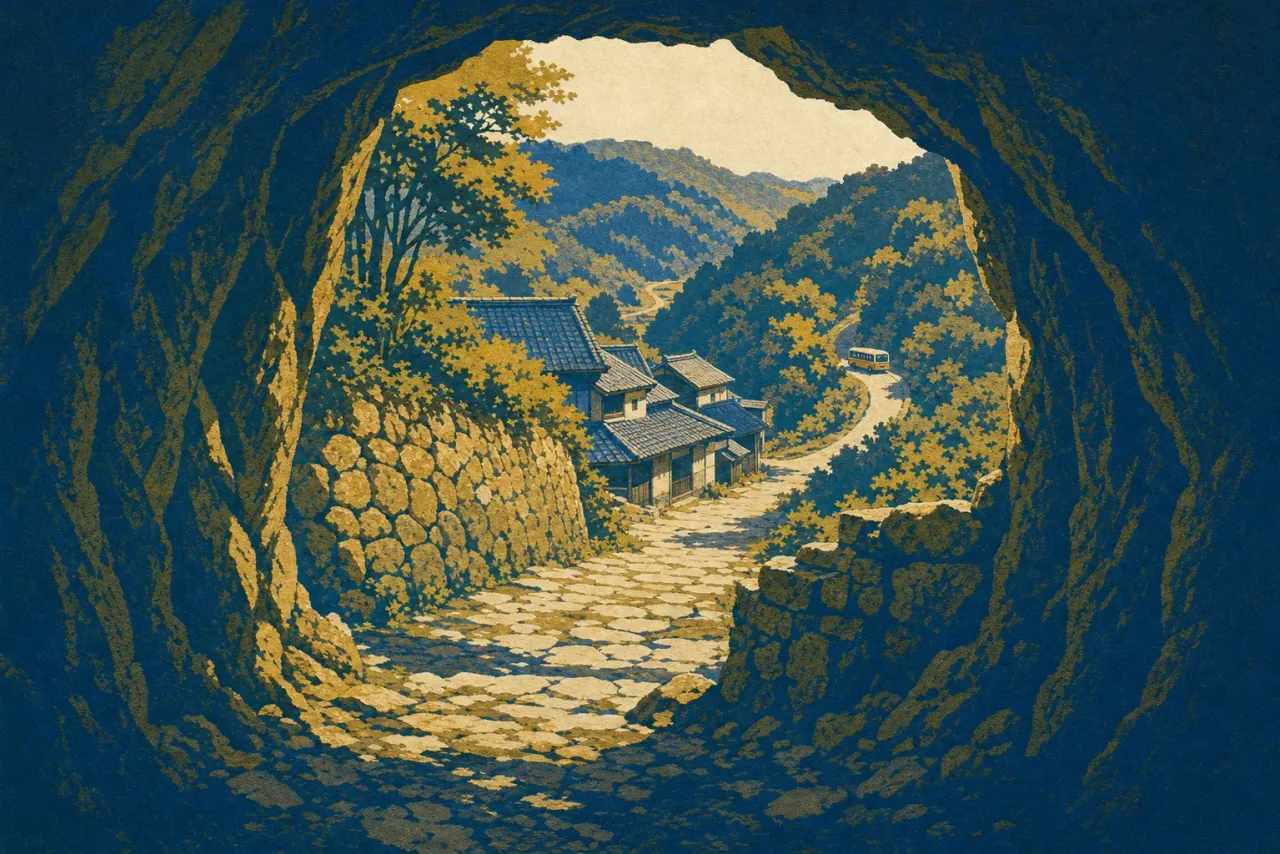
The mine that doesn't look like a mine: reading Iwami Ginzan in half a day
Iwami Ginzan once produced a meaningful slice of the world's silver, yet arriving visitors see only a quiet street and wooded hills. Here is how to read the valley in half a day, in the right order, without missing the last bus.
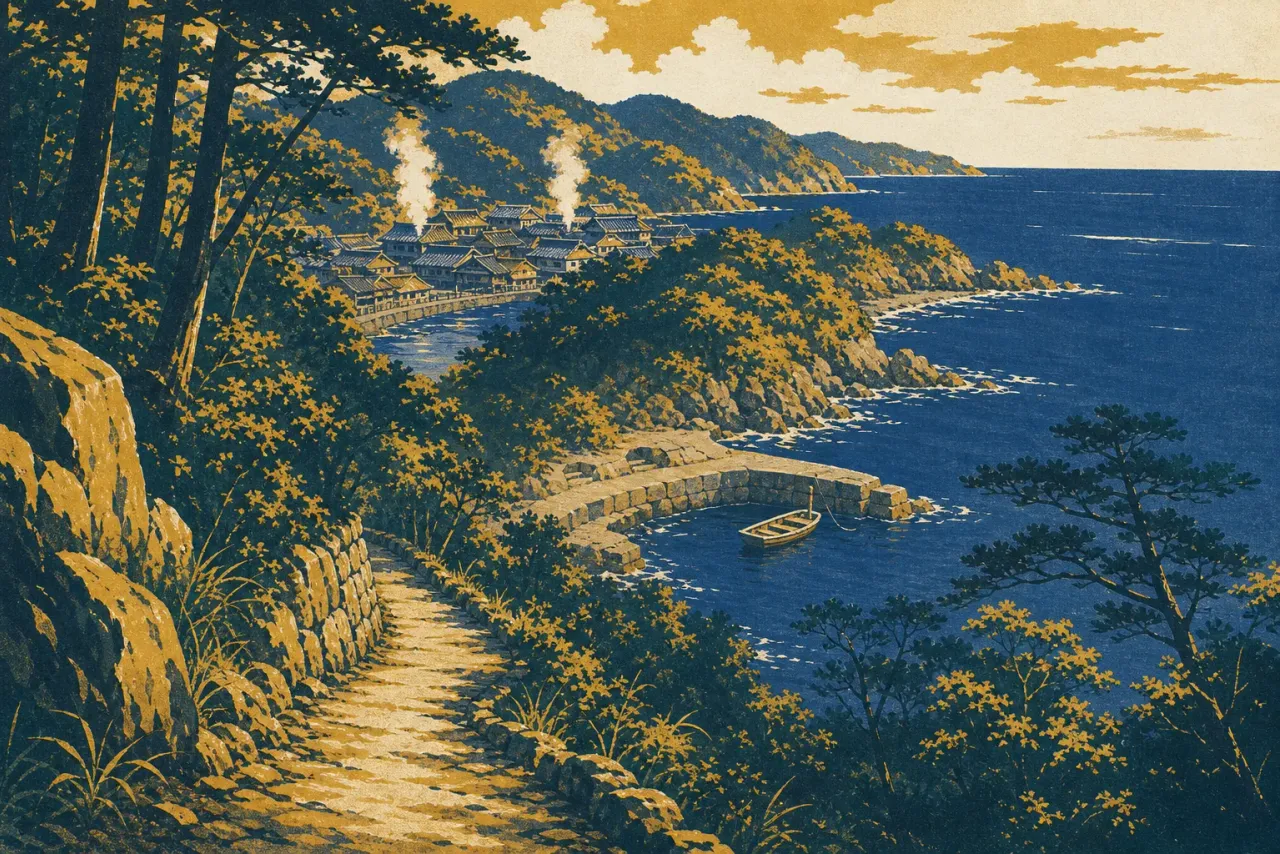
Follow the silver to the sea: the ports, roads and hot springs most visitors never reach
Five of Iwami Ginzan's fourteen inscribed components sit nowhere near the mine: two transport roads and the ports they fed. Walking the 12 km trail to Okidomari, and sleeping in the hot-spring port of Yunotsu, is the half of the site most visitors never see.