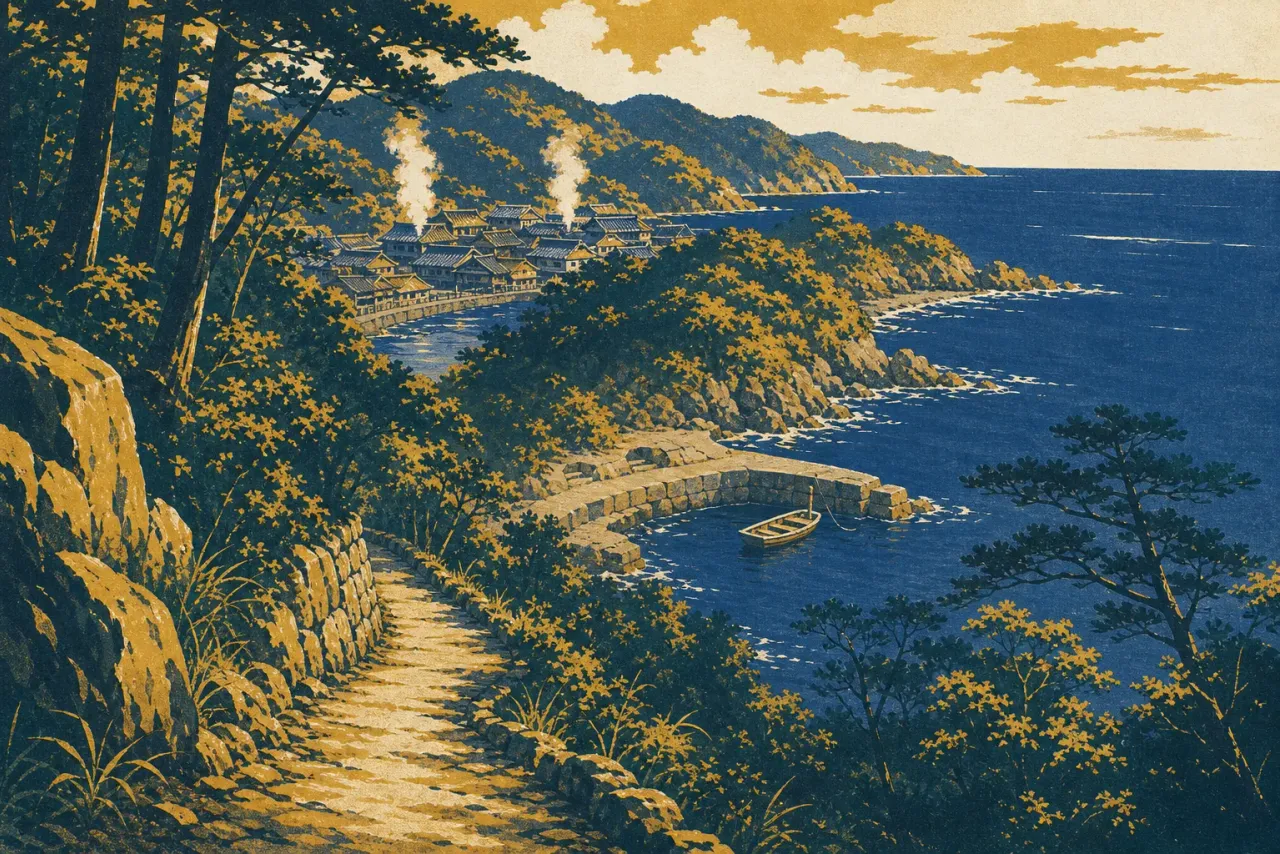
The mine that doesn't look like a mine: reading Iwami Ginzan in half a day
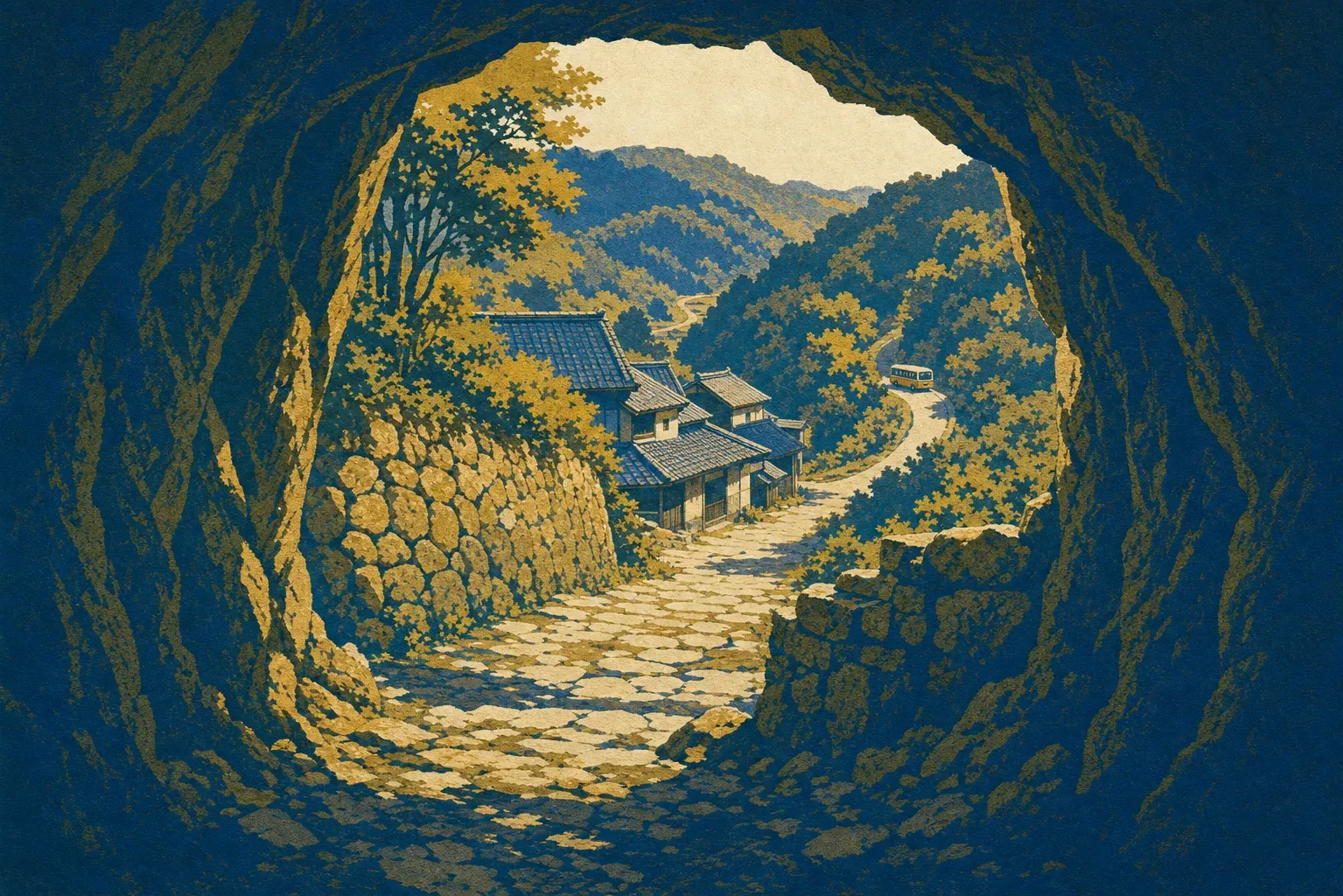
In the first decades of the 1600s, the valley behind Ōmori produced around 38 tonnes of silver a year. Japan at the time was turning out roughly 200 tonnes annually, about a third of all the silver in the world, and much of it left this coast under the trade name Soma silver, bound for Ming China and, through Portuguese and Dutch hands, well beyond. Then you step off the bus in Ōmori and face a single quiet street of dark wooden houses, a small river, and cedar-covered hills. People stand at the bus stop turning in a slow circle, looking for the mine.
There is no mine to look for, not in the sense you're picturing. Iwami Ginzan was worked by hand for four centuries, from 1527 to 1923, through roughly a thousand small tunnels called mabu that honeycomb the mountainsides. No open pit, no headframe, no slag mountain. The tunnel mouths are small, and most are hidden in the trees. If you arrive expecting a spectacle, you will leave saying there was nothing there. Plenty of visitors do exactly that.
The forest is the exhibit
Here's the reframe that makes the visit work: UNESCO didn't inscribe Iwami Ginzan in 2007 despite the fact that it looks like ordinary woods. It inscribed it partly because it looks like ordinary woods. Silver refining ate timber, as furnace fuel and as tunnel props, and around most mines of the period in Europe and the Americas the surrounding country was stripped bare. At Iwami, timber was cut on a managed rotation, and the mountains were never deforested. The green slopes you walk under are not what grew back after the mine; they are how the mine was run. One of the three criteria for the World Heritage listing rests specifically on that point.
The other thing to hold in your head is that the inscription covers a system, not a spot. Fourteen components spread over some 20 kilometers: the tunnel-riddled core zone, the magistrate's office, three mountain fortress sites, the town, the refining works, the transport roads, and the three coastal ports and port towns they served — Tomogaura, Okidomari, and the hot-spring town of Yunotsu. You won't see all of that in half a day. You can see enough to read the rest.
The half day, in order
Start at the Iwami Ginzan World Heritage Center, and not only because you have to. If you're driving, you do: private cars can't enter the Ōmori historic area, so you park at the Center, which has about 390 car spaces across three lots, and ride a paid local bus into town. Train travelers take the Iwami Kōtsū bus from Ōdashi Station, about 30 minutes, ¥760 to the Center on the city's 2025 fare table. But start there mainly because the Center is the interpretation. The site itself is deliberately understated; the models and excavated objects in the exhibition rooms are what turn the woods into a legible landscape. The building opens at 8:30, and from December through February the exhibitions run 9:00 to 17:00 with last entry at 16:30; from March through November everything shifts thirty minutes later, so the exhibitions stay open to 17:30 with last entry at 17:00 and the building to 18:00. It closes the last Tuesday of each month. Adults pay ¥400, with a ¥300 rate for foreign visitors, as of 2026.
One serious caveat. The paid exhibition rooms close from October 2026 through March 2027 for renewal ahead of a double anniversary in 2027 (twenty years on the World Heritage list, five hundred since the mine's discovery). The information desk and guide services continue, but if your trip falls in that window, do more reading in advance than you otherwise would, because the thing that usually does the explaining will be dark.
From the Center, take the bus down to Ōmori. Now comes the decision most people get wrong. The tunnel you can actually enter, Ryūgenji Mabu, sits about 40 minutes uphill on foot from the Ōmori bus stop. Walking is pleasant if you have the time; on a half day you probably don't, at least not in both directions. The Ginzan Cart, an electric cart that runs the 3 kilometers up from the Daikansho end of the street, takes about 24 minutes; its fares were revised in April 2026 and now run by section, ¥200 to ¥700 one way. It cannot be reserved (first come, first served), it seats six per cart, and it doesn't run on Wednesdays. The alternative is an e-bike from Rental Cycle Kawamura beside the Daikansho, ¥1,000 for up to two hours as of 2026, with the caveat that rentals can be suspended when the roads are wet. Take the cart or the bike up, and walk back down.
Ryūgenji Mabu itself costs ¥500 for adults and ¥250 for children, a price set on April 1, 2024; several English-language pages still quote ¥410, and they are simply out of date. Hours are 9:00 to 17:00 from March through November, 9:00 to 16:00 December through February, last entry ten minutes before closing, closed only on January 1. Inside, the ceiling drops and the temperature does too, and the walls carry the marks of hand chisels from workings documented in 1715. This is where the numbers from the Center become physical: someone cut this passage a few centimeters per swing, and there are a thousand tunnels like it in these hills. You exit onto a forest path that descends toward town in about 40 minutes, past tunnel mouths in the undergrowth that you now know how to see.
Back in Ōmori, if energy and schedule allow, the Kumagai Residence is the interior worth paying for: the house of the town's richest merchant family, ¥600 for adults as of 2026, open 9:30 to 17:00, closed Tuesdays. There's a small incentive to do the full circuit — pay admission at the Center, at Ryūgenji Mabu and at the Kumagai house, and you receive a commemorative card when you show your first two tickets at the third. The city's own model courses put the whole loop at 5 to 6 kilometers and about three hours of walking, with a compressed version at 1.5 to 2 hours. Those figures are honest. Trust them over your usual pace.
A street people live on
Ōmori is not an open-air museum. A few hundred people live along that street, and in 2007, the year of inscription, residents adopted a charter whose spirit runs roughly: this town has people living in it, and because we live here, it is a town we can be proud of. They accepted restrictions on altering their own houses to keep the streetscape whole. What that asks of you is simple. Don't open a door unless the building is clearly open to the public; many of the handsome facades are somebody's front hall. Keep to the paths. Bring cash, since small businesses here mostly don't take cards, and eat before you arrive or plan around a specific lunch, because there is no convenience store in the historic district and the few cafés keep short hours.
Skip Tuesday if you can: the Kumagai house is closed, and on the month's last Tuesday the Center is too. And before you walk anywhere from the Ōmori bus stop, photograph the timetable posted there. The buses back to Ōdashi Station are few, the evening ones fewer, and the difference between a good half day at Iwami Ginzan and a stressful one usually comes down to knowing exactly when the second-to-last bus leaves.