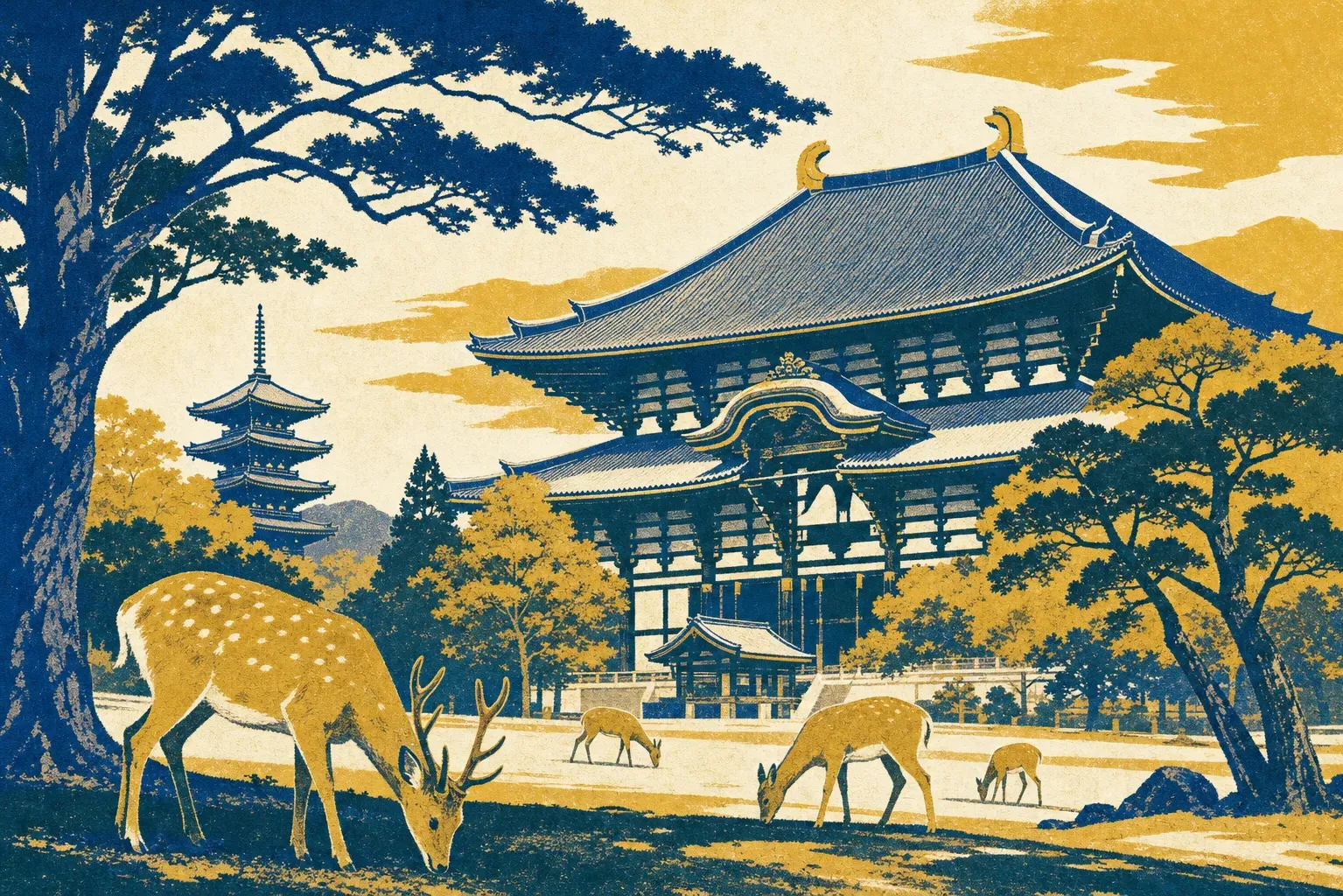
Ancient Nara (Todai-ji and Nara Park temples)
古都奈良の文化財
- Nara Station (JR) / Kintetsu-Nara Station, via Kyoto
- ≈3.5 h from Tokyo
- Depends on route — see Access
- Spring (late March-April, cherry blossoms in Nara Park)
Quick facts
- ≈3.5 h from Tokyo
- roughly 14,500-15,000 yen one way (Nozomi reserved to Kyoto about 14,000 yen plus about 720 yen for the local rapid)
- Depends on route — see Access
- Spring (late March-April, cherry blossoms in Nara Park) · Autumn (November, foliage around the temples and Kasugayama) · Early August (Nara Tokae lantern festival) and mid-December (Kasuga Wakamiya On-matsuri)
- Nara Station (JR) / Kintetsu-Nara Station, via Kyoto
- Kofuku-ji's five-story pagoda is fully enclosed by a restoration structure and cannot be seen until around March 2034; the Central Golden Hall and National Treasure Museum remain open as usual.
- Deer rutting season peaks in September and calls for caution through November: antlered males can charge, so feed only shika senbei, show empty hands when done, and keep your distance from males and mothers with fawns.
- Kasuga Taisha's paid inner sanctuary (700 yen as of 2026) is closed on the mornings of the 1st, 11th and 21st of every month and on roughly a dozen further ceremony dates, among them Setsubun, both equinoxes, November 3 and November 23, and closes fully around March 8-13, December 20-January 7 and the second Monday of January; check the shrine's own calendar before planning a morning visit.
Overview
Why it's inscribed
For 74 years, from 710 to 784, Nara was the capital of Japan. The planned city of Heijo-kyo is where the country consolidated its first real framework of national government, working from blueprints borrowed from Tang-dynasty China and Korea. Buddhism poured in through the same channel, and the temples built here became the engine of an extraordinary cultural flowering. When the court left in 784, partly to escape the political muscle of the great monasteries, the monasteries stayed.
That accident of history is the point. Kyoto's monuments span a millennium of rebuilding; Nara's eight inscribed sites preserve the eighth century specifically. UNESCO listed them in 1998 because together they show what life in an early East Asian capital actually looked like: the excavated grid of the Imperial Palace, the temples that ran the state's spiritual machinery, the shrine of the all-powerful Fujiwara clan, and the sacred forest behind it, where logging has been banned since 841. None of this is a museum piece. Todai-ji and Kasuga Taisha are working religious institutions, and the deer wandering the park are still, officially, divine messengers. Few places let you stand inside the eighth century with so little imagination required.
What you'll actually see
The eight components split into two clusters: five in and around Nara Park, walkable in a day, and three in the western part of the city that deserve a separate half day of their own.
Kofuku-ji
Walking in from Kintetsu-Nara Station, you reach Kofuku-ji before anything else. This was the Fujiwara clan's family temple, founded in Kyoto in 669 and moved here with the capital in 710, and its five-story pagoda has long been the symbol of Nara. One caveat: the pagoda is completely hidden inside a restoration enclosure until around 2034, its first major repair in roughly 120 years. The National Treasure Museum (900 yen as of 2026) still holds the three-faced Ashura statue, one of the finest pieces of Buddhist sculpture in Japan, and the grounds themselves are free and never close.
Todai-ji
Consecrated in 752 as the head temple of every provincial temple in the land, Todai-ji grew so politically powerful that moving the capital away from it was partly the point of leaving Nara. The Daibutsuden (800 yen as of 2026) houses the 14.98-meter Vairocana, the world's largest bronze statue of that cosmic Buddha, inside a 1709 reconstruction that still ranks among the largest wooden buildings anywhere. Then climb the lantern-lined steps east to Nigatsudo, a sub-hall most visitors skip. Its wooden balcony is free, open around the clock, and gives the best view over the city — worth the ten extra minutes at any hour.
Kasuga Taisha
Follow the deer-cropped paths east into the forest and the stone lanterns begin, thousands of them, mossy and irregular, lining the approach to the Fujiwara clan's tutelary shrine, founded in 768. Bronze lanterns hang in rows from the vermilion eaves. The outer grounds are free from early morning; the inner sanctuary costs 700 yen as of 2026 and is worth it for a closer look at the hanging lanterns. Behind the shrine rises Kasugayama Primeval Forest, 250 hectares where hunting and logging have been banned since 841, with a roughly 10-kilometer trail skirting its edge.
Gango-ji
Modest, quiet, easy to walk past. Gango-ji descends from Japan's very first full-scale Buddhist temple, founded at Asuka in 593 and moved here in 718, and some of the roof tiles on its main hall have been in continuous use since the sixth century. Look for the darker, rougher tiles in the roof's patchwork. The temple sits inside Naramachi, the old merchant quarter of lattice-fronted townhouses, so it pairs naturally with a slow afternoon of shops and cafes. Admission is 700 yen as of 2026 (800 yen during the autumn special exhibition).
Yakushi-ji
Out in western Nara, Yakushi-ji was commissioned in 680 by Emperor Tenmu to pray for his consort's recovery from illness. Its layout is strictly symmetrical, with twin pagodas flanking the main hall, and the East Pagoda is the only structure on the grounds surviving from the eighth century. Stand between the two pagodas and you can read thirteen centuries in the contrast: one weathered dark, one rebuilt bright. Admission is 1,000 yen as of 2026, and you will likely share the grounds with a handful of people rather than a crowd.
Toshodai-ji
A short distance from Yakushi-ji, Toshodai-ji was founded in 759 by Jianzhen, known in Japan as Ganjin, a Chinese monk who went blind attempting the sea crossing to Japan and finally succeeded on his sixth try. He came to teach the monastic precepts, and the temple remains head of the Ritsu school he established. Its Kondo is the classic surviving example of a Tang-style golden hall, the building to picture when you imagine what eighth-century Chinese architecture looked like. Admission is 1,000 yen as of 2026.
Heijo Palace remains
The palace site is the opposite of a temple visit: a vast, open field where the imperial residence and government offices stood, under excavation since 1959. The reconstructed Suzaku Gate and Former Imperial Audience Hall give the scale, and the emptiness between them does the rest of the work. Everything here, reconstructions and museums included, is free, but the hours run on two separate schedules. Suzaku Gate, the First Daigokuden, the Toin Garden and the archaeological halls open 9:00 to 16:30 with last entry at 16:00 and close on Mondays (the next weekday when Monday is a holiday) and from December 29 through January 3. The Izanai-kan visitor museum, Daigokumon and the Reconstruction Project Information Hall open 9:00 to 17:00 with last entry at 16:30 and close only on the second Monday of February, April, July and November, plus December 29 to January 1. Come toward the end of the afternoon, when the light goes long across the grass, and remember that all of Nara Park's temples once answered to this spot.
Worth knowing
The classic mistake is treating Nara as a three-hour stop: see the Daibutsu and leave. The park cluster alone deserves a full day, and the reward for staying past 5 p.m., when day-trippers drain back toward Kyoto, is having the lantern paths and the deer nearly to yourself. Those deer bow for shika senbei crackers (about 200 yen a pack as of 2025, sold in the park). Feed them nothing else, show your empty hands when you're done, and give antlered males a wide berth from September through November, when the rut makes them genuinely pushy. Two scheduling quirks catch people out. Kasuga Taisha's paid inner area closes on the mornings of the 1st, 11th and 21st of each month and on about a dozen further ceremony dates, November 3 and November 23 among them, so check the shrine's calendar rather than trusting the three-date rule. At Heijo Palace, a Monday closes Suzaku Gate, the First Daigokuden and the archaeological halls, while the open ground, the Izanai-kan museum and Daigokumon stay open. If you can time a visit for March 1–14, Omizutori at Nigatsudo sends six-to-eight-meter torches blazing along the balcony after sunset each night, a rite that has run for over 1,250 years. Late October brings the once-a-year Shosoin treasures exhibition, and with it the year's thickest crowds and fullest hotels.
Highlights
Todai-ji with its Great Buddha Hall and the giant bronze Daibutsu
Kasuga Taisha shrine with its lantern-lined approach through the forest
Kofuku-ji and its five-storied pagoda beside Nara Park
The free-roaming deer of Nara Park
Yakushi-ji (celebrated East Pagoda) and Toshodai-ji (statue of the monk Ganjin) in the western Nishinokyo area
Heijo Palace Site with the reconstructed Daigokuden audience hall, and the 10 km trail through the Kasugayama Primeval Forest
Getting there from Tokyo
Tokaido Shinkansen (Nozomi) Tokyo to Kyoto (about 2 hours 15 minutes), then JR Nara Line Miyakoji Rapid to Nara Station (about 45 minutes); the main temples around Nara Park are a 15-20 minute walk or short bus ride from JR Nara or Kintetsu-Nara Station
Where to base & what to eat
Where to base
Kintetsu-Nara Station area
The closest practical base, 15-20 minutes on foot from the park temples, with solid mid-range and ryokan-style hotels; it books out well ahead for autumn foliage and the Shosoin exhibition.
Naramachi
Restored machiya townhouse stays like the 8-room NIPPONIA HOTEL NARA NARAMACHI, a former sake-brewery residence, deliver the most atmosphere but the fewest big-hotel amenities.
JR Nara Station area
Business hotels at noticeably better rates with a direct ~45-minute JR line to Kyoto; the tradeoff is an extra 15-20 minutes of walking (or a short bus) to reach the temples.
Kyoto or Osaka (day-trip base)
Either city is about 45 minutes away by train, which is convenient on a longer itinerary, but you forfeit the quiet park after 5 p.m. when the day crowds leave.
What to eat
Kakinoha-zushi (persimmon-leaf sushi)
Pressed mackerel or salmon sushi wrapped in antibacterial persimmon leaves, invented to carry fish to the landlocked capital; Hiraso, Izasa Nakatani Hompo and Kakinohazushi Hompo Tanaka (with its small dine-in corner) are the names to know.
Yomogi mochi
Mugwort mochi with red bean paste; Nakatanidou near Sanjo-dori pounds it in a famously fast performance, most often from early afternoon into the evening, whenever stock runs low.
Chagayu (tea porridge)
Rice simmered in roasted tea, Nara's austere monastic breakfast, still served at traditional restaurants around Naramachi.
Narazuke (sake-lees pickles)
Gourd, cucumber and melon cured in sake lees from a city that claims to be refined sake's birthplace; Ashibi no Sato in Naramachi serves narazuke set meals and Harushika Sake Brewery Store pours tastings.
Kuzu (kudzu) sweets
Translucent kuzumochi and kuzukiri made from kudzu starch, best sampled at Tengyokudo.
Official links
Fares, hours and closures change with little notice. These are the operators' and authorities' own pages — worth a look close to your travel dates.
Related stories
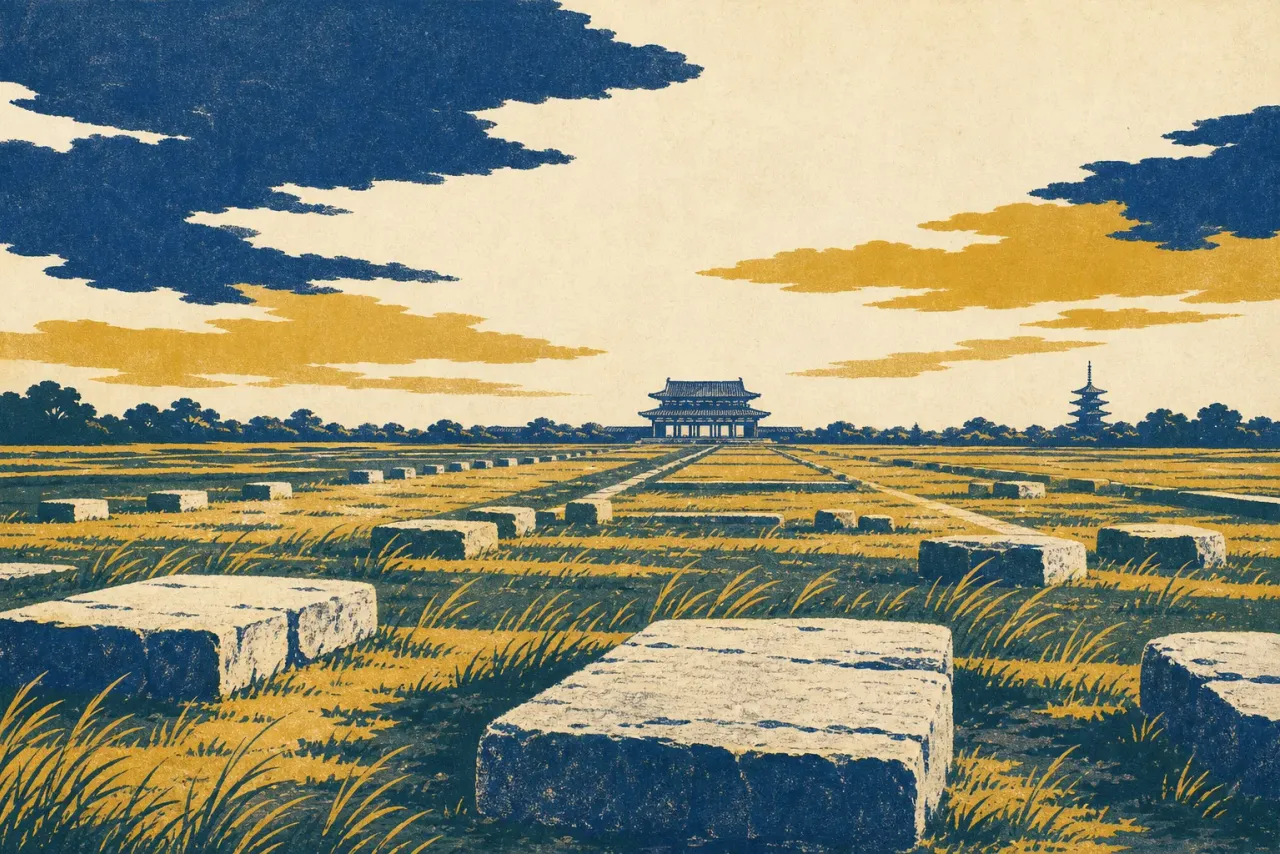
Beyond the deer park: a half day where Japan was invented
Yakushi-ji, Toshodai-ji, and the field where the imperial palace stood: the western half of Nara's World Heritage inscription is nearly crowd-free and explains what the eighth-century capital actually was.
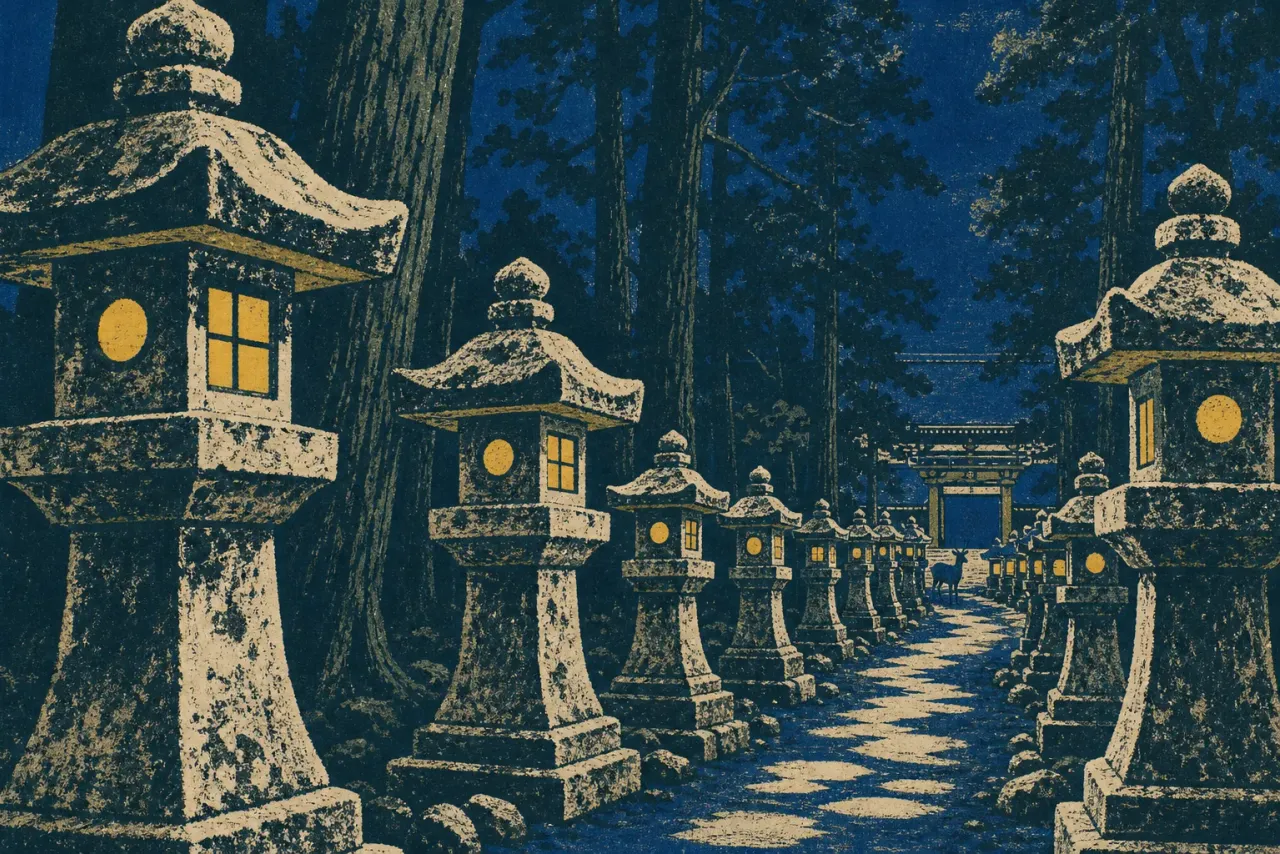
One Perfect Day in Ancient Nara: A First-Timer's Route Through the Eighth-Century Capital
Five of Nara's eight World Heritage sites sit within one long walk of Kintetsu-Nara Station. An hour-by-hour route that beats the tour buses to the Great Buddha and saves the lantern paths for after dark.