Japan in Miniature: Reading Yakushima's Forest from the Shoreline to the Snowline
Most people arrive with one tree in mind, and Jomon Sugi repays the pilgrimage. But the famous cedar is not the reason Yakushima is on the World Heritage list.
The inscription came in December 1993, a few months after an IUCN team inspected the island that May. Yakushima went on the list together with Shirakami-Sanchi, which straddles Aomori and Akita, as Japan's first entries. What was inscribed is not the whole island but 10,747 hectares of mountainous interior, roughly 21 percent of the land area. Two criteria were cited. Criterion (vii) covers natural beauty: forests of enormous cedar beneath peaks approaching 2,000 meters. Criterion (ix) covers ongoing ecological processes, and it is the one nobody explains at the trailhead.
Two thousand meters, five vegetation zones
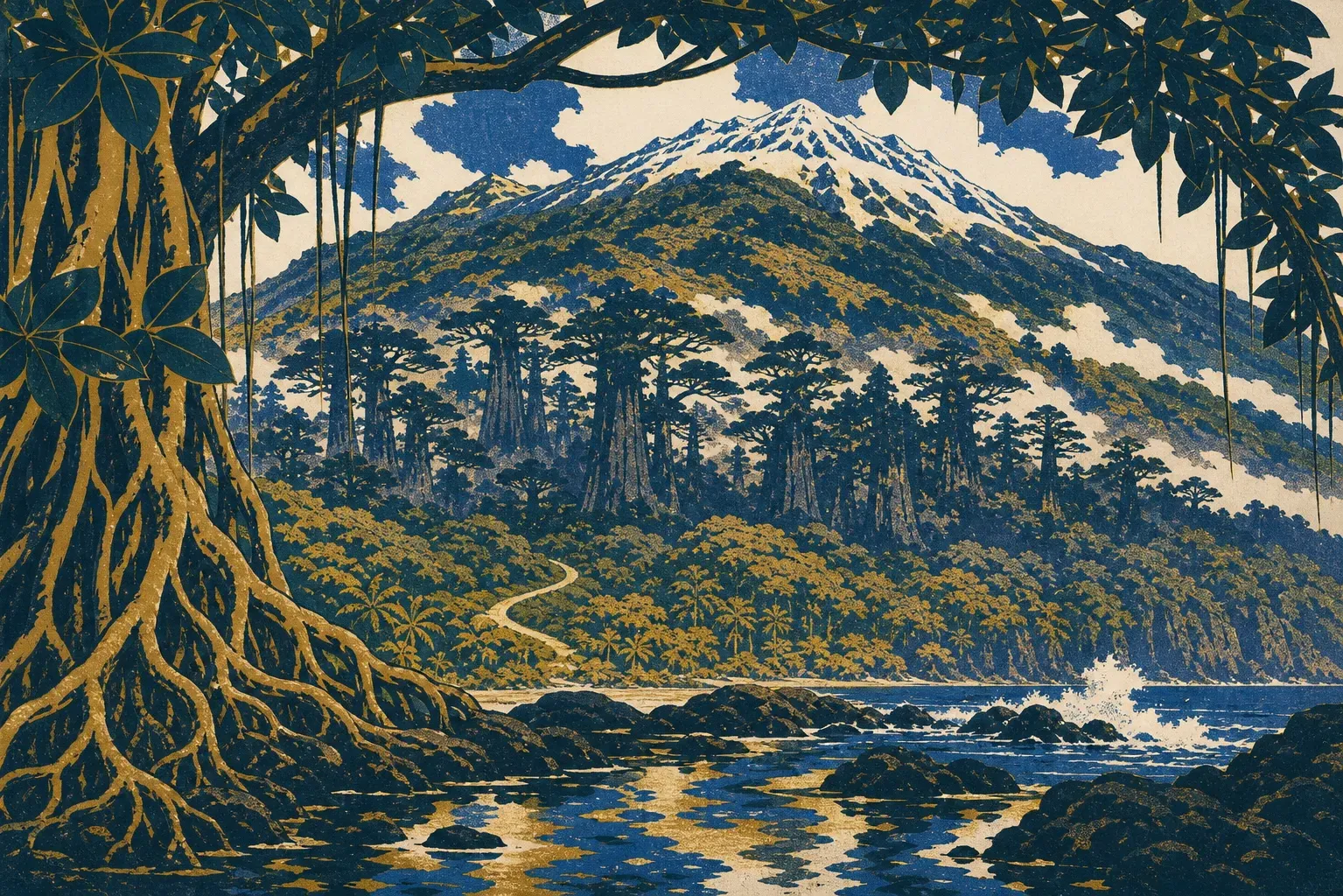
Here is criterion (ix) in plain language. Yakushima compresses the vegetation of the whole Japanese archipelago into a single vertical column about 2,000 meters tall. At the shoreline you are in subtropical coastal forest, with the fig Ficus superba var. japonica. Climb a little and the canopy becomes evergreen broadleaved forest dominated by Castanopsis sieboldii. Higher, the cedar forest begins. Above the cedars, cold-temperate bamboo grassland and high moor. Near the summits, subalpine scrub.
Walk that in a day and you have walked the latitude of the whole country. It sounds like a tourist-board slogan; it is closer to a literal reading of the elevation profile. Near the peaks, average temperatures run about 11.5°C below the coast, and Miyanoura-dake, the island's 1,936-meter high point, holds snow for months in winter while figs fruit at sea level a few hours' walk below.
Two other things stack onto that vertical squeeze. Yakushima sits where the Palaearctic and Oriental biotic regions meet, so its roughly 1,900 plant species and subspecies draw on stock from both. Several of those plants are at the outer edge of where they can survive at all. Cryptomeria japonica, the Japanese cedar, reaches its southern limit here. Caesalpinia crista reaches its northern limit. The gentian Gentiana yakushimensis grows nowhere else on earth.
Rain is the engine that drives the whole system. The Ministry of the Environment puts annual precipitation at over 8,000 mm, close to five times the Japanese average, with roughly 4,000 mm falling on the coastal plain and up to 10,000 mm in the mountains. Every visual thing you came for is downstream of that number: the moss that carpets granite boulders, the epiphytes rooting in the crooks of branches, the ferns crowding the streambeds. Pack for it, then stop resenting it. The weather is the exhibit.
Why the cedars outlive the textbook
A yakusugi, by local definition, is a cedar over 1,000 years old. That sounds like a small distinction until you know that Cryptomeria japonica normally lives around 500 years. The explanation is in the rock. Yakushima's granitic soils are poor, drainage is fast, and the trees grow slowly as a result: tight rings, dense wood, high resin content. Resin resists rot, and rot is what kills cedars in a wet climate. What looks like abundance is actually the opposite. These giants are old because the ground was stingy.
You can see this in cross-section at the Yakusugi Museum in Anbo. If you have a full hour, spend it there before you enter any forest; the ring samples reframe everything you'll look at afterward. If you have twenty minutes, go instead to the free Yakushima World Heritage Center, three minutes' walk from the museum in Anbo, which lays out the elevation zones on one wall.
Reading the gradient without the twelve-hour day
The honest version of Yakushima is that the Jomon Sugi hike is a commitment, not a walk, and skipping it costs you far less than people assume. Shiratani Unsuikyo, a ravine of moss forest 12 kilometers inland from Miyanoura Port, is where the inscription becomes legible on foot. It's a 24-minute drive, or 35 minutes by bus for ¥560 one way as of 2026, though buses run only every two to three hours. The gates never close.
Of the three marked courses from the entrance, Taiko-iwa is the one I'd argue for: 5.6 kilometers and about four hours, passing through the Moss Forest that a Studio Ghibli lead artist sketched for Princess Mononoke before continuing to its namesake rock at the top of the course. The Bugyo-sugi course's Satsuki suspension bridge section, closed by typhoon damage, reopened on 2 May 2026. Watch your footing at Ikoi-no-Oiwa, the big rock a few minutes past the entrance that the management council specifically flags as dangerously slippery; there is a marked bypass. Underfoot, the trails mix Edo-period stone paving with modern boardwalk, and English signage is good throughout.
If your knees vote for something shorter, Yakusugi Land, the managed forest inland from Anbo, strings looped courses through thousand-year cedars at every effort level.
Bring cash for both parks. The cooperation fee covering Shiratani and Yakusugi Land was revised on 1 April 2026 to a flat ¥800 per adult per park, or ¥600 each for groups of 20 or more; outside staffed hours (08:30 to 16:30) you drop your money into an honesty box.
The animals belong to the gradient too. Yakushima's macaque and sika deer are endemic subspecies found nowhere else, most reliably seen along the Seibu-rindo forest road on the west coast.
Where the column actually ends is in the water. Loggerhead turtles come ashore to nest at Nagata Inakahama on the northwest coast, mainly from May through July, on the same island whose summits hold snowfields. From 1 May to 30 September visitors are asked to stay off the beach between 20:00 and 05:00; the request carries no penalty yet, though a statutory restriction is under discussion. The practical way to watch a nesting is the official observation programme, which runs during the egg-laying season only, 10 May to 15 July: capacity is capped at 50 a night and reservations are required through the Nagata Sea Turtle Liaison Council, so book before you leave home. Through the hatching months that follow, the night-time request still stands and no tours run. The turtles keep their own calendar, and it does not consult yours.
Sources
- https://whc.unesco.org/en/list/662/
- https://www.japan.travel/en/world-heritage/yakushima-island/
- https://www.japan.travel/national-parks/parks/yakushima/how-to-get-there/
- https://www.env.go.jp/park/yakushima/ywhcc/index.htm
- https://y-rekumori.com/pdf/shiratani_pamphlet_en2026.pdf
- https://umigame-yakushima.com/nagatahama-kansatsukai/