The Star Map That Opens a Few Weeks a Year
In 1973, Japan's postal service issued a commemorative stamp of women in pleated skirts, copied from the west wall of a tomb chamber in a farming village south of Nara. The stamp sold roughly 120 million copies. Japan's population at the time was about 109 million.
The women are the Asuka Bijin, the "Asuka beauties," found on March 21, 1972, when archaeologists cut into a small two-tier mound called Takamatsuzuka during a survey for a walking path. Half a century on, they are the most famous faces in Japanese archaeology, and you cannot see them. After mold and fading became public knowledge in 2004, the entire burial chamber was dismantled and carried off in 2006 and 2007 for conservation. The neat grassed mound at the site today is a restoration. The paintings in the Takamatsuzuka Mural Hall beside it (300 yen as of 2026, open 9:00 to 17:00) are replicas.
That is the honest place to begin with Japan's newest World Heritage property. The Ancient Capitals of Asuka and Fujiwara were inscribed on July 26, 2026, at the committee session in Busan: 19 component sites totaling 137.99 hectares across Asuka Village, Kashihara, and Sakurai, listed under criteria (ii) and (iii). Most of the 19 are archaeology in the strict sense, meaning mown grass and foundation stones. The two most spectacular objects in the property, the painted chambers of Takamatsuzuka and Kitora, are either dismantled or sealed, with the originals shown only a few weeks a year. So a fair question: if you go, what will you actually be looking at?
What the mounds are arguing
UNESCO's citation is about something invisible. Asuka (588–694) and Fujiwara (694–710) were the successive capitals where Japan assembled a centralized state on the model of Chinese ritsuryō law, the template that shaped the later capitals at Nara and Kyoto. Nearly all the evidence survives underground, and it was excavation, not standing architecture, that reconstructed how the Japanese state came into being.
The tombs make that argument physically, if you know the sequence. Across the seventh century, burial mounds shrink. The enormous keyhole shapes of the earlier Kofun period disappear. Then, at the very end, a new form appears: the octagonal mound, reserved for emperors alone. Kengoshizuka (probably Empress Saimei), Nakaoyama (probably Emperor Monmu), and the joint mausoleum of Emperor Temmu and Empress Jitō are all octagons, and the Temmu-Jitō tomb sits precisely on the extended axis of Suzaku Avenue, the central street of the Fujiwara capital. Tomb and city were laid out as one design. A ruler was no longer a clan chief with the biggest pile of earth; he was the fixed point of a planned state.
Ishibutai shows the other end of that sequence. It is a square mound about 50 meters per side whose earthen cover was stripped away centuries ago, leaving the megalithic burial chamber standing naked in the fields. The leading candidate for its occupant is Soga no Umako, the clan chief who dominated the court around 600. Entry costs 500 yen (revised April 2026).
Umako also built the thing that made tombs like his obsolete. Asuka-dera, completed in 596, was Japan's first full-scale Buddhist temple and its first tiled-roof building, and it marks the moment power stopped being expressed in mounded earth and started being expressed in temples. The original buildings are long gone, but the bronze Asuka Daibutsu still sits exactly where it was installed more than 1,400 years ago. Admission is 500 yen (2026).
Two painted rooms
Takamatsuzuka's chamber, dated to the Fujiwara period, is absurdly small: 265 centimeters long by 103 wide, with 113 centimeters of clearance, built from cut tuff blocks skimmed with a few millimeters of plaster. Onto that plaster went sixteen figures in groups of four, a blue dragon with the sun on the east wall, the tiger and moon on the west, the tortoise-serpent Genbu on the north, and a ceiling of gold-leaf stars linked by vermilion lines. Among the grave goods was a Sui-Tang-type mirror. This was a court burying its dead in the visual language of the continent.
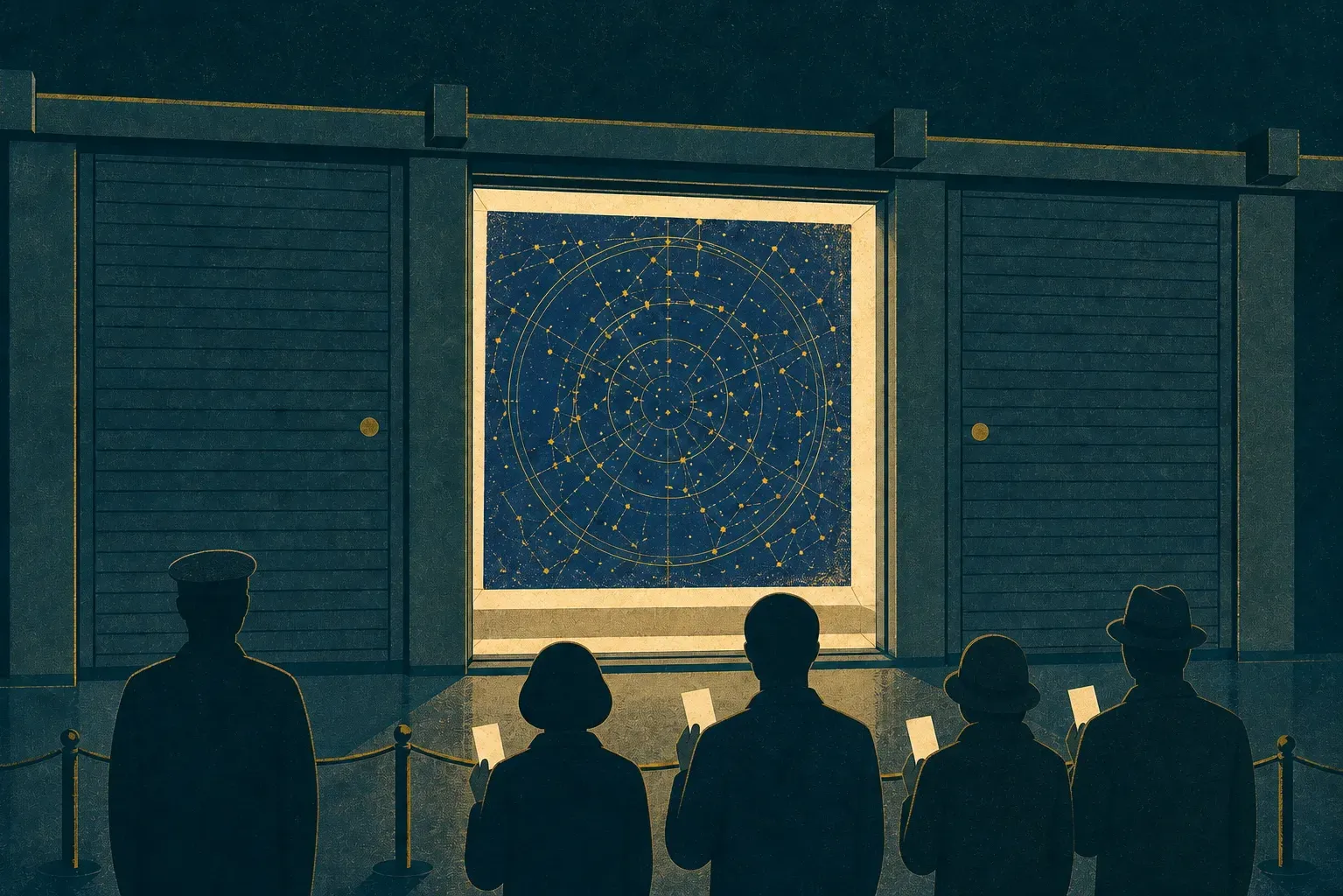
Kitora, a neighboring mound to the south, holds something stranger. Its ceiling carries the oldest surviving scientific astronomical chart in East Asia, with the celestial equator, the ecliptic, and the Chinese constellations plotted as a working system rather than decoration. All four directional deities survive on its walls, including the Suzaku phoenix that was lost at Takamatsuzuka, along with rare zodiac figures that have animal heads on human bodies. One detail keeps scholars busy: Kitora's White Tiger faces north, the reverse of the normal orientation. The discoveries came by machine. A fibrescope spotted Genbu in 1983, a CCD camera found the tiger and the star chart in 1998, and a digital camera finally caught Suzaku in 2001. The paintings were physically detached from the walls in 2004, the mound was refilled and restored to its ancient dimensions in 2015, and the murals became National Treasures in 2019.
The 2026 windows
The real Kitora paintings surface at ground level, in an Agency for Cultural Affairs conservation facility inside the Shijin-no-Yakata hall at the foot of the mound. The agency usually runs four viewings a year; 2026 has three. The astronomical chart showed from May 23 to June 21. The White Tiger runs August 1 to 30, and the final window, September 19 to October 18, brings out Suzaku, Seiryū, and Genbu together. Viewing is free but requires advance application, capacity runs to about 340 people a day, and a visit lasts around 20 minutes, roughly ten of them in the mural room itself. Outside those windows the hall shows full-scale replicas, and the building costs nothing year-round.
Getting there takes planning, because the Asuka–Kitora bus line has been abolished. Walk 12 to 15 minutes from Kintetsu Tsubosakayama Station, 22 to 30 from Asuka Station, book the Asuka Demand shared-ride service, or solve it with a rented bicycle from Asuka Station. One warning: the national park's main orientation pavilion next to Takamatsuzuka closed in April 2026 for a rebuild lasting until around 2030, so start instead at Asuka-bito no Yakata, the information center in front of Asuka Station, open 8:30 to 17:00.
If you have a single day, spend it on the visible fabric first, Ishibutai in the morning and Asuka-dera after lunch, then the Takamatsuzuka Mural Hall for the replicas. But if your dates overlap a Kitora window, build the entire day around your entry slot. Replicas are informative. The originals, painted by artists steeped in Chinese astronomy, are the reason this landscape is on the list.
There is one more thing that stamp did. The national obsession it recorded fed a preservation movement that produced the 1980 Asuka Law, which froze the whole village against development; Asuka remains the only municipality in Japan whose entire area is legally protected, and that is why the rice terraces and farmhouses around the mounds still look the way they do. As of this writing, the White Tiger is on view through August 30 (closed August 12 and 26), with applications open through August 29 and same-day entry only when the quota isn't full. Twenty minutes with a 1,300-year-old tiger that faces the wrong way. Plan for it.