Booked, Not Bounced: The Reservation Rules That Decide Your Shiretoko Day
Every summer, somebody rents a car at Memanbetsu Airport, drives the two-plus hours to the end of the Shiretoko park road, and gets turned away at Kamuiwakka Yu-no-taki by a staffer with a tablet. The falls weren't full at that moment. The day's 210 slots had been claimed online, some of them days earlier, by people who had watched a safety video and accepted a written risk statement before they ever left home.
Shiretoko runs on this logic. The peninsula holds one of the highest recorded densities of brown bears in the world, and the park's answer is not fencing everything off but scheduling: caps, lectures, guided-only windows, live closure boards. At most Japanese World Heritage sites, the general rule is that you can simply show up. Here, showing up is the mistake. Almost every story of a foreign visitor's ruined day traces back to one of four rules, and all four are checkable before you book a flight.
One parking lot, two very different walks
The Shiretoko Five Lakes, the most visited spot in the park, sells two products from the same trailhead, and conflating them is error number one.
First, the elevated boardwalk: 1.6 kilometers round trip, about 40 minutes, free, no reservation, no lecture, open through the whole April 20 to November 8 season. It runs behind an electrified bear-proof fence and is wheelchair- and stroller-accessible. It reaches exactly one of the five lakes. As a fallback it is genuinely good, with the Shiretoko range lined up behind the water. It is not "seeing the Five Lakes."
The ground pathway is the other product, the forest loop that actually circles the lakes, and its rules change three times a season.
From opening day until May 9, and again from August 1 to closing, you can walk it on your own, but only after a compulsory ten-minute lecture at the Field House, the trailhead building: ¥450 for adults and ¥200 for children as of 2026. Fifty people are released every ten minutes, and slots can be reserved from ten days ahead up to 30 minutes before your walk. In late April, expect snow underfoot; rubber boots are the local advice.
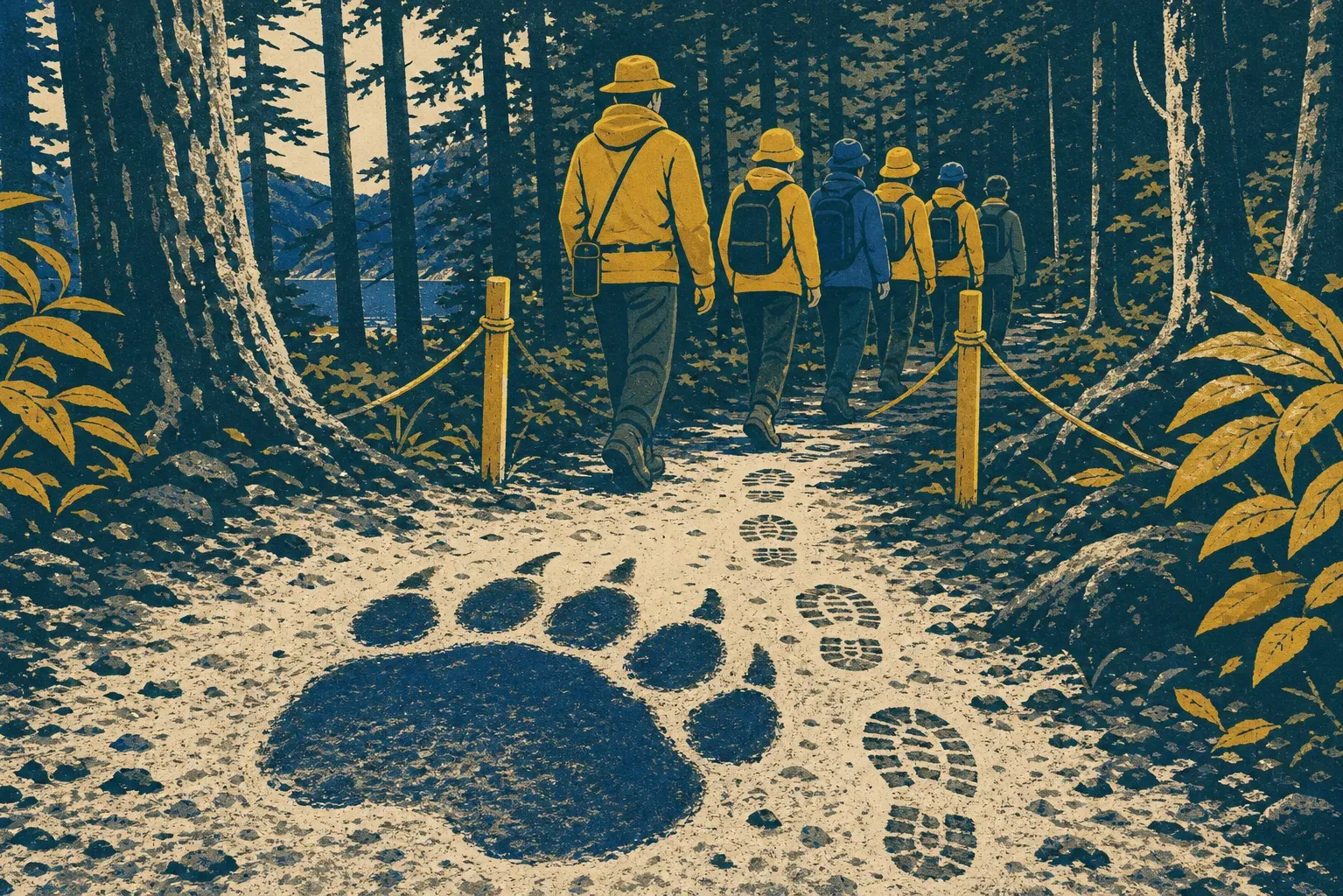
Between May 10 and July 31, the brown bear activity period, the ground path is guided-only. No exceptions. Groups max out at ten people, departing every ten minutes. The short loop takes an hour and 45 minutes at ¥4,000 per adult; the long loop, all five lakes in about three hours, starts at ¥6,000 booked ahead, and walking up on the day pushes the long loop to ¥7,000 (2026 prices). If your June itinerary says "morning stroll around the Five Lakes," what it actually says is "guided tour I have not booked yet."
One rule overrides everything: the moment a bear is sighted near the trail, the ground path closes, with no advance notice and no timetable for reopening. The park posts status live on the Five Lakes website and on the physical board at the Field House. Check it the morning you go, not the night before.
Kamuiwakka is an activity you apply for
Kamuiwakka Yu-no-taki is a river of warm spring water tumbling down a mountainside, and you ascend it in the water itself, which is what makes it both the best two hours in the park and the most regulated. The 2026 season runs July 1 to September 30, capped at 210 people per day, and entry requires three things done online in advance: watch the official lecture video, accept the risk statement, book your slot.
Admission is ¥2,900 per adult for most of the 2026 season. From August 8 to 15, private cars are banned from the access road and a shuttle bus lifts the price to ¥3,900. A helmet is mandatory and free. Water shoes rent for ¥550 to ¥1,100 depending on size (2026 prices), best reserved online since same-day stock at the Nature Center is thin. You climb as far as the fourth falls, where the water reaches 35 to 38 degrees Celsius. Take the gear seriously: the site's own 2026 running log already lists eight bear sightings and seven rockfall incidents; three people have been injured. This is an adventure activity that happens to be warm, not a spa with scenery.
The decision tree, by month
Put the two calendars together and your travel date decides your paperwork.
Late April to May 9: Five Lakes self-guided with the ¥450 lecture; snow lingers; Kamuiwakka closed. Book a lecture slot for a clear morning and keep the boardwalk in reserve.
May 10 to June 30: the awkward window. Ground path guided-only, Kamuiwakka still shut. Reserve a guided loop before you arrive, because ten-person groups fill.
July: both systems live at once. Book the Five Lakes guide and the Kamuiwakka slot as soon as your dates firm up. These are separate reservations on separate websites, and neither knows about the other.
August 1 to September 30: the most flexible stretch. Self-guided Five Lakes walking returns, lecture included, and Kamuiwakka runs until September 30. September itself adds salmon pushing up the rivers and the first autumn color in the forest. Mind the August 8 to 15 shuttle rule.
October 1 to November 8: Five Lakes only, self-guided, quieter every week until the November 8 close.
Winter is a different trip entirely. The lakes are shut, and the marquee activity, walking on the frozen Sea of Okhotsk in a dry suit (¥7,500 to ¥8,000 with Utoro operators in 2026), now sells out more than two months in advance. A February drift-ice walk booked in December is realistic; booked in late January, it usually isn't.
Two logistics rules sit underneath all of this. The direct bus from Memanbetsu Airport to Utoro is seasonal: Shari Bus ran the 2026 Shiretoko Airport Liner from June 1 to September 30 and again from January 17 to March 8, so a mid-January arrival is covered even though the shoulder weeks on either side are not. Outside those windows you're on the JR line to Shiretoko-Shari plus a Shari Bus connection, or in a rental car. And carry cash. The Aurora cruise desk does take Visa, Mastercard and a handful of other brands on the day, but coverage is partial and small-town Shiretoko in general is card-patchy.
None of this is bureaucracy for its own sake. Every rule maps to a bear, a rockfall, or a road that snow owns half the year, and the system works: the lakes are still ringed by primeval forest, not railings. Your part is small. Make the bookings your dates require and carry yen. Then, on the morning of your Five Lakes walk, before you pay for anything, stand in front of the live board at the Field House and read it. The bears set the final schedule. Everyone else just reserves around them.