Ice, Salmon, Bear: Eating the Food Chain That Made Shiretoko a World Heritage Site
The boats don't fish on Sundays. Remember that, because the best free show in Utoro, the small port-and-onsen town on Shiretoko's Okhotsk coast, is the Utoro Salmon Terrace, where on autumn mornings you can watch the day's catch land: salmon by the crate, hauled ashore within sight of the town's restaurants. Time your visit for any morning but Sunday, and go early. What you're watching isn't just a fish market. It's the last link in the chain of reasoning that made this peninsula a World Heritage Site.
Most UNESCO listings have nothing to do with dinner. You cannot taste a cathedral. Shiretoko, inscribed in 2005 under natural criteria (ix) and (x), is the rare place where the official citation and the local menus describe the same system. The food here isn't a sideline to the sightseeing; it is the interpretation.
The citation you can taste
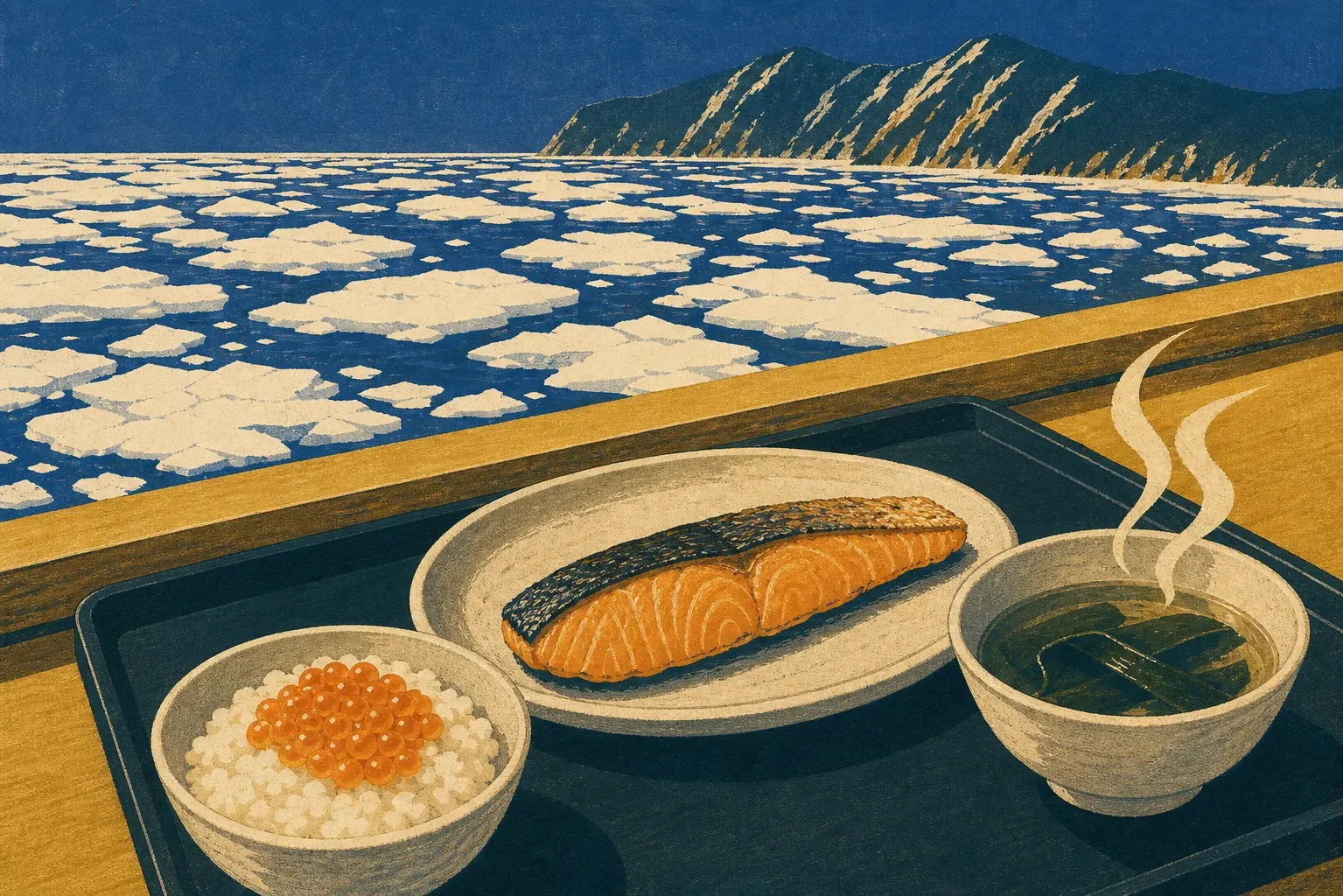
Here is the mechanism, compressed. The Sea of Okhotsk along this coast freezes every winter, and it does so at the lowest latitude anywhere in the Northern Hemisphere where seasonal sea ice forms. As the ice crystallizes it expels its salt. The dense brine sinks, pushing nutrient-rich deep water up toward the surface, and when the ice breaks up in spring, sunlight hits that fertilized sea and sets off enormous phytoplankton blooms. The plankton feeds a food web that supports five species of Pacific salmonids, and each autumn the salmon push up the peninsula's short rivers, hauling the ocean's productivity into the forest.
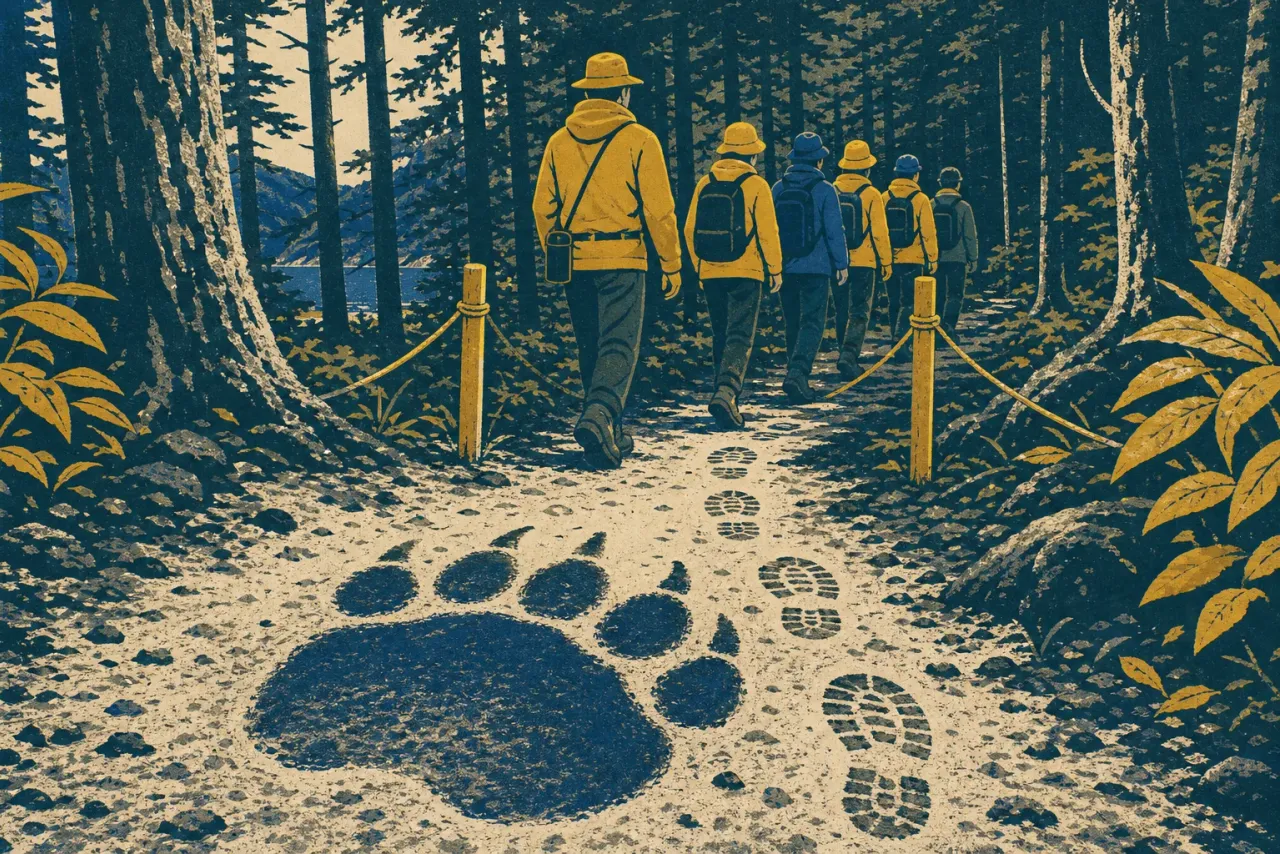
Criterion (ix) inscribes exactly that: a marine and terrestrial ecosystem stitched together by sea ice. Criterion (x) covers who is waiting at the other end. Blakiston's fish-owl, an endangered species, hunts salmon from the riverbanks. Steller's sea eagles take their share. And the peninsula holds one of the highest recorded densities of brown bears in the world, animals that stand in the September rivers doing roughly what you will be doing at a counter in Utoro that evening, minus the chopsticks.
Shari, the town that administers the Utoro side, understands all this with unusual clarity. It brands itself as Japan's number-one salmon town, runs a Shiretoko Salmon Week, and publishes local recipes through a project called the Shiretoko Salmon Kitchen. Its tagline translates as: the sea's blessings are also the blessings of the forests and the people. Which is the World Heritage citation, paraphrased and put on a fish.
Where to eat it in Utoro and Shari
Start easy. The restaurant inside Michi-no-Eki Utoro Shirietoku, the roadside station at the edge of town, builds its menu around seasonal Shiretoko ingredients, and it's the simplest first stop if you've just stepped off the bus and want lunch without a plan.
Then get specific. Shokudo Leonardo is the town's salmon specialist, the natural follow-up to a morning at the Salmon Terrace. GVO's pitch is hard to argue with: the owner dives for his own sea urchin. Shiretoko Kani-no-ya, which relocated and reopened in July 2022, handles the crab side of the Okhotsk catch, while Ryoshi no Mise Kaniya, run by fishermen, serves seafood with a view of the water it came from. Namishibuki, a tonkotsu ramen shop that has made Michelin's list, is the answer on the inevitable rainy night. And Bonz Home, which doubles as a budget guesthouse, has built its reputation on aged Shiretoko potatoes, a reminder that the peninsula grows things as well as catches them.
Shari proper, back down the coast by the train station, has its own tables: Shiretoko Gohan "tomoni," opened in February 2023 around local produce, and Shiretoko Satomi, a seafood-forward Japanese restaurant working with local ingredients. Between Shari and Utoro you'll also find Ezo deer on menus, marketed locally as high-protein, low-fat venison. The deer browse the same forest the salmon carcasses fertilize, so ordering it is arguably still on theme.
For the suitcase, look for the "Shiretoko Shari Brand" certification mark on souvenirs; most shops will send chilled or frozen goods ahead to a later address in Japan, which beats carrying ikura through three train transfers.
One boundary to respect. The single place in Shiretoko where you must not eat is on the trails at the Five Lakes, where eating, snacking, and cooking are banned outright, because food smells teach bears to associate humans with meals. The rule is enforced. In a landscape where you and the bears are after the same fish, the etiquette is simple: eat in town.
Over the pass, the specialty changes
Cross the Shiretoko Pass on Route 334, the seasonal road over the spine of the peninsula, and the food changes with the watershed.
Rausu, the fishing town on the Nemuro Strait side, is not chasing the salmon crown. Its specialty is Rausu kombu, the kelp Japanese chefs pay a premium for, which the town itself describes as giving a fragrant, refined dashi with deep umami. This is the quiet end of the same system: the cold, productive strait grows kelp whose flavor travels into kitchens far beyond Hokkaido. Hokke, a grilled-fish standard here, and salmon round out the town's named specialties. If your travels so far have taught you that kombu is kombu, a bowl of anything made with Rausu dashi is a worthwhile correction.
Timing, then. September and October are when the strands braid together: salmon crowding the rivers, autumn color coming down the pass, and the season's last boats still on the water. The four-hour Aurora cruise from Utoro to the roadless cape at the peninsula's tip sails only into mid-October, and it shows you the coastline the bears keep to themselves, so don't leave it to your last week. Come then. Sleep in Utoro, set an alarm for the harbor, and give yourself the morning show before lunch at Leonardo. Any morning but Sunday.