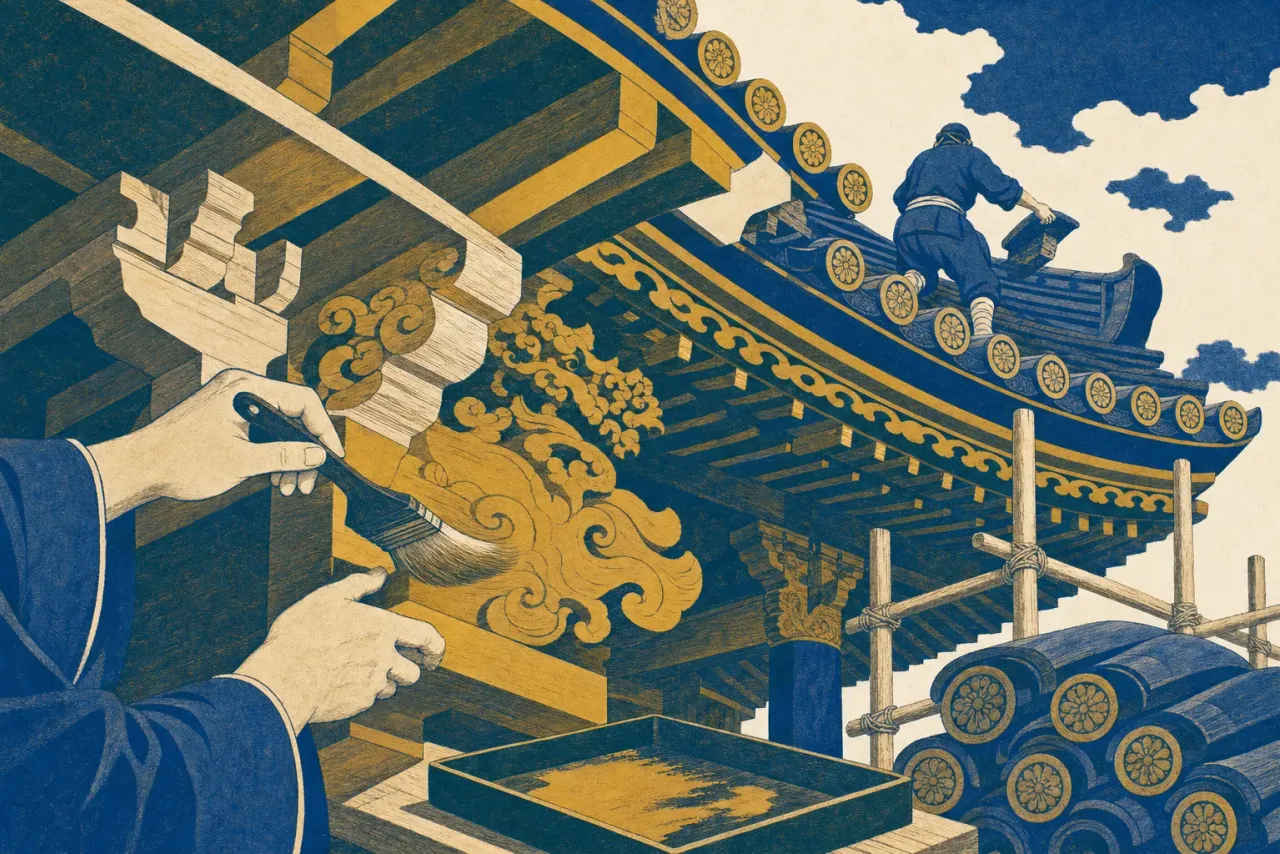
Beyond Shuri: driving the gusuku trail through Okinawa's lost kingdom
Shuri Castle has burned to the ground twice in living memory, once in the 1945 Battle of Okinawa and again in an electrical fire in 2019, and its centerpiece hall, the Seiden, does not reopen to the public until November 23, 2026. The vermillion palace in the photographs is a reconstruction of a reconstruction. Here is the detail most visitors miss: UNESCO never inscribed those buildings. What earned World Heritage status in 2000 was the stone underneath, plus eight other sites scattered across the length of Okinawa's main island. Several of them still have their original walls, laid by Ryukyuan masons roughly six centuries ago. Almost nobody goes.
The inscription is formally titled Gusuku Sites and Related Properties of the Kingdom of Ryukyu. Four of its nine components cluster within reach of Naha's monorail and city buses: Shuri itself, the royal mausoleum of Tamaudun, the Sonohyan-utaki stone gate, and the Shikinaen garden. The other five sit one to three hours out, served by buses infrequent enough that a rental car stops being a convenience and becomes the plan. Those five are the trip. They are where the kingdom actually survives.
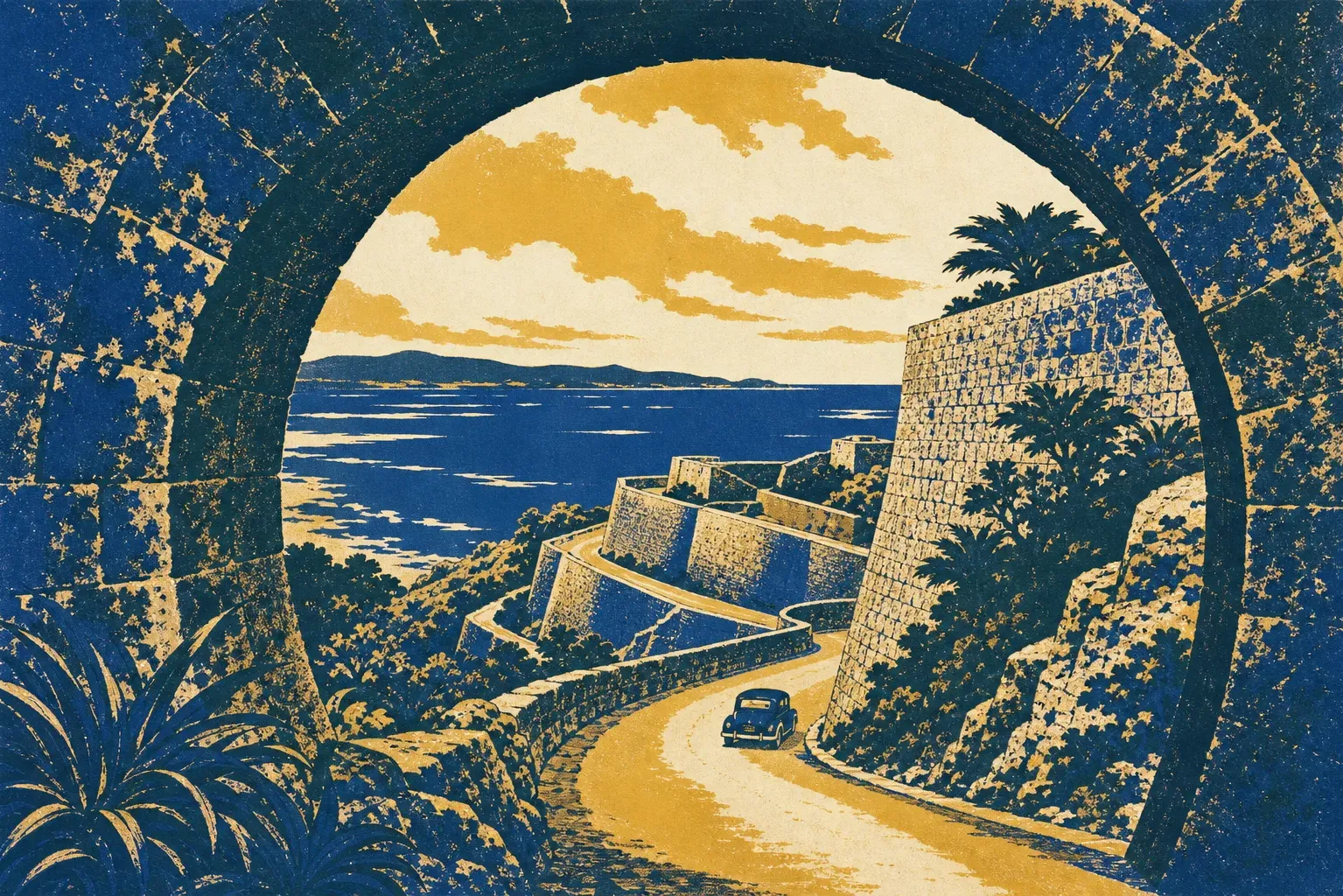
First, a word on what you're looking at. A gusuku is a Ryukyuan fortress, and its walls resemble nothing on the Japanese mainland. No keep, no white plaster tower. Limestone flows along ridgelines in long curves, swelling and tightening like something poured rather than stacked, pierced by arched gates. The kingdom that built them, independent from 1429 until Japan absorbed it in 1879, traded between China, Japan, and Southeast Asia, and its builders turned everything that came through the ports into an architecture that belongs to nowhere else.
The central three: one unhurried day
Base yourself in Chatan, the beach town around American Village midway up the west coast (the Vessel Hotel Campana and the Hilton Okinawa Chatan Resort are the dependable names), and the central trio arranges itself into a single relaxed day by car.
Start at Nakagusuku Castle, in the hills of Nakagusuku village. Its six enclosures hold the best-preserved original walls of any gusuku on the island; when Commodore Perry's expedition called at Okinawa, his crew climbed up and came away impressed by the masonry. Admission is 500 yen for adults as of 2026, 300 for junior high and high school students and 200 for elementary-age kids; groups of twenty or more pay 400 each. Hours are 8:30 to 17:00, extended to 18:00 from May through September, with the gates locking half an hour after the last admission. Give it ninety minutes, and wear real shoes. The paving is centuries old and treacherous after rain, and climbing the walls is forbidden here, as at every site on this list.
Katsuren Castle stands on a clifftop in Uruma, once the seat of Lord Amawari. Archaeologists digging here turned up Roman coins — hard evidence of how far Ryukyu's trade web stretched. Entry runs through the Amawari Park visitor complex at the base: 600 yen for adults, 300 for ages six to eighteen, free below that, with 148 free parking spaces and no closing days all year. Hours are 9:00 to 18:00, last admission 17:30.
Save Zakimi Castle in Yomitan for late afternoon, partly because the ruins are free to enter and partly because its arched gates, the work of the early-15th-century master builder Gosamaru, are the most graceful surviving examples of the form. The adjacent Yomitan museum charges separately. If the light is good, skip it and spend the time in the enclosures instead.
North to Nakijin, where Japan's cherry season begins
The northern site asks for an overnight. Nakijin Castle spreads its walls across a hillside on the Motobu Peninsula with the sea behind them, and it carries the oldest story of the nine: this was the capital of Hokuzan, the northern of the three principalities that fought over the island before unification in 1429, making it older than the kingdom itself.
Two numbers matter for planning. Admission rose to 1,000 yen for adults in September 2025, with junior high and high school students at 500 yen and elementary-age kids free. Hours are 8:00 to 18:00, extended to 19:00 from May through August, last entry 30 minutes before closing. Then one date: from late January into early February, the cherry trees at Nakijin bloom, the earliest in Japan, while the rest of the country is still in coats.
Motobu is also where Churaumi Aquarium sits, so the pairing is natural. Take a resort night near Emerald Beach (Hotel Orion Motobu Resort & Spa is the obvious pick), do the aquarium in the morning, and walk the castle in the softer afternoon light. Or reverse it and have the walls nearly to yourself at 8:00.
Sefa-utaki is not a ruin
The ninth component follows different rules, and it belongs to a Naha-based day rather than the driving loop proper. Sefa-utaki, on the Chinen Peninsula in Nanjo southeast of the capital, is the holiest sacred grove of the old kingdom, where the kikoe-ogimi, the royal high priestess, performed her rites. The path ends at a triangular passage formed by leaning rock, opening toward the sacred island of Kudaka offshore — though for much of 2026 that passage is the part you cannot reach, for reasons covered below. There are no ramparts to admire. What survives here is the religion itself; the indigenous nature worship of the Ryukyus never died, and people still come to pray at these altars.
Behave accordingly. Dress modestly and keep your voice low. Never touch the altars or the offerings left on them. Stay on the marked paths, and don't photograph anyone who is there to worship.
Admission is 300 yen through September 30, 2026 and 600 yen from October 1, when the children's rate also doubles to 300 yen. The grove is open 9:00 to 18:00 from March through October, 9:00 to 17:30 from November through February, with last entry 30 minutes before close.
Two things can close the gate on you, and both ambush trip planners. The first is construction. Maintenance work shuts the stretch between Sansharo and Yuinchi from July 1 to November 1, 2026, at the usual fee, and then from November 2, 2026 to January 5, 2027 everything beyond the Ujoguchi entrance is off-limits — the triangular passage included. During that second phase only the entrance area and the Kudaka-jima viewing point are open, and admission is free, which tells you how much of the visit is missing. The second is ritual: Sefa-utaki rests about six days a year on dates set by the lunar calendar, the first through third days of the fifth and tenth lunar months, which in 2026 fall around June 15 to 17 and November 9 to 11. It also closes December 29 through January 3. Check before you drive out; it is a long way to come for a locked gate.
As for when to do all of this, October and November are the sweet spot, with temperatures around 25 degrees Celsius and the summer crowds gone. Typhoon season runs from August into early October and can shutter every site on this list at a few hours' notice, so build slack into any late-summer plan. Winter works too, especially if you time Nakijin's blossoms.
And if your dates land after November 23, 2026, sequence the trip deliberately: originals first, palace last. Stand inside Nakagusuku's six-hundred-year-old enclosures, run your eyes along walls that shrugged off Perry's century and ours, then go see Shuri's fresh vermillion lacquer. The reconstruction stops reading as a substitute and becomes what it actually is, the newest work in a building tradition you have just watched hold its ground. The Seiden opens at the end of November 2026. The walls have been ready for six hundred years.