Why is Toshogu so gaudy? Reading the monkeys, the cat, and the politics of gold
When Tokugawa Ieyasu was enshrined at Nikko in 1617, the year after his death, the shrine that held him was by all accounts a modest one. It lasted about twenty years. Then his grandson Iemitsu, the third shogun, sent a workforce reported at 127,000 craftsmen up the mountain and rebuilt the complex into a gilded spectacle that looks like nothing else in Japanese religion.
That number is the real answer to the question every first-time visitor mutters in front of the Yomeimon Gate. You are not looking at a shrine in the usual sense. You are looking at a government proclamation issued in gold leaf and painted carving, and it was designed to be read.
A warlord becomes a god
Ieyasu ended more than a century of civil war and founded a shogunate that kept Japan at peace for roughly 260 years. Death did not retire him. He was deified as Tosho Daigongen, and in Toshogu's main shrine he is enshrined alongside Toyotomi Hideyoshi and Minamoto Yoritomo, the two other men with a serious claim to having unified Japan. The company you keep in the afterlife is a ranking. Installing Ieyasu among those two, as a god, was Iemitsu's declaration that Tokugawa rule was not a chapter of history but its conclusion.
The rebuild made the same argument in architecture. The style is called gongen-zukuri, and when UNESCO inscribed the Shrines and Temples of Nikko in 1999 (103 buildings across two shrines and a temple, under criteria i, iv, and vi), the citation noted that the style "reached the peak of its expression" here and went on to shape Japanese religious architecture afterward.
Older Shinto building runs to unpainted cypress and empty space. Toshogu inverts that deliberately. Austerity does not advertise a dynasty. Gold does.
Reading the carvings
Slow down at the sacred storehouses near the entrance, where the "imagined elephants" were carved by an artist working from written descriptions, having never seen the animal. You can tell. They are better for it.
Nearby hang the Three Wise Monkeys: see no evil, hear no evil, speak no evil. These panels draw the densest crowds in the complex, and by noon the crowd moves past them at a shuffle, which is a strong argument for being at the gate when it opens at 9:00.
Yomeimon itself has a fair claim to being the most ornate structure in Japan, and its Heisei-era restoration is finished, so you now see it clean and unscaffolded. Stand under it and pick one carving to follow rather than trying to take them all in.
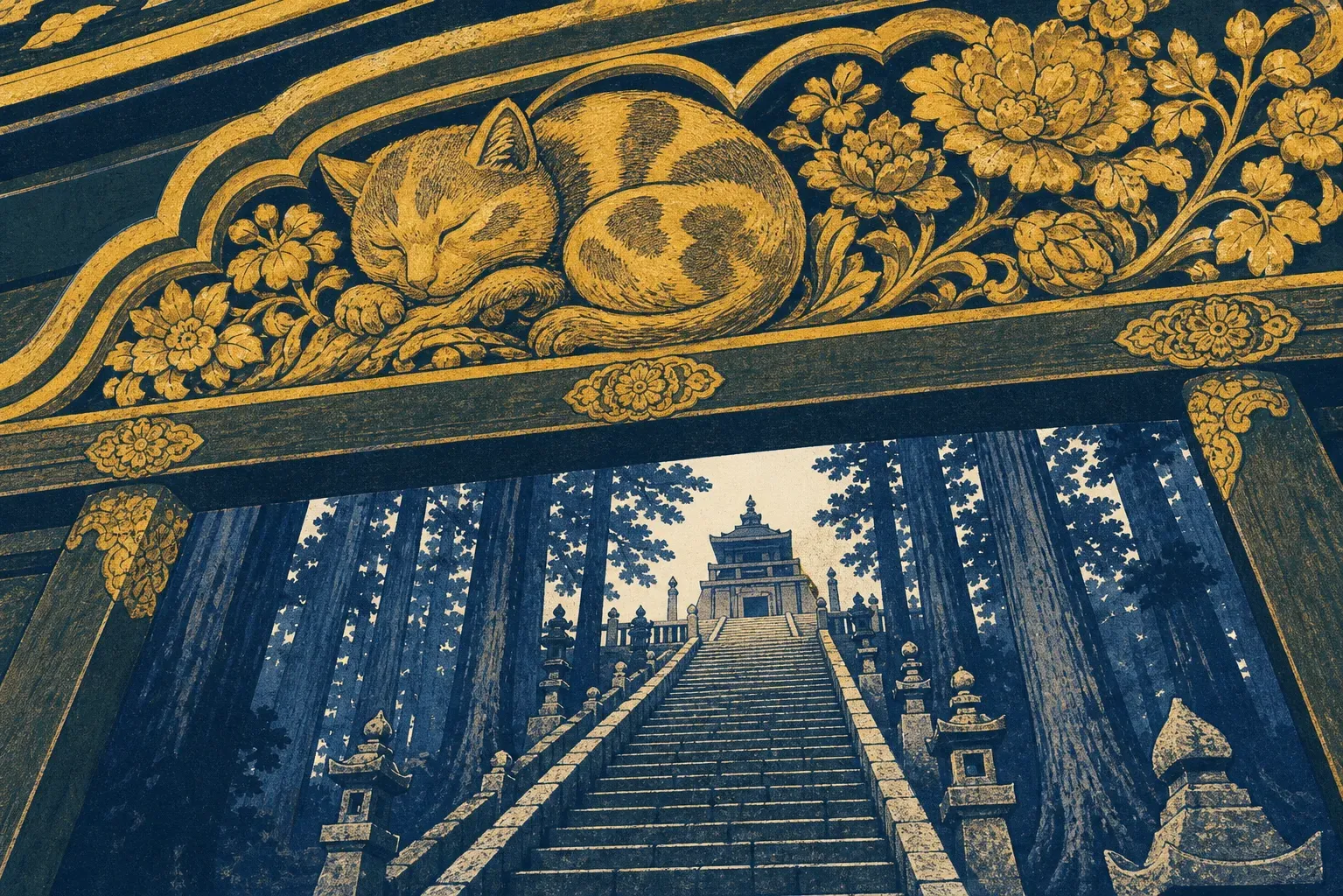
In Honjido Hall, a priest claps beneath the Crying Dragon painted on the ceiling to demonstrate how the room rings. Lines form here by 10:00, and shoes come off, as they also do at the Main Shrine, so wear slip-ons. Then, above the Sakashitamon Gate, crouches the Nemurineko, a sleeping cat small enough to miss at a stride. It guards the doorway to the path up to Ieyasu's tomb, which is where the whole complex changes character.
The silence at the top
Past the cat, 207 stone steps climb through the forest to Ieyasu's actual tomb. It is plain gray stone. After the gold below, the restraint lands hard, and it reads as intentional: the spectacle downhill was for the state's audience, the tomb for the man. The round trip takes about 30 minutes. Do it early in your visit, while your legs still agree with you, not as a tired afterthought.
Iemitsu understood the grammar he had created. His own mausoleum, Taiyuin, a short walk west and administratively part of Rinnoji Temple, was built humbler than Toshogu out of deference to his grandfather. Tour groups skip it, which is their loss and your gain. Taiyuin opens at 8:00, a full hour before Toshogu. Admission is 550 yen as of 2026 (900 yen combined with Rinnoji's Three Buddha Hall), and the circuit takes about 50 minutes in something close to solitude. See gongen-zukuri twice in one morning, first at a murmur and then at full volume, and the style stops being spectacle and starts being language.
None of this sanctity was a Tokugawa invention. Futarasan Shrine was founded in 782 by the monk Shodo Shonin and is dedicated to the deities of Nikko's three sacred mountains: Nantai, Nyoho, and Taro. The shoguns borrowed a mountain that had been holy for eight centuries already. Notice, too, that a Buddhist monk founded the Shinto shrine here and a Buddhist temple administers a shogun's mausoleum. That blend survived the Meiji government's forced separation of the two religions, and Nikko remains one of the clearest places in Japan to see it intact.
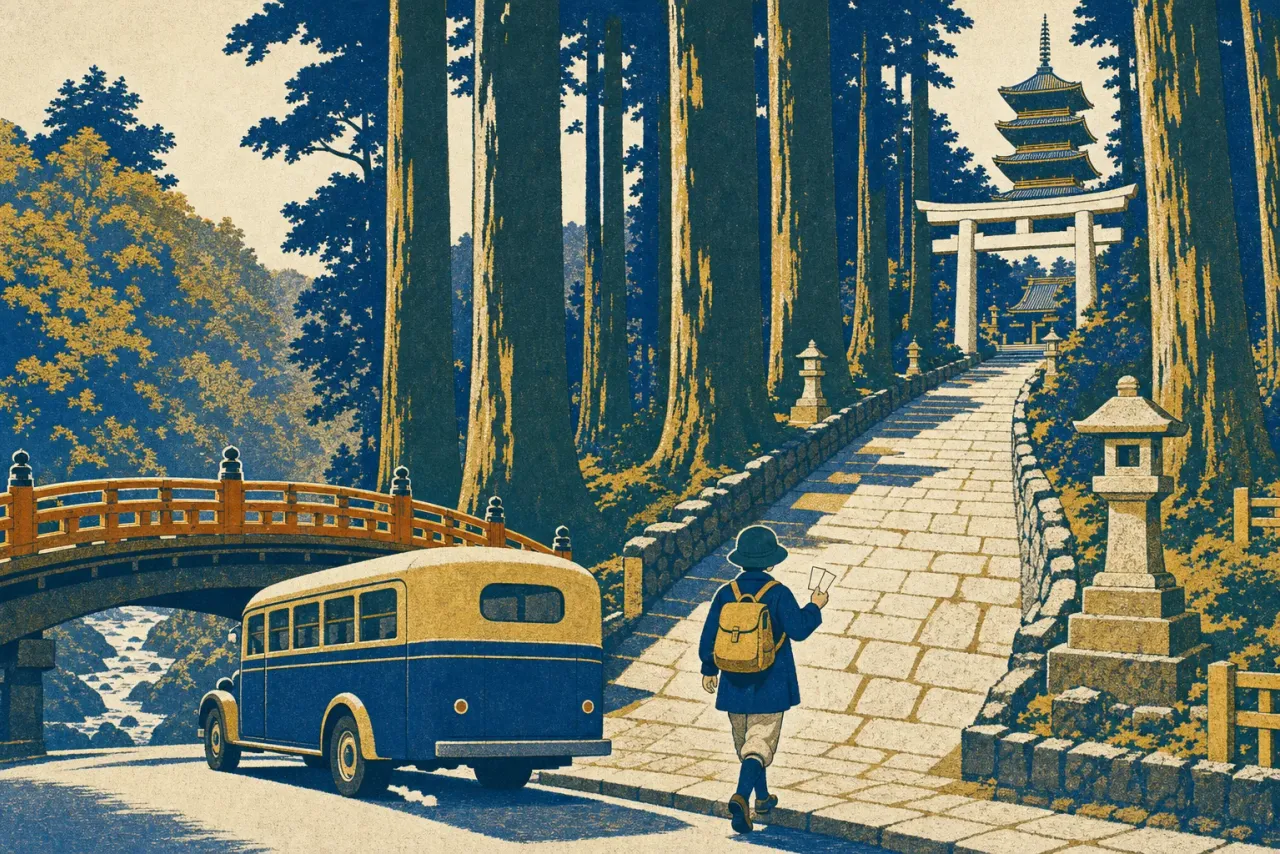
The mythic front door is the Shinkyo Bridge, 28 meters of vermilion lacquer arched over the Daiya River, where legend says two serpents formed a crossing so Shodo could reach the mountain. Walking it costs 300 yen as of 2026, cash only.
Cash, in fact, is the operating theme. Since March 31, 2026, Toshogu's on-site ticket machines take cash only (admission is 1,600 yen), and goshuin stamps are cash as well: 500 yen, or 1,000 yen for the limited Crying Dragon version, best collected as you pass each office instead of in a backtracking sweep at the exit. One last spending decision: the Treasury Museum (1,000 yen alone in 2026, 2,400 yen as a combo with admission) holds Ieyasu's armor and letters. Give it 30 minutes if you have them. Skip it without guilt if you don't.