The Only Le Corbusier in East Asia: How to Read a Building in 45 Minutes at Ueno
Most people who visit the National Museum of Western Art never actually look at it. They cross the forecourt reading their phones, queue for the Monets, and leave having stood inside the only Le Corbusier building in East Asia without registering a single thing he designed. Which is a strange way to treat a World Heritage Site whose inscription has nothing to do with the paintings.
That is the part that confuses first-timers: this museum is on the UNESCO list as architecture. In July 2016 it was inscribed as one of 17 Le Corbusier works across seven countries, listed together as a single property. Villa Savoye outside Paris is on that list. So is the chapel at Ronchamp and the capitol complex at Chandigarh. And so is this quiet concrete box in Ueno Park, the only representative work by the architect anywhere in the Far East. The criteria cited, (i), (ii) and (vi), boil down to a work of creative genius that carried the Modern Movement's ideas across the world. Japan sweated for the inscription: the first nomination went in back in 2007, was sent back for more work in 2009, drew a "do not inscribe" recommendation in 2011 that was later softened to deferral, and finally passed on July 17, 2016.
None of this requires you to know anything about architecture. It requires roughly 45 minutes and a willingness to walk more slowly than you normally would. Taken in the right order, the building explains itself.
Why France sent an architect with the paintings
The museum exists because a collection got stuck. Kojiro Matsukata, a shipping magnate, bought European art on a huge scale in the years around 1920, and the portion he kept in France was sequestered as enemy property after the Second World War. France agreed to return the works, 370 of them at the museum's opening, on one explicit condition: a French architect would design the building that housed them. Le Corbusier took the commission. The museum that opened on June 10, 1959 is therefore not just a gallery. It is a physical handshake, the built record of Japan and France resuming relations after the war.
Le Corbusier visited Tokyo only briefly and supplied the basic design. The working drawings and the construction site fell to three Japanese architects who had trained in his Paris atelier: Junzo Sakakura, Kunio Maekawa and Takamasa Yoshizaka. Hold on to Maekawa's name. He returns at the end of this story.
The walk: forecourt, pilotis, hall, ramp
Begin outside the ticket gate, because the best free exhibit in Ueno is the museum's own front yard. A renovation completed in 2022 restored the forecourt to Le Corbusier's original conception, with the Rodin bronzes returned to their intended positions and decades of accumulated planting stripped back to almost nothing. This is the closest thing to seeing 1959 as designed, it costs nothing, and it stays open when the museum does not. Even on a closed Monday you can stand here with The Thinker and the whole facade to yourself.
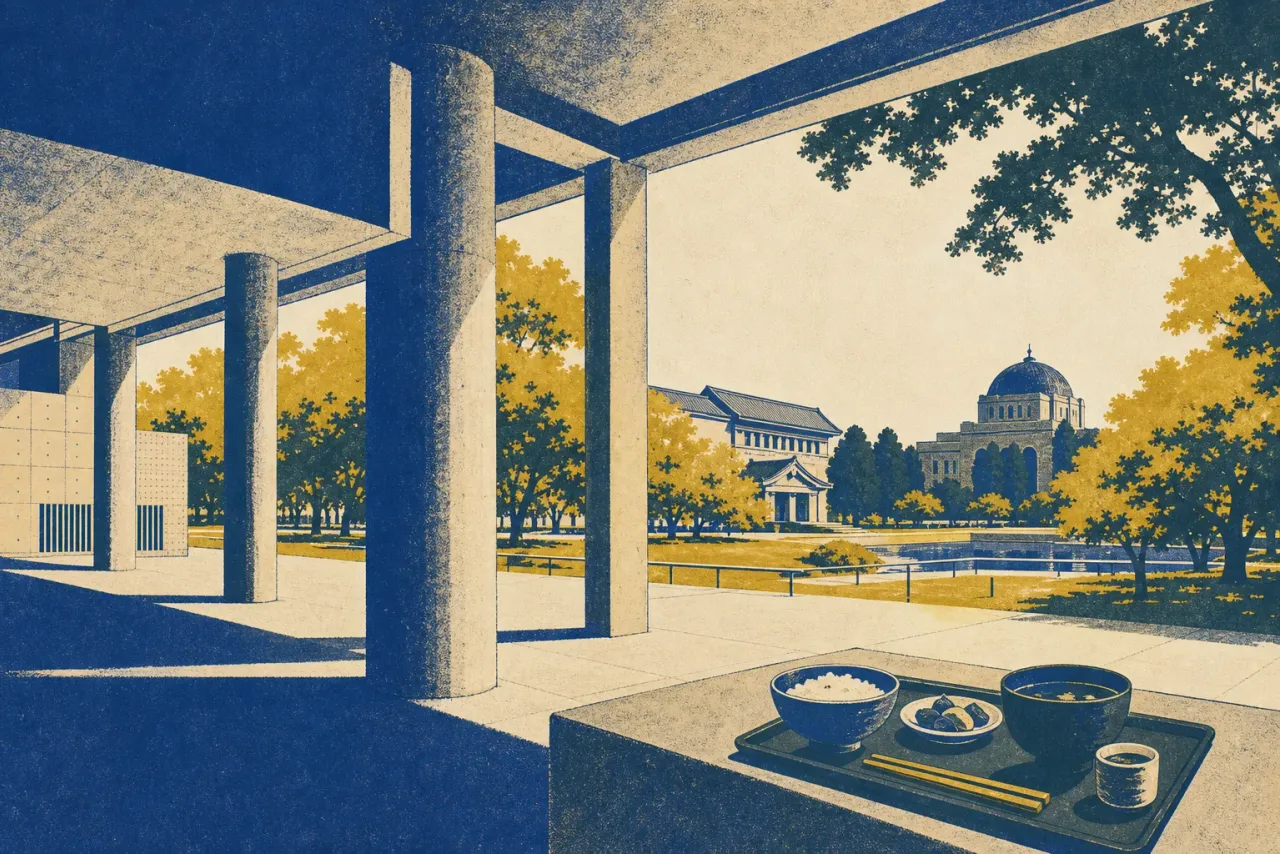
Now look at what the building is doing. The gallery box does not sit on the ground; it floats above it on exposed round concrete columns, the pilotis, seven per side. Count them. Lifting the mass frees the ground level into open, shaded space you can walk under, and it is the first of Le Corbusier's signature moves you will encounter. The facts underneath the effect are plain: reinforced concrete, three floors plus a basement, 4,399 square meters, an Important Cultural Property in Japan since 2007.
The plan is the second move, and worth grasping before you enter. Le Corbusier called the concept the Museum of Unlimited Growth: a square ring of galleries spiraling around a top-lit central hall, engineered so new galleries could be added outward, coil by coil, forever, as the collection grew. He chased the idea most of his life. Tokyo is one of only a handful of places where it was ever actually built.
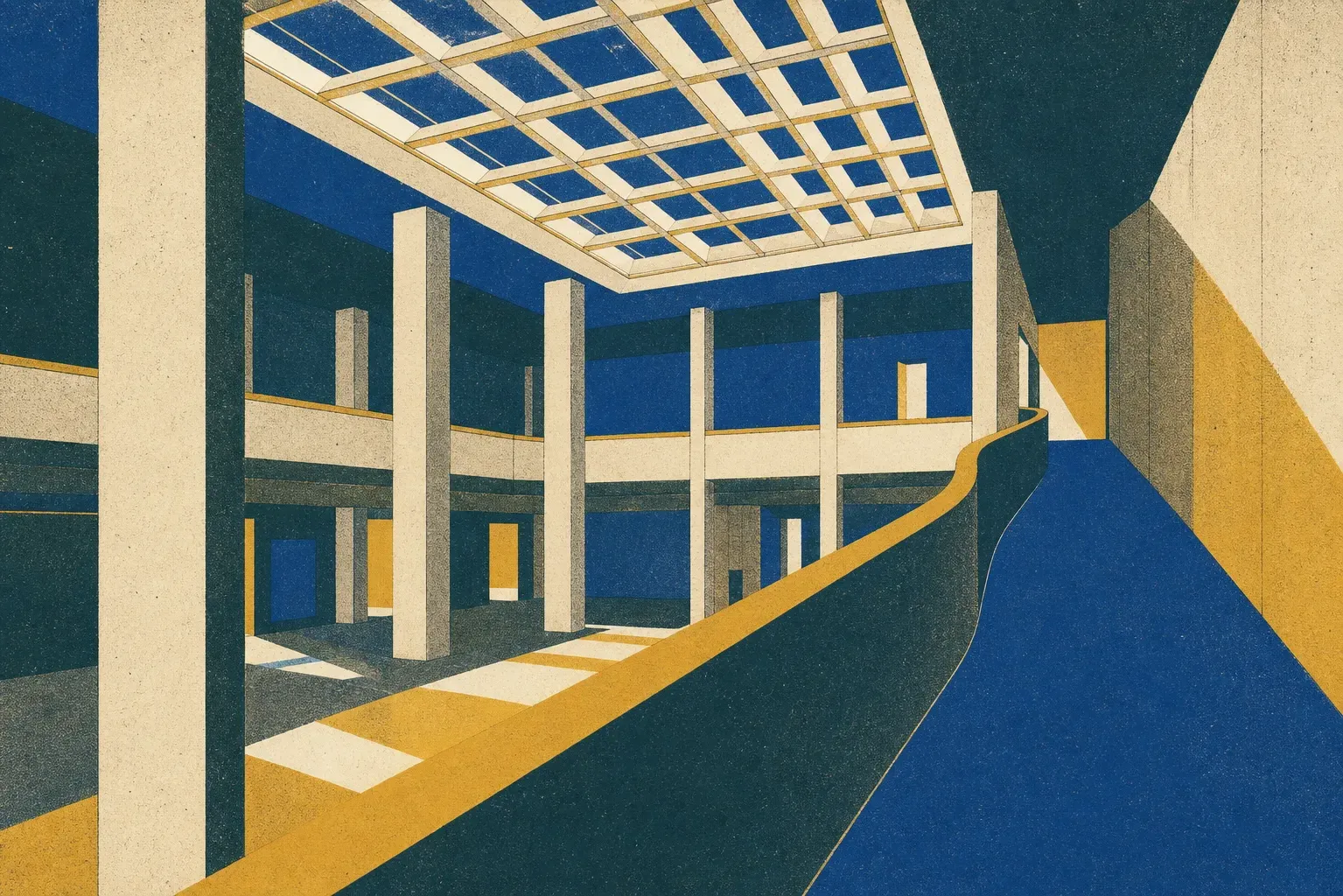
Inside, buy your ticket, 500 yen for adults as of 2026 and free if you are under 18 or 65 and over, and walk into the 19th Century Hall. This is the center of the spiral: a double-height space under a skylight, with sculpture holding the floor. Stand in the middle rather than at the edge. Every route in the building begins and ends here, which is exactly the point.
Then comes the third move, the one most people waste. You do not climb a staircase to the galleries. You walk a ramp, a long slope lined with sculpture, rising gently along the hall. Le Corbusier called this the promenade architecturale: the idea that a building should be experienced as a sequence unfolding as you move, the way music unfolds in time. Stop halfway up. Look back down into the hall and notice how the space recomposes itself with every few steps. The ramp is the single most important thing in the building, and walking it slowly is the whole reason to come.
Upstairs, the ring galleries run on proportions from Le Corbusier's Modulor, his measurement system scaled to the human body. Look up and you will spot one honest compromise: the four light troughs that originally pulled natural light into the galleries are now artificially lit, because conservation standards for paintings won the argument with 1959. The museum does not hide this, and you should not hold it against them.
One more thing you cannot see at all. In 1998 the building received Japan's first full-scale base-isolation seismic retrofit, the entire structure including the basement cut free of the ground and set on isolators, so that in an earthquake the earth moves and the Le Corbusier, with its Monets, largely does not. The most radical intervention in the building's history is invisible, which is roughly how conservation is supposed to work.
Master, disciple, and when to go
Do not leave without the New Wing, connected at the back. Kunio Maekawa, one of the three atelier students who built the Main Building, designed it himself in 1979 for the museum's 20th anniversary. Walking from the 1959 building into the 1979 one, you are reading a conversation between master and disciple, held in concrete, twenty years apart. No other museum in Tokyo offers that.
The logistics are gentle. Ueno Station is about 8 minutes from Tokyo Station on the Yamanote Line; take the Park Exit and the museum is one minute into the park. Hours are 9:30 to 17:30, with last admission 30 minutes before closing, and Fridays and Saturdays run until 20:00. Mondays the museum closes, along with nearly everything else in Ueno Park, so do not spend a Monday here. CAFÉ Suiren inside covers coffee without leaving the building. One warning for planners: the permanent-collection galleries close for maintenance from January 12 to March 19, 2027.
Whatever the calendar says, though, the exterior never closes. The pilotis, the facade and the restored forecourt sit outside the ticket gate, free, every day of the year. If your Tokyo schedule collapses and all you have is ten minutes on a Monday, go anyway. Stand under the columns and look up at the box floating over your head; that is more of Le Corbusier than most paying visitors ever see.