The mountain at ground level: seeing Fujisan's World Heritage without climbing it
The most reproduced photograph of Mount Fuji is not a photograph of the World Heritage site. That shot with the five-story pagoda in the foreground and the snow cone floating behind it is taken from Chureito, a war memorial built in 1963 on a hillside above Fujiyoshida. It is not one of the listing's 25 components. It postdates the pilgrimage culture UNESCO honored by three centuries, and the residential neighborhood below it now keeps a running record of what the photo line brings: noise, litter, cars parked where they shouldn't be, tourists cutting through private yards. Climb the roughly 400 steps if you like. The view is real and it costs nothing. Just know that the actual heritage site is down in the town behind you, and almost nobody in the queue will visit it.
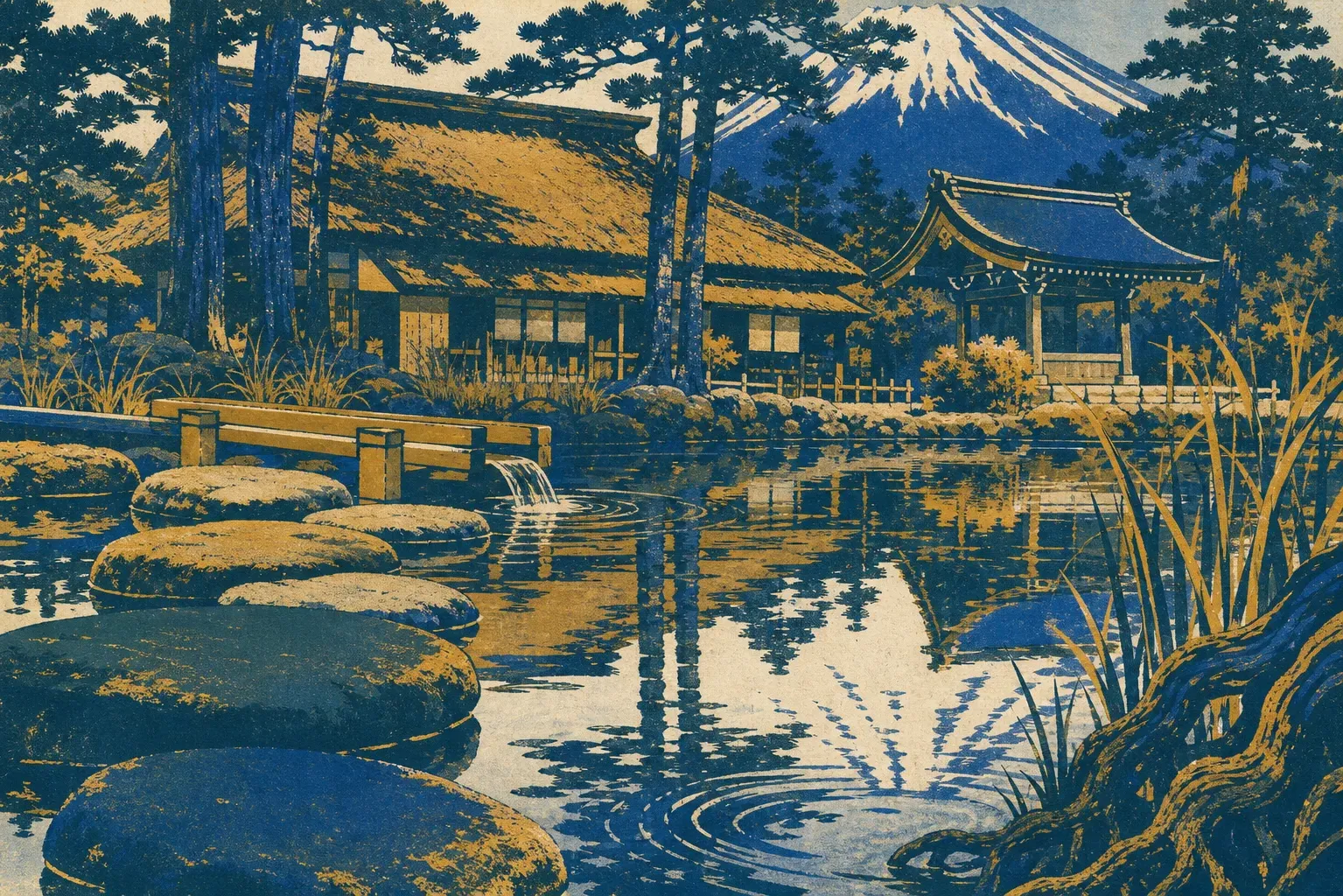
What UNESCO inscribed in 2013 is "Fujisan, sacred place and source of artistic inspiration," under cultural criteria (iii) and (vi). Not natural criteria. The committee did not list a volcano; it listed a religion and an art history. The value, in the official language, lies in ritual ascents to the summit and circuits walked around the crater, organized from the seventeenth century by Edo's Fuji-ko societies into something like package pilgrimage, plus the Hokusai and Hiroshige prints that pushed the mountain's image into Western art. The property covers 20,702.1 hectares in 25 parts, and the mountain area itself is a single component of 19,311.9 hectares. Everything else is small and sits at ground level: trailhead shrines, two pilgrim inns, spring ponds, lava caves shaped like the trees they engulfed, one pine grove across a bay. Oshino Hakkai alone counts as eight separate components, one per pond, IDs 1418-013 through 1418-020.
So the honest answer to "I'm not climbing in July, what is there to see?" is: most of the site. Nearly all of it is open in February, when the mountain is easier to see anyway.
The north side: a pilgrim town in half a day
Start in Fujiyoshida rather than Kawaguchiko. The Fuji Excursion limited express runs four round trips a day from Shinjuku (4,200 yen to Kawaguchiko as of 2026; seats open at 10:00 exactly one month ahead, and they go), and Fujisan Station is two stops before the terminus. In front of the station a dead-straight street aims directly at the summit. Five minutes up it stands the Former Togawa Residence, an inn built in 1768 for the oshi trade. An oshi household was innkeeper, priest and mountain guide at once: Fuji-ko members arrived from Edo, slept and purified themselves here, and were led up the mountain. The building runs 40 meters back from a narrow street frontage, tatami room after tatami room, ending at an internal shrine, with pilgrim clothing and gear on display. It stayed in business until 1962. That date is worth sitting with; this was a working pilgrim inn within living memory. Admission is 100 yen as of 2026, or 400 yen combined with the Fujisan Museum. Both run 09:30 to 17:00, last entry 16:30, and close Tuesdays — though the museum drops that closure entirely through July and August, and when a Tuesday is a national holiday it opens and takes the Wednesday off instead.
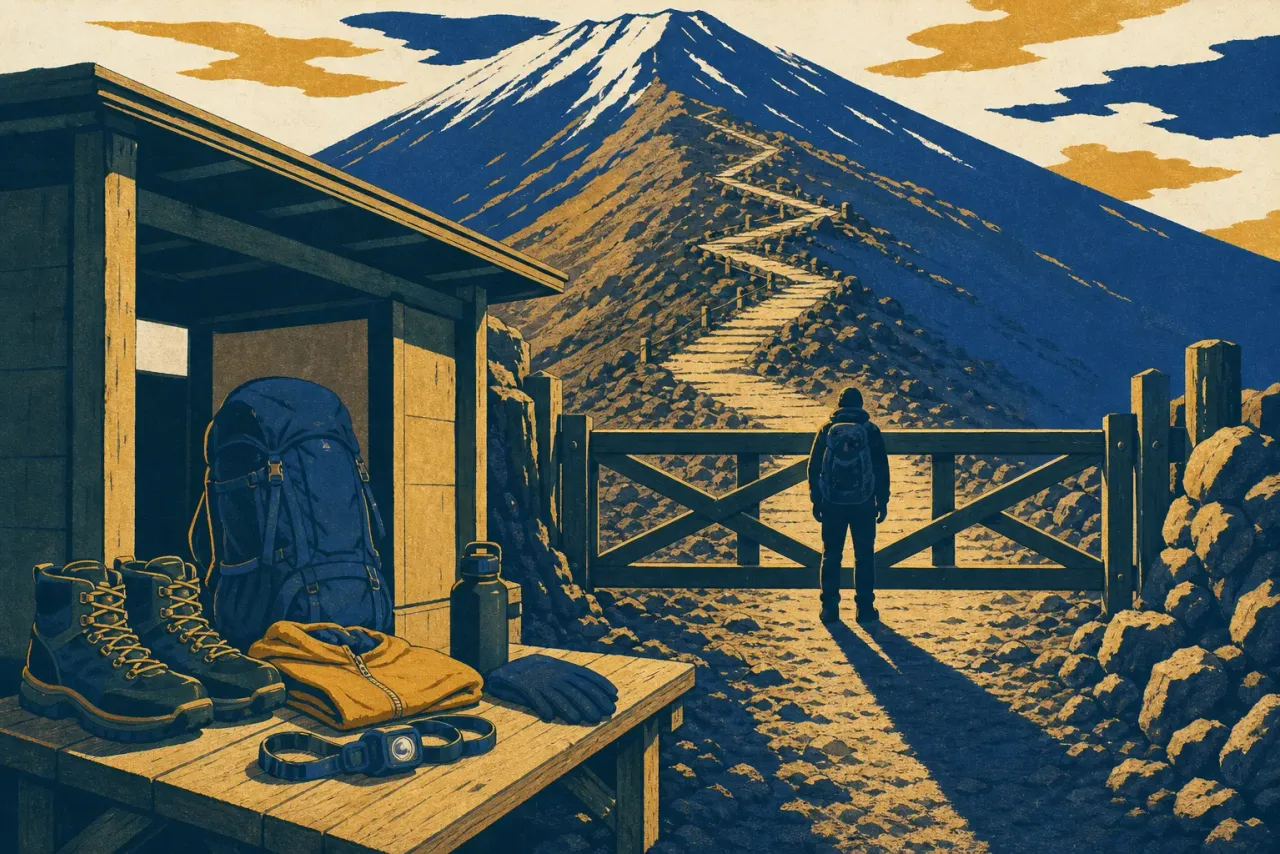
From there, continue to Kitaguchi Hongu Fuji Sengen-jinja, about 30 minutes on foot from Fujisan Station, with hourly buses from Kawaguchiko. The approach passes under tall cedars between rows of stone lanterns to a red-painted main hall built in 1615. Entry is free and the grounds never close. The important part is easy to miss: walk behind the main hall to a plain wooden torii. Through it runs the original Yoshida trail, the path every north-side ascent used before the toll road moved the starting line up to the 5th station. Traditionalist climbers still pray here first and pass through that gate. Stand under it and the whole inscription snaps into focus. A trailhead is a threshold, not a parking lot.
Lunch is Yoshida no udon, the town's own dish: noodles firm to the point of defiance, a soy-miso broth, horse meat and cabbage on top. More than 50 shops serve it at around 500 yen a bowl as of 2026, a genuine bargain this close to a resort area.
Afternoon, take the bus toward Gotemba (roughly hourly from Kawaguchiko Station) to Oshino Hakkai, where snowmelt surfaces after filtering for more than 80 years through the volcano's lava layers. The ponds were purification sites where pilgrims washed before the climb; one designated spring still lets you drink at the source. The water is absurdly clear. The village is also genuinely crowded, so go early or adjust expectations.
Finish at the Fujisan World Heritage Center at the foot of the Subaru Line in Fujikawaguchiko, which is free and better than free things usually are: a 15-meter-wide model of the mountain made of washi paper, AR handsets lent at no charge, and a practical climbing-information desk in the North Hall. Hours run 08:30 to 18:00 in July and August; the South Hall closes the fourth Tuesday of each month.
The south side: the shrine that owns the summit
Shizuoka's half of the story slots neatly into a Tokyo-to-Kyoto Shinkansen trip via Shin-Fuji or Mishima. Fujinomiya grew up as a temple town around Fujisan Hongu Sengen Taisha, head shrine of roughly 1,300 Sengen shrines nationwide, and this shrine is no museum piece: it owns the mountain above the 8th station, summit sanctuary included. Every climber who stands at the crater is standing on its land. Grounds open 05:00 to 20:00 from April through September; drones and hang gliders are banned outright to protect the precinct. Inside, the spring pond Wakutama-ike is where climbers historically performed ablutions before starting up the mountain. On August 1 the shrine holds the Sacred Fire Festival, and the next evening about 1,200 dancers fill the streets for the Miya Odori.
Next door, the Mt. Fuji World Heritage Centre makes the ascent for you — a sloped ramp called "the Worshipped Mountain" spirals through five floors of exhibits to an observation hall aimed at the cone. It stays open to 18:00 in July and August and closes the third Tuesday of the month. Admission is 500 yen for adults as of 2026; visitors under 15, those 70 and over, and enrolled students through university get in free with ID. Eat Fujinomiya yakisoba while you're in town: firm steamed noodles, crisp pork-fat cracklings called niku-kasu, and powdered dried sardine over the top, a formula defended by a local "yakisoba academy" whose stated mission is to carry the dish 100 years forward.
Then the strange, essential coda. Miho no Matsubara is a pine grove on a sandspit in Shizuoka City, 45 kilometers from the crater, and in April 2013 ICOMOS recommended cutting it from the nomination for being too far away. The World Heritage Committee overruled its advisors that June and inscribed all 25 components. The committee was right. This grove holds the Hagoromo legend, the celestial feather-robe story behind centuries of painting and Noh drama, and its view across Suruga Bay is the frame through which Japan learned to look at the mountain — the thing criterion (vi) is actually about. The Miho Shirube center explains why the pines survive only through constant human tending. From JR Shizuoka it's 13 minutes to Shimizu, a 25-minute bus toward Miho, then a 15-minute walk.
Two scheduling notes, because this region closes in shifts. Tuesdays are the trap: the Fujisan Museum and Togawa Residence close on Tuesdays, the Shizuoka centre the third, the Yamanashi South Hall the fourth. The reprieve is that the museum runs seven days a week through July and August, and moves its closure to Wednesday whenever the Tuesday is a national holiday. And the mountain keeps hours of its own. Clouds build through every day, summer haze is the worst of the year, and at Kawaguchiko your best odds of seeing the cone come before 09:00. Sengen Taisha opens its gates at five in the morning all summer. Take the hint.
Sources
- https://whc.unesco.org/en/list/1418/
- https://www.japan.travel/en/destinations/tokai/shizuoka/mt-fuji-area/
- https://www.japan.travel/en/fuji-guide/mt-fuji-climbing-guide/
- https://e.fujikyu-railway.jp/fujikaiyuu/
- https://www.jrailpass.com/blog/fuji-excursion-train
- https://www.fy-museum.jp/info/15
- https://www.fujikyu-railway.jp/station/