Permits, gates and a 14:00 curfew: climbing Mount Fuji under the 2026 rules
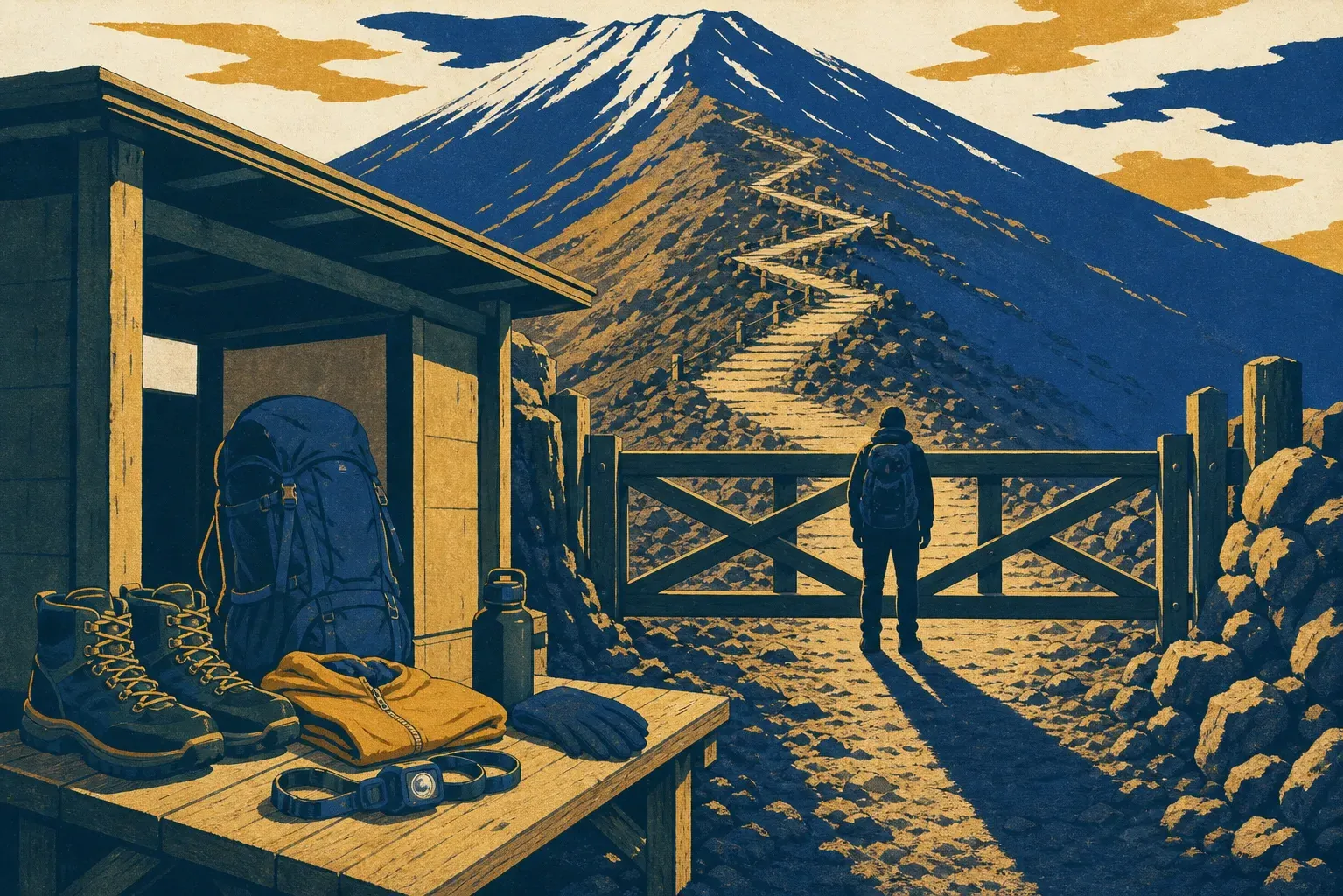
The cheapest way up Mount Fuji used to be no plan at all. You boarded a night bus in Shinjuku after work, dozed until the Fuji Subaru Line 5th Station, started walking around midnight, watched sunrise from the crater rim, and came down wrecked but triumphant. Climbers called it the bullet climb. The 2026 rules are built to end it: all four trailheads now close their gates from 14:00 to 03:00, and the only people allowed through during those hours are climbers holding a reservation at a mountain hut.
That is one of several rules that can now stop your climb at the gate itself, paid bus ticket in hand. None of them are hard to satisfy. Every one of them has to be satisfied in advance, which is the part that catches people out.
Two systems, one fee, one hard cap
Every climber on every trail pays 4,000 yen (as of 2026), and there is no cash box at the trailhead. Registration and payment happen in advance, and they run through two separate systems depending on which prefecture your trail starts in. The Yoshida Trail, on the Yamanashi side, books through the asoview ticketing platform. The systems do not talk to each other. Register on the wrong one and you have paid to climb a different side of the mountain.
The three Shizuoka trails — Fujinomiya, Gotemba, Subashiri — are not a booking form at all, and this is where foreign climbers most often come unstuck. Shizuoka runs its process inside the prefecture's own smartphone app, Shizuoka FUJI NAVI, and it has three steps in order. First, complete the mandatory e-learning module on mountain rules and safety. Second, pass the Fuji-san test that follows it; every question has to be right, and there is no partial credit. Third, pay the 4,000 yen. Only then does the app issue the QR code that is your entry permit, and only that QR gets you past the trailhead staff. Budget an evening for it rather than ten minutes in a departure lounge. The same rules apply on this side as on Yamanashi's: entry between 14:00 and 03:00 requires a mountain-hut booking.
Season dates split differently, and not along the prefectural line. Yoshida and Subashiri run from July 1 to September 10 in 2026. The Fujinomiya and Gotemba trails, along with the walk around the summit crater rim, open later, on July 10, and close on the same September date. Outside those windows the trails are not merely quiet. They are closed and unstaffed, the huts shuttered.
Yoshida adds one more constraint: a cap of 4,000 climbers per day. In fairness, the cap went unfilled on every single day of 2024 and 2025. It is enforced all the same, and booking a specific date early still beats gambling that an August weekend stays under it, because your hut bed will sell out long before the trail does.
Then there is the equipment rule, new for 2026 on the Yoshida Trail. At registration you pledge that you are carrying three things: trekking shoes, cold-weather clothing and rainwear separate from it. Staff at the gate may refuse passage to anyone plainly under-equipped, so sneakers and a convenience-store poncho are a bet against your own 4,000 yen. The rule reads as bureaucratic overreach until you learn that the summit averages 5 to 8 degrees Celsius in midsummer, and that afternoon thunderstorms up there are a routine feature of the weather, not bad luck.
The trail math
Four trails, four different climbs. The numbers do most of the deciding for you.
Yoshida is the default, and for sound reasons. It starts at 2,305 meters, runs 6.8 kilometers to the summit, and takes roughly six hours up and four down. More than a dozen huts line it between the 7th and 8th stations, more than any other route has, which matters both for booking a bed and for bailing out gracefully. Access is the simplest in Japan: direct buses run from Shinjuku to the Fuji Subaru Line 5th Station for 4,800 yen one way (2026), about two and a half hours, with four to six departures daily in season.
Fujinomiya is the shortest and the steepest. It begins at 2,400 meters, the highest trailhead of the four, with just 4.3 kilometers of trail and about five hours of ascent. Its 5th station is also the last place to buy water, oxygen and other supplies at anything close to normal prices. Note that private cars are banned from the access road during the climbing season; you come up by bus from Shin-Fuji (about two hours, 2,740 yen) or Mishima (about 90 minutes, 3,500 yen), both on the Tokaido Shinkansen. If you have half an hour to spare, a side trail from the 6th station reaches Hoeizan, the raw side crater blown out in the eruption of 1707-08.
Subashiri splits the difference: a 2,000-meter start, 6.9 kilometers, about seven hours up. Gotemba is the outlier. It starts way down at 1,440 meters and grinds through 10.5 kilometers and roughly nine hours of ascent, with only about four huts near the 7th and 8th stations. Unless you already know why you want the Gotemba Trail, you don't want the Gotemba Trail.
Sleep partway up, or don't bother
A hut booking is the linchpin of the whole 2026 system, for two reasons. It is your pass through the gate after 14:00. It is also the best defense against the thing that stops climbers more reliably than fitness, which is altitude.
Expect to pay 13,000 to 15,000 yen per person with two meals included (2026 prices). Calibrate before arrival: the huts have no running water, the toilets are not connected to plumbing, and toilet use costs extra. You are paying for a futon slot at high altitude where every liter of water was hauled up the mountain. Beds sell out from late July through late August, so treat the hut reservation and the trail registration as a pair, and pick your date around the hut's availability rather than the other way around.
Altitude sickness is widespread on Fuji, and it ignores how fit you are. The counter-measures are unglamorous. Climb slowly. Drink at least two liters of water. Sleep a few hours at a hut on the way up instead of pushing through the night. The classic pattern — reach the trailhead by early afternoon, walk to a hut, sleep until the small hours, summit for sunrise — exists because it works, and the gate curfew now more or less enforces it.
Before you commit to a bus ticket, spend five minutes on fujisan-climb.jp, the official climbing portal. It carries live camera feeds from the mountain and multilingual safety videos, plus the current volcanic advisory status (nothing posted as of early August 2026). Trust the cameras over your itinerary. If the feed shows sideways rain at noon, everyone in that frame did their paperwork perfectly. The weather has not read the rules.
Sources
- https://whc.unesco.org/en/list/1418/
- https://www.japan.travel/en/destinations/tokai/shizuoka/mt-fuji-area/
- https://www.japan.travel/en/fuji-guide/mt-fuji-climbing-guide/
- https://e.fujikyu-railway.jp/fujikaiyuu/
- https://www.jrailpass.com/blog/fuji-excursion-train
- https://www.fujisan-climb.jp/en/shizuoka-notice/
- https://www.fujisan-climb.jp/en/yamanashi-notice/