The six chestnut posts: a half-day at Sannai Maruyama from Tokyo
In 1992, construction crews on the southwestern edge of Aomori City began preparing ground for a prefectural baseball stadium and dug straight into a village more than four thousand years old. Post holes appeared. Then graves. Then pottery in quantities nobody had budgeted for. The prefecture did something governments almost never do: it canceled the stadium and kept the village.
That village is Sannai Maruyama, occupied from roughly 3900 to 2200 BCE, designated a Special Historic Site in 2000 and inscribed in July 2021 as the flagship of the Jomon Prehistoric Sites in Northern Japan, a 17-part World Heritage property scattered across four prefectures. The UNESCO criteria, (iii) and (v), translate to something genuinely odd: the people here never farmed grain and never kept livestock, yet this village held its ground for some seventeen centuries, raising monumental timber structures and trading jade over hundreds of kilometers. The textbook sequence says agriculture first, then settled life. This place says otherwise.
It is also the only one of the 17 components you can plausibly see as a day trip from Tokyo. Here is the honest math, and what you are actually looking at once you arrive.
The morning math
The Hayabusa covers Tokyo to Shin-Aomori in about three hours. Board one around 7 a.m. and you step off before 10:30 with the whole middle of the day in hand. At Shin-Aomori, walk out the East Exit to bus stop no. 3 and take the Nebutan-go shuttle: ¥300 for adults, ¥150 for children, or ¥800 for a one-day pass, roughly 15 minutes to the site entrance. Pay the driver in cash; IC cards are not accepted. A taxi does it in 10. One warning that saves real grief: Shin-Aomori, the Shinkansen station, and Aomori, the city-center station, are two different places about six minutes apart by local train. The shuttle you want leaves from Shin-Aomori.
Admission is ¥500 for adults as of 2026, ¥250 for university students, free for anyone of high school age or younger. A surprising number of English-language pages, including the official Jomon portal, still print the old ¥410 rate; the operator's own site is the one that matches the till. The grounds and the attached Sanmaru Museum open at 9:00 and close at 17:00, stretching to 18:00 from June 1 through September 30 and during Golden Week. Closed days are few but unforgiving: the fourth Monday of every month (the following day if that Monday is a public holiday) and December 30 through January 1. Check the calendar before you buy the train ticket, not after.
At the entrance, ask about the volunteer guides. They are free, run about 50 minutes, and can be arranged ahead of time by email at [email protected]. If no guide is on hand, borrow one of the tablets, which work in six languages. Budget two to three hours for the whole visit. Travelers who allot 45 minutes leave annoyed at themselves.
Six holes in the ground
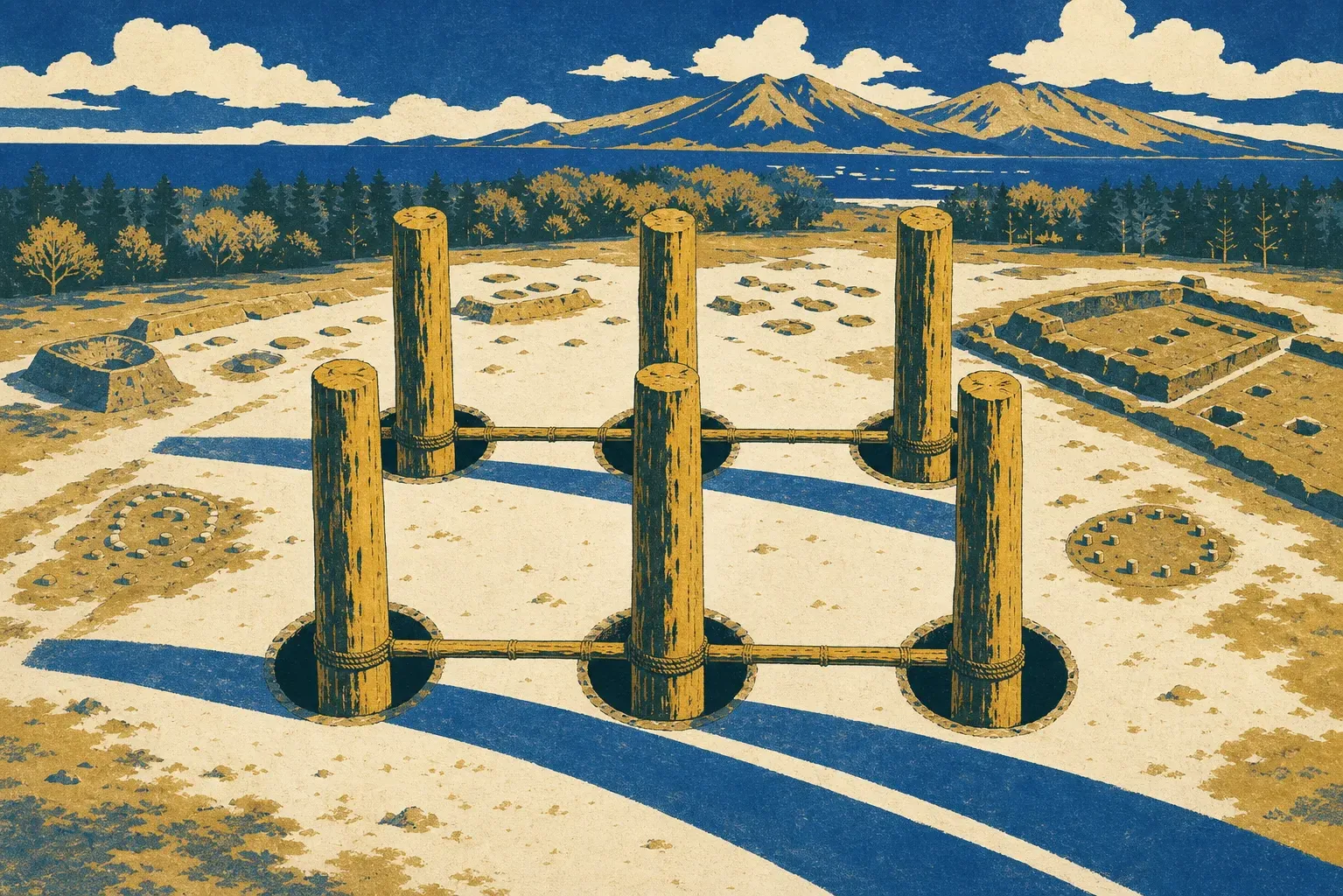
Everything at Sannai Maruyama radiates out from one structure, and the structure is really six holes. Each pit is about two meters across and two meters deep, and they sit 4.2 meters apart with a regularity that reads as engineering, not habit. Each once held a chestnut post roughly one meter in diameter. Sit with that for a second: a chestnut trunk a meter thick, felled and hauled and stood upright, six times, by people without metal.
The tower of heavy timbers standing over the pits today is a reconstruction, and an honest guide will tell you that everything above ground level is inference. Nobody knows how tall the original stood or what, if anything, it carried on top. The holes and their spacing are the facts; the rest is careful guesswork, which is part of why standing under it feels less like visiting a monument and more like being handed a question.
A short walk away sits the other giant: a pit dwelling 32 meters long and 10 meters wide, read as a communal hall or a shared longhouse. As of summer 2026 part of its interior is closed off for maintenance work, but the scale registers fine from the doorway.
Then the graves. Adults were buried in two facing rows flanking a path running east from the village, so that anyone walking in or out passed between the dead. Children were buried separately, placed inside pottery jars. The signage does not dramatize this. It doesn't need to.
Notice the chestnut trees, too. Analysis at the site shows the villagers were not simply gathering nuts; they were managing chestnut stands, practicing a kind of arboriculture without ever taking the further step to grain. "Hunter-gatherer" undersells them. They were orchard keepers who buried their dead along an avenue.
What the museum adds
The Sanmaru Museum, included in your ¥500, holds the small things, and the small things are the site's other claim to fame. More than 2,000 clay figurines have been recovered here, the largest count from any single site in Japan. Many artifacts came out of an artificial mound on the grounds where pottery, stone tools, jade, and miniature vessels were deposited in layers over generations — ritual accumulation, not a trash heap. The jade and the obsidian both came from far away, which means these supposedly simple foragers were nodes in an exchange network spanning hundreds of kilometers.
My advice on sequencing: do the grounds first with a guide while your legs are fresh and the tour slots are open, then the museum. If your day collapses and you have only an hour, spend it outside and skip the museum entirely; this site makes its argument in the open air. Through October 12, 2026, a special exhibition called "Northern Jomon and Asia" is running for a separate fee, worth a look only if your schedule is loose.
One caution for summer visitors: the grounds are big, flat, and nearly shadeless. Bring water and a hat in July and August. Winter is the opposite problem; Aomori is among the snowiest cities on earth, and while the site stays open outside its fixed closure days, the walk between structures turns serious.
A final rule catches more visitors than the fourth-Monday closure does: no eating and no smoking anywhere on the grounds except one designated picnic area. The ekiben you bought at Tokyo Station should be finished on the train, somewhere around Morioka. There is a restaurant by the visitor center, open 11:00 to 15:30 year-round with last orders at 15:00 and closed on the site's own closed days, so nobody starves.
And if you come between June and September, resist the urge to sprint for an early train home. The 18:00 closing time exists for a reason: late afternoon puts the best light of the day on the six-pillar structure, long and low across timber that was, in its first life, a managed forest. The shuttle back to Shin-Aomori takes 15 minutes. Give the holes the extra hour.
Sources
- https://whc.unesco.org/en/list/1632/
- https://jomon-japan.jp/en/
- https://www.japan.travel/en/world-heritage/jomon-prehistoric-sites-in-northern-japan/
- https://aomori-tourism.com/en/spot/detail_7.html
- https://www.gltjp.com/en/directory/item/12489/
- https://sannaimaruyama.pref.aomori.jp/
- https://www.atca.info/access_nebutan/