Why the White Heron Still Stands: Reading Himeji-jo as the Masterpiece of Japanese Castle Design
Himeji Castle's official website asks you to bring your own bag for your shoes, and suggests indoor shoes or a pair of socks against the splinters in four-hundred-year-old floorboards. Take the request literally. Inside the keep you'll climb six stories of a wooden building finished in 1609 in stocking feet, up stairs pitched close to 45 degrees, because the boards underfoot are the original boards. No elevator, no air conditioning, no replica anything. That last fact is the reason to come.
Japan has hundreds of castles, and most of the famous ones are reconstructions in the friendliest sense: twentieth-century concrete shells with museum displays where the armory used to be. Twelve castles in the entire country still have their original keeps. Himeji is the best preserved of the twelve, and it is not close. When UNESCO inscribed it in 1993 as one of Japan's first two cultural World Heritage sites, the citation skipped the usual diplomatic hedging: "a masterpiece of construction in wood," it reads, and "the culmination of Japanese castle architecture." The protected property runs to 83 buildings. Seventy-four are designated Important Cultural Properties. The keeps are National Treasures.
None of those numbers explains what happens when you step out of Himeji Station's north exit and see the castle a kilometer away, dead ahead at the end of Otemae-dori, white against the sky. For that, you need to know what the white is for.
The plaster is armor
Locals call it Shirasagi-jo, the White Heron Castle, and for once the nickname is precise: white plaster covers the walls from the stone foundations right up under the roofs, so the whole complex reads as one pale bird settling onto its hill. The plaster was never cosmetic, though. The thick coating resists fire and bullets, sheathing the timber structure in mineral armor. Wooden castles burned, so Himeji's builders fireproofed theirs, and the fireproofing happened to be beautiful. The silhouette filling every camera roll in Hyogo Prefecture is a side effect of siege engineering.
The main keep performs a similar double act. The Daitenshu shows five stories from outside; inside there are six, plus a basement, framed around giant central pillars you can lay a hand on as you climb. It tops out around 46 meters counting the stone base, with roughly 32 meters of wooden structure above it. And it does not stand alone. Three smaller keeps join it through roofed corridors in a layout called renritsu-shiki, the linked-keep plan, which barely survives anywhere else in Japan. What looks from town like a single elegant tower is actually a connected cluster with covered lines of movement between strongpoints. On the top floor, past weapon racks and portholes, sits a small shrine, Osakabe Shrine, with windows over the whole city.
Architecture that expects a siege
A fort first went up on this hill in 1346. Toyotomi Hideyoshi later expanded it, and the castle standing today is the work of Ikeda Terumasa, whose crews rebuilt the complex over nine years, finishing in 1609. Terumasa's designers assumed the place would one day have to repel an army, and everything about the ground plan says so.
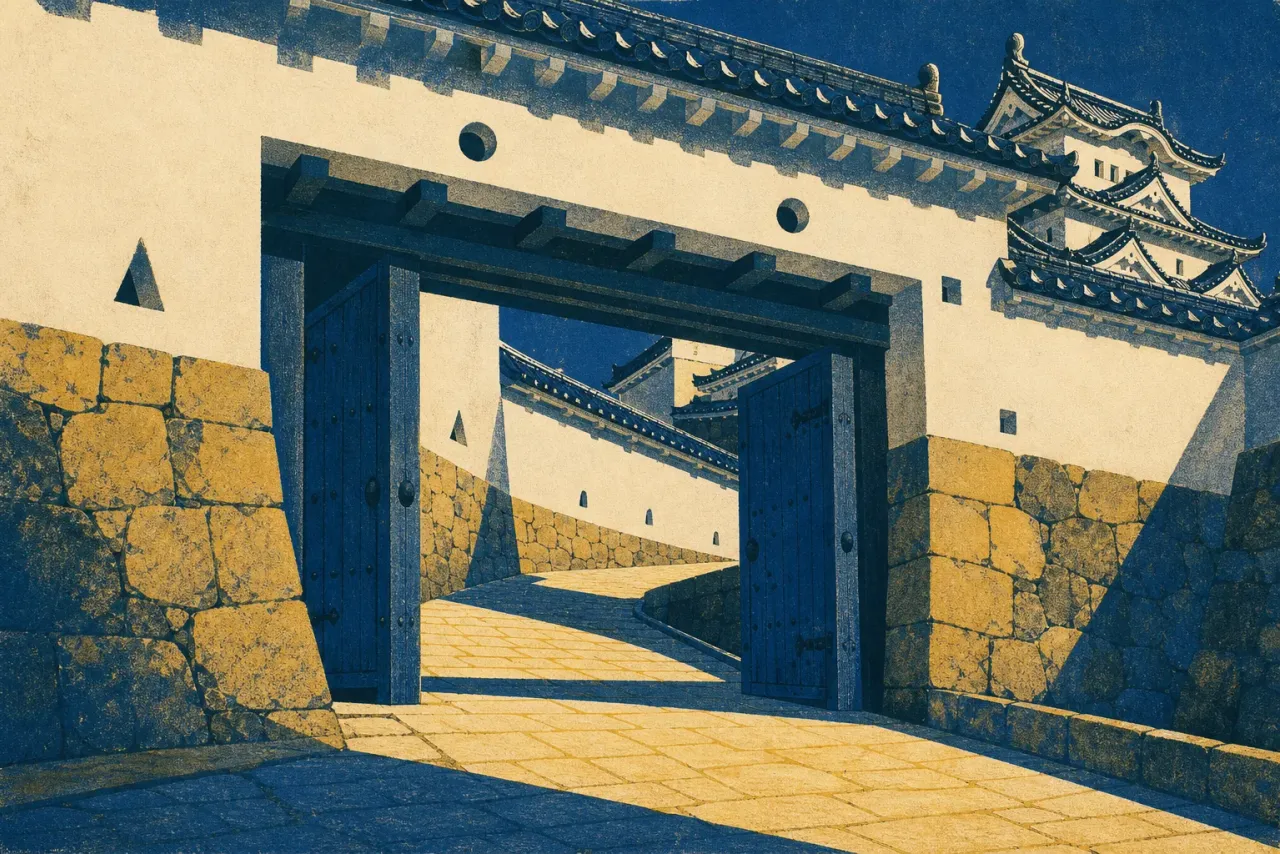
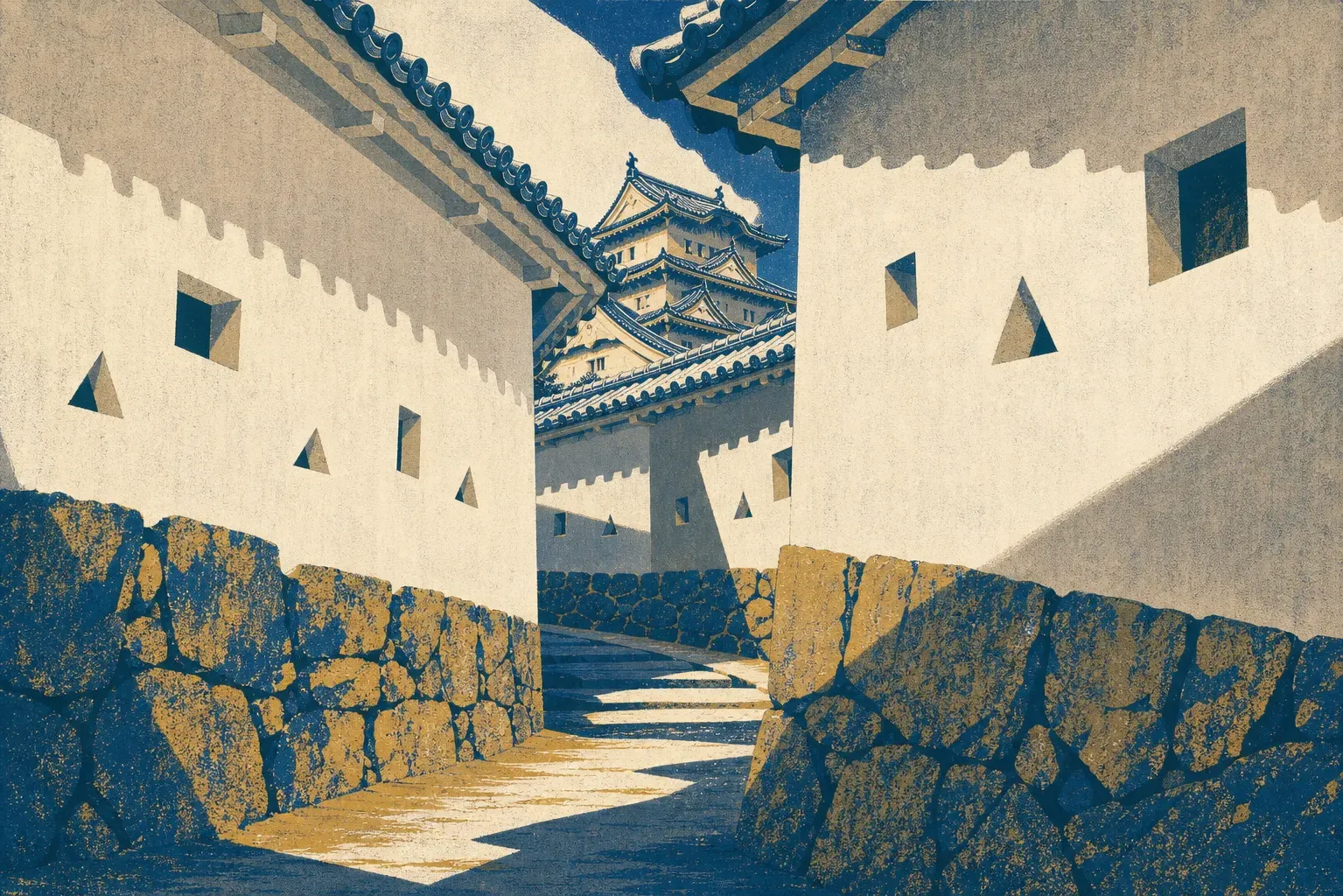
Walk from the Hishi Gate toward the keep and the route betrays you almost immediately. Baileys spiral. Paths that seem to head straight for the tower slide past it instead. Gates funnel you into tight turns under walls cut with sama, small loopholes for arrows and matchlock guns, and beneath ishi-otoshi, chutes built into the overhangs for dropping stones on anyone standing where you are standing. Concealed spaces hide inside the keep itself. The building is a weapon with rooms in it.
The dangers that actually arrived were modern ones: bombing in World War II, fire, earthquakes up through the 1995 Kobe disaster just down the coast. The castle came through all of it, which is why "intact" here means something it means almost nowhere else.
There is softness on the grounds too, if you know where to look. Nishinomaru, the west bailey, was the residence quarter of Princess Sen, and her long covered corridor, the Hyakken-roka, still runs along the bailey's rim to the Kesho Yagura, the Cosmetic Tower. Most visitors bolt straight for the main keep and never enter. That's a mistake: the corridor is the quietest wooden interior in the complex, and walking its length is the one stretch where the castle feels like a household rather than a fortress.
What the new ¥2,500 ticket actually buys
In March 2026, adult admission jumped from ¥1,000 to ¥2,500 for visitors who aren't Himeji residents, and the grumbling online was immediate. Read the fine print before joining in. Anyone under 18 now enters free, where school-age kids used to pay ¥300, and the increase funds a projected ¥28 billion or so of seismic and preservation work. Other famous castles solved the earthquake problem with rebar. Himeji is trying to solve it while remaining made of wood. Your ticket is a preservation payment with a castle attached.
Here is the practical drill, as of 2026. Gates open 9:00 to 17:00 with last entry at 16:00, the same all year, closed only December 29 and 30. The castle no longer publishes the extended summer closing that older guides mention, so plan around that 16:00 cutoff in August exactly as you would in January. Timed e-tickets with QR codes go on sale about 90 days out, and booking one matters most in cherry-blossom week and Golden Week, when numbered tickets cap entry to the keep. Arrive for the 9:00 opening, give the visit two to three hours, and take the ¥2,600 combo that adds Koko-en, the nine walled Edo-style gardens next door, since that prices the garden at effectively ¥100.
One more thing costs nothing at all. Sannomaru, the cherry-tree lawn between the Otemon Gate and the paid zone, needs no ticket, and the castle is floodlit white every night from sunset to midnight. Stand on that lawn after dinner and the plaster does one last job: it catches the lights, and the heron glows above the dark town. Four centuries of carpenters, plasterers, and now seismic engineers have kept it ready to do exactly that.