Himeji Castle in Half a Day: Beating the Crowds at Japan's Greatest Original Castle
By 10:30 on a fine spring morning, the staircases inside Himeji Castle's main keep move like a stalled escalator. Six floors of near-45-degree steps, everyone in socked feet, everyone holding a bag with their shoes in it, nobody advancing more than a step at a time. The visitors who left Osaka at 9:40 are discovering the hard truth of Japan's finest original castle: the difference between a great morning here and a shuffling one is about ninety minutes.
The fix costs nothing. Be at the gate when it opens at 9:00.
Himeji rewards the effort more than any castle in the country. It was one of Japan's first two cultural World Heritage sites, inscribed in 1993 as, in UNESCO's words, "the culmination of Japanese castle architecture in wood." That's not committee-speak inflation. Only twelve castles in Japan are originals rather than postwar concrete reconstructions, and Himeji is the best preserved of the twelve: 83 buildings, defensive works intact, the main keep completed in 1609 after a nine-year build under Ikeda Terumasa and never destroyed since. It survived the WWII bombing of the city, plus earthquakes and fires. The white plaster that earned it the nickname Shirasagi-jo, the White Heron, wasn't decoration; it was fireproofing.
The train math
From Osaka, this is almost embarrassingly easy: about 30 minutes on the Shinkansen, or roughly an hour on the JR Special Rapid, which is covered by the JR Pass or an ICOCA-style IC card. From Tokyo the ride is about 3 hours 10 minutes, with two details worth checking twice: only some Nozomi services stop at Himeji, so you may be changing at Shin-Osaka for a Hikari or Sakura, and even the first departure of the morning puts you at the castle gate nearer 9:30 than 9:00. If the opening bell is the point, sleep in Osaka or Kobe the night before, or in Himeji itself. More on why that last option is better than it sounds at the end.
Himeji Station makes navigation a non-issue. Exit the north side and the keep is sitting there at the end of Otemae-dori, one kilometer dead ahead. The walk takes 15 to 20 minutes; a bus covers it in five for 210 yen (2026) if you're cutting it close.
Buy your ticket before you travel. Since March 2026, adult admission is 2,500 yen, up from the 1,000 yen that most older blog posts still quote; the increase is earmarked for preservation and seismic work. The softener: anyone under 18 now enters free, where school-age kids used to pay. And the combo ticket including Koko-en, the garden complex next door, is 2,600 yen, which makes the garden a 100-yen add-on. Take that deal. Timed e-tickets with QR codes go on sale about 90 days out and let you walk past the ticket-window line entirely. The castle is open 9:00 to 17:00 with last entry at 16:00, and it closes only two days a year, December 29 and 30.
One more calendar note. During cherry blossom season in early April, Golden Week, and the summer holidays, staff hand out numbered tickets that cap entry to the keep, and they run out. On those days, be at the gate 30 minutes before 9:00, not at 9:00.
Two hours inside the walls
Budget two to three hours from the Otemon Gate and back. The Sannomaru lawn just inside the gate is free and open to anyone; if a companion doesn't want the stairs, this is where they wait, with a full view of the keep over the cherry trees.
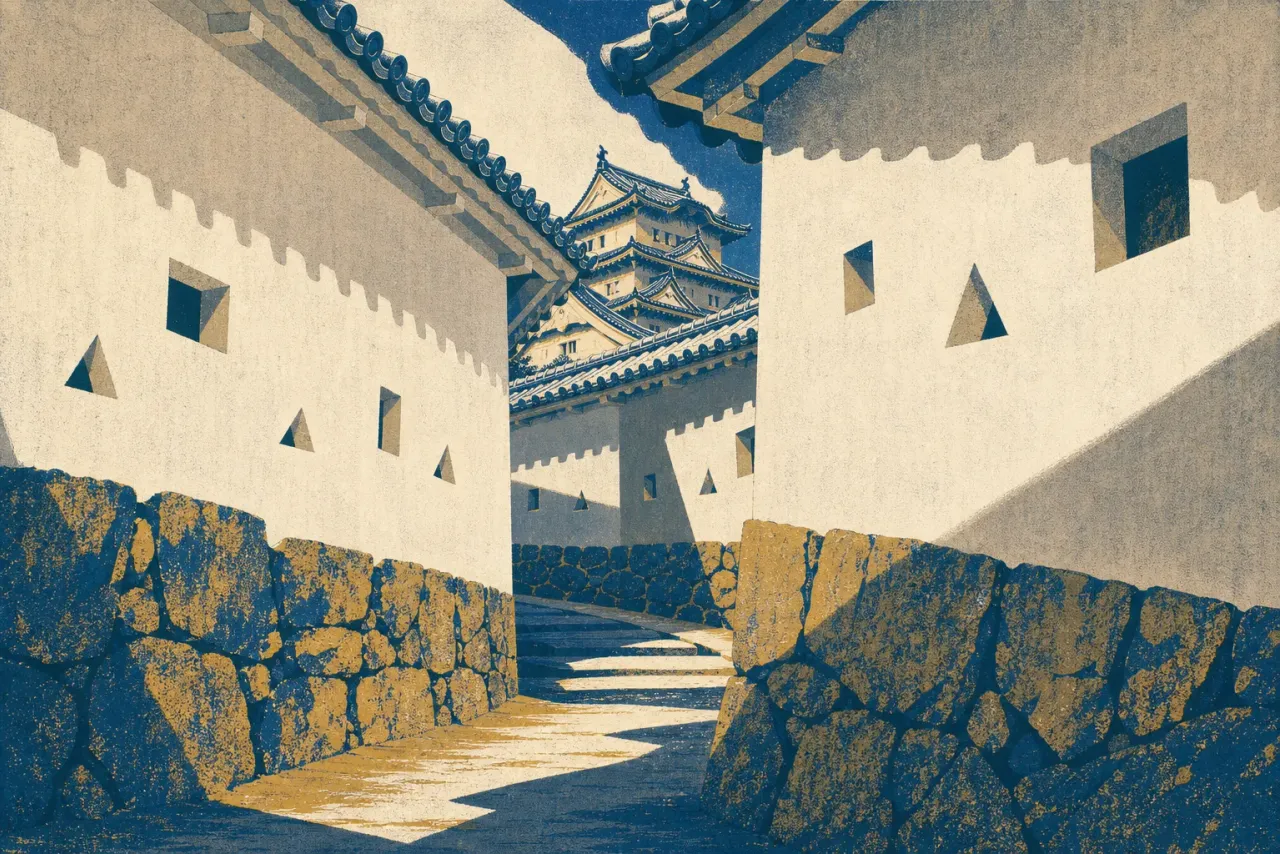
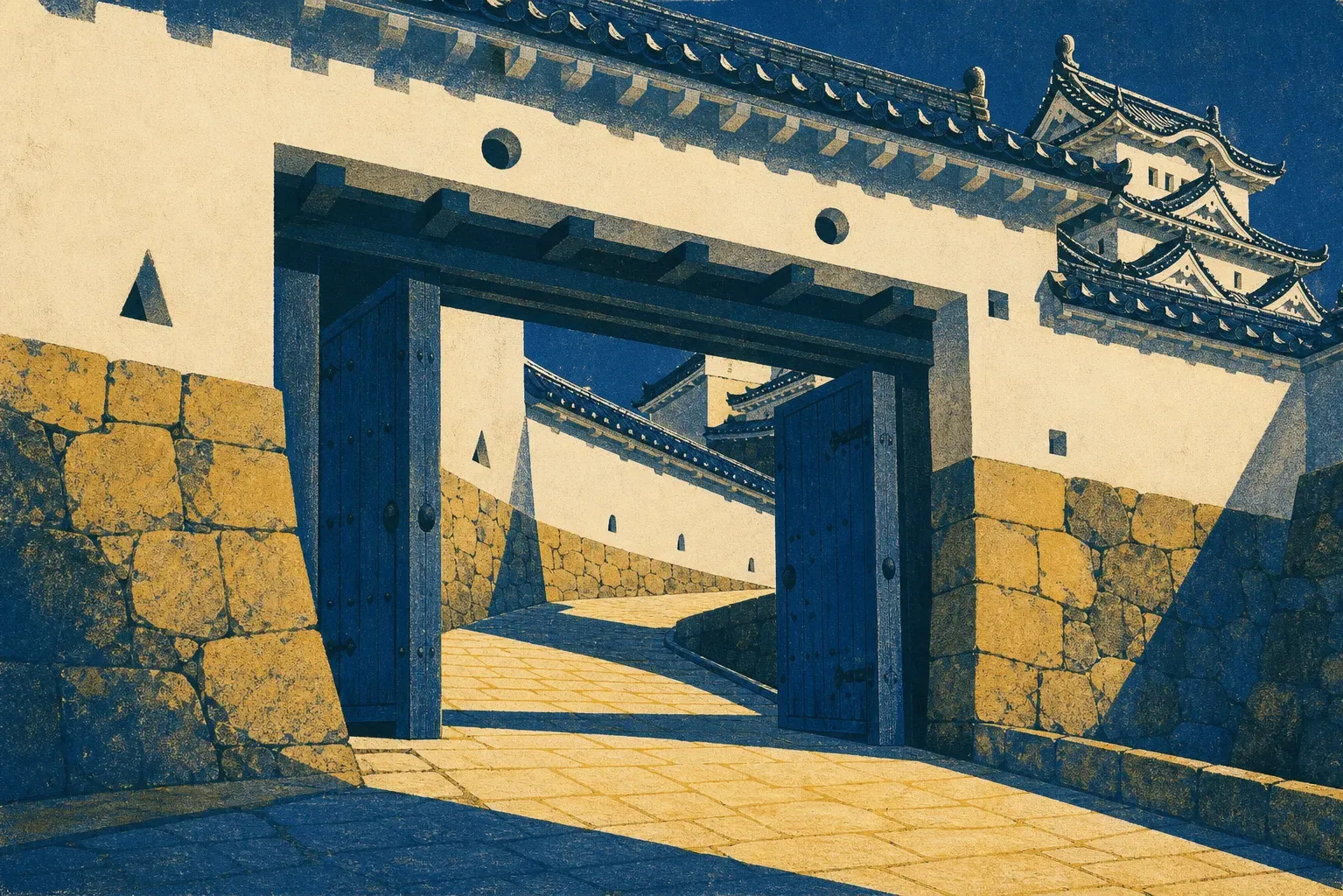
Past the ticket gate, the route funnels you into the castle's defensive maze through the Hishi Gate. Go slowly here, because this is the part reconstructed castles can't give you. The paths spiral and double back on purpose. Walls are punched with sama, the round and triangular loopholes for guns and arrows, and the galleries above conceal ishi-otoshi, chutes for dropping stones on attackers. You will, at some point, find yourself walking away from the keep while trying to approach it. That was the idea.
At the base of the Daitenshu, shoes come off. Bring your own shoe bag — a castle notice from June 2026 asks for one — and wear socks you don't mind, because the old floorboards throw splinters and the temple-style indoor slippers some visitors carry are no help on the stairs. There is no air conditioning, no elevator, and no shortcut. Keep and stone base together stand about 46 meters, and the upper staircases approach 45 degrees, closer to ladders than stairs. Travel light. A big backpack on those steps is a hazard to you and everyone behind you.
Inside, the keep is nearly empty of exhibits, and that's its strength. What you see is the building itself: the giant central pillars running up through the structure, the racks along the walls that once held weapons, portholes and concealed spaces for defenders. The top floor holds the small Osakabe Shrine and views out over the city. Get there before the stairs clog and you may have it briefly to yourself.
On the way out, do not skip Nishinomaru, the west bailey. Plenty of people do, which is exactly why you shouldn't. This was the residence quarter of Princess Sen, and its Hyakken-roka corridor runs the length of the bailey wall, room after room, ending at the Kesho Yagura, the Cosmetic Tower. From Nishinomaru you also get the photograph: the full keep with its layered roofs stacked against the sky, the angle on every poster. Shooting it at 11:00 beats shooting anything at 14:00 through a crowd.
The walk back down
If you bought the 2,600-yen combo (2026), Koko-en is right beside the castle: nine walled gardens in Edo-period styles, each different in character. After the keep's bare wood and stone, forty-five minutes here recalibrates you. It keeps the same hours as the castle and the same two closing days.
Hungry is the correct state for Otemae-dori. Yamasa Kamaboko, a century-old fish-cake maker, sells the Jokamachi-Dog on the street between the castle and the station for 150 yen (2026): a corn-dog-shaped skewer with cheese kamaboko inside, the ideal one-hand snack for the walk back. If you'd rather sit down, Himeji's specialties skew humble and good. Oden here comes with grated-ginger soy sauce rather than mustard, a habit a local promotion group christened Himeji oden in 2006 and has been pushing ever since; the shop in Himeji Noren Street by the station serves it with castle-shaped konnyaku. Anago, conger eel from the Harima Sea, is the other signature, and Hiiragi, a minute from the station, does a 2,530-yen lunch set (2026) built around an anago rice bowl, with tempura and sashimi alongside. And if you're in town early for that 9:00 gate, Cafe de Muche near the station runs a 500-yen breakfast set (2026) from 7:00 featuring almond toast, a Himeji kissaten invention worth planning around.
Most visitors are back on a train by mid-afternoon, and the half-day plan works. But there's a case for a business hotel by the station, and it isn't the room. Every night, the castle is illuminated white from sunset until midnight, with 15-minute light shows at 20:00 and 21:00. Walk up a nearly empty Otemae-dori after dinner and the White Heron floats above the dark city: no lines, no numbered tickets, no socks required.