The Building That Refused to Fall: Why the Genbaku Dome Looks the Way It Does
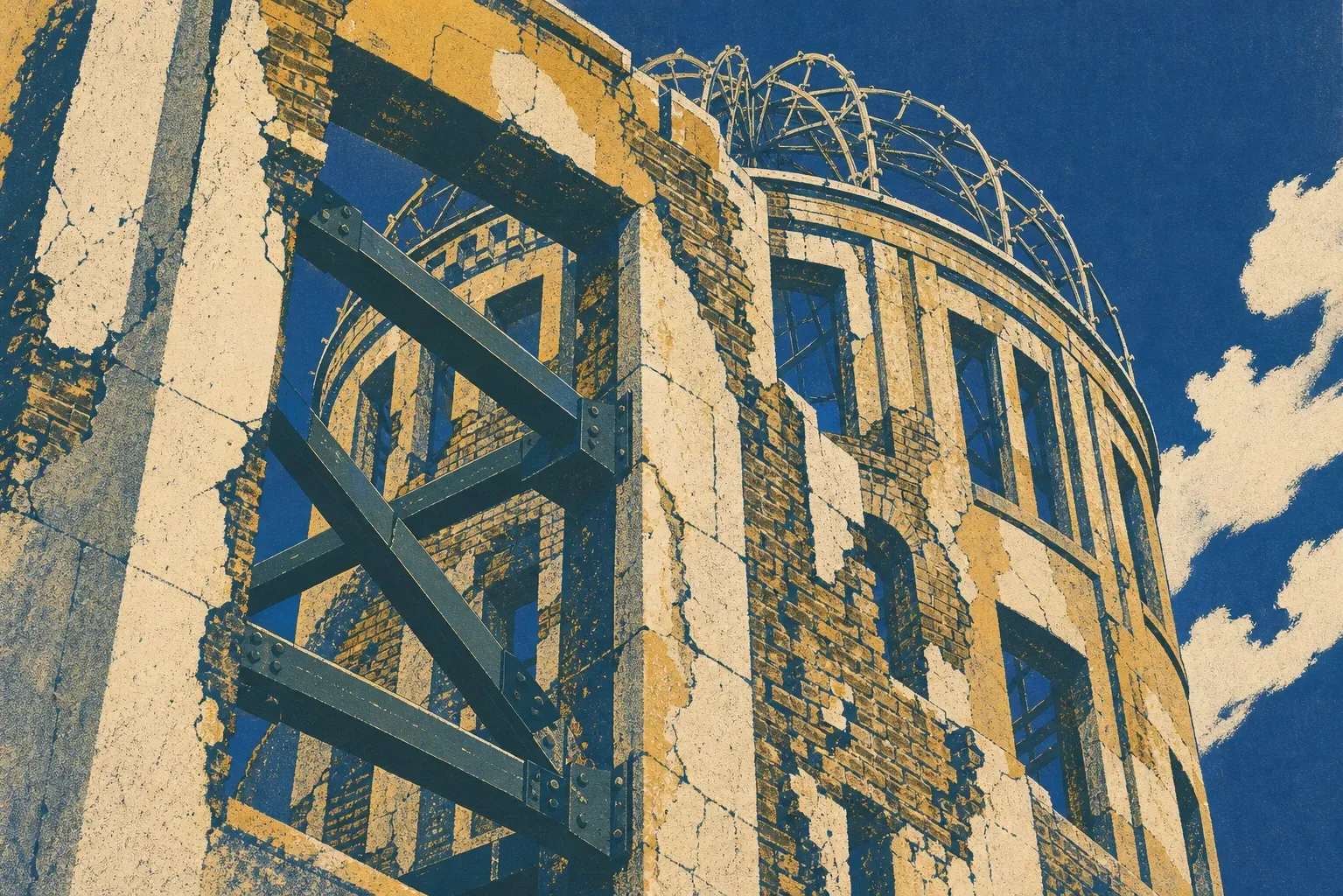
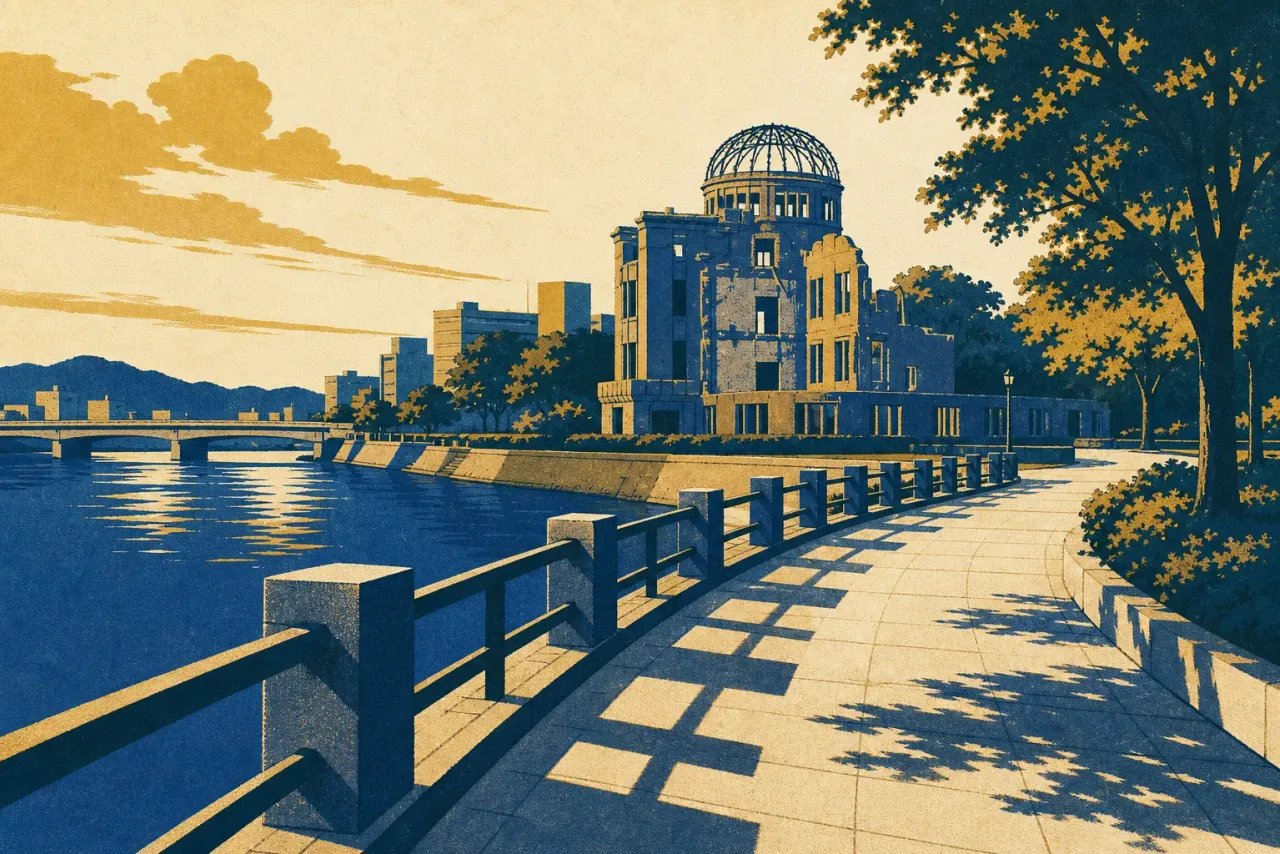
Most first-time visitors photograph the Genbaku Dome believing they're looking at what the bomb left behind. Close, but not quite. What stands on the bank of the Motoyasu River is a ruin that has been engineered, on five separate occasions, to remain a ruin. Steel bracing went in during 1967. Preservation crews returned in 1989–90, in 2002–03, and again in 2015–16, that time to add reinforcing steel to three sections of wall specifically against earthquakes, with the most recent campaign following in 2020. Every one of them has had the same quietly paradoxical brief: hold the building at the moment of its destruction, indefinitely.
Nothing about that outcome was planned, and for a long time it wasn't even wanted.
An exhibition hall, then a skeleton
Completed in April 1915 and opened to the public that August as the Hiroshima Prefectural Commercial Exhibition Hall, this was a proud, faintly exotic building: a European-style venue designed by Jan Letzel, a Czech architect working in Japan, its dome rising over the riverbank. The city used it the way cities use such halls, for art shows and industrial fairs, and renamed it twice along the way — the Hiroshima Prefectural Products Exhibition Hall in 1921, then the Hiroshima Prefectural Industrial Promotion Hall in 1933. For thirty years it was a pleasant place to spend an afternoon.
On the morning of August 6, 1945, the first atomic bomb detonated roughly 600 meters above the city and only about 150 meters from the hall horizontally. That geometry explains nearly everything you see today. Because the burst was almost directly overhead, the blast arrived close to vertically, pressing down through the structure rather than shoving it sideways. The columns and portions of the brick-and-concrete walls, loaded along the axis they were built to carry, held. The dome's steel frame kept its outline. Everyone inside the building died. Around it the district was leveled, which is how a mid-sized exhibition hall became, in UNESCO's words, "the only structure left standing near the hypocenter."
Twenty years of wanting it gone
The hardest thing to grasp in 2026 is that preservation was never the default. Hiroshima debated demolishing the wreck for two decades. For residents rebuilding a city from nothing, a shattered hall on the riverfront was not automatically a monument; it was the worst morning of their lives, left standing where they could see it daily.
Change arrived in 1966, when the city council voted to preserve the building permanently. Mayor Shinzo Hamai then raised funds both in Japan and abroad to pay for the work, and in 1967 engineers threaded the first steel reinforcement through the ruin. Notice the choice inside that choice: the money bought stabilization, never restoration. Nobody rebuilt the dome or tidied the walls into respectability. The mandate, renewed in each later campaign, has been to arrest decay while changing nothing the eye can register.
UNESCO ratified that logic in December 1996, and the inscription itself is worth knowing about as you stand there. World Heritage listings usually reward a place for its architecture or its beauty. The Genbaku Dome was inscribed exceptionally under criterion (vi) alone, the category for places tied to events and ideas of universal significance. ICOMOS, the advisory body, made clear it was not judging Letzel's design; it called the ruin "a stark and powerful symbol of the achievement of world peace for more than half a century following the unleashing of the most destructive force ever created by humankind." Even that was contested; the American and Chinese delegations entered reservations at the session. So the thing in front of you is, on paper, among the least architectural World Heritage sites anywhere: a building listed for what it means rather than for what it is.
How to read it now
The park around the Dome is arranged to be read along one line. Stand at the Cenotaph for the A-Bomb Victims, the low arch at the center of Peace Memorial Park, and look through it: the opening deliberately frames the Flame of Peace and, beyond it, the Dome on a single axis.
Fencing keeps you out of the ruin itself; a surprising number of visitors arrive assuming they can enter, and you cannot. Walk the full perimeter path instead, slowly, and use the AR marker on the information board on the north side, which serves a 360-degree view of the interior to your phone. Both park and Dome are open around the clock and free, and the ruin is illuminated nightly from sunset until about midnight. See it twice. Daylight is for the brickwork and the bent steel; after dark, from the far bank of the Motoyasu, you get the lit skeleton doubled in the water, which may be the best single reading of the building the city offers. For an overhead angle, the rooftop observation deck of Orizuru Tower next door looks down into the shattered frame.
The museum across the park runs on its own timetable of seasonal hours and reservation windows and deserves separate planning; the ruin asks only that you give it more than one glance. Come back to the far bank after sunset and stay until the lights cut out around midnight, when the reflection dissolves and the building goes back to doing the one thing it has been engineered, five times over, to do: stand there.