Cocoons, Cold Air and a Column-Free Hall: Reading the Four Sites That Built Japan's Silk Empire
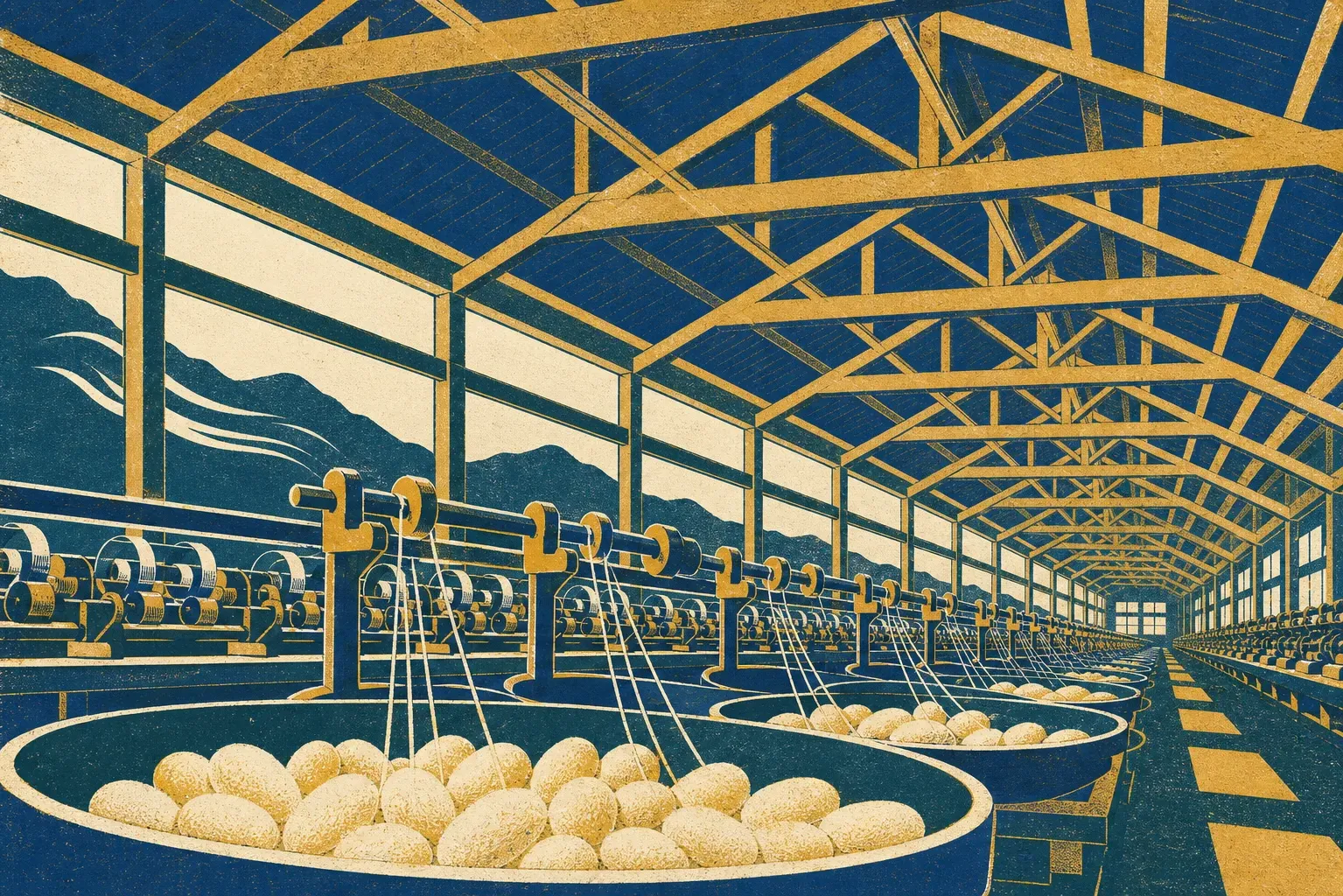
Stand in the middle of Tomioka's Silk-Reeling Workshop and watch what people photograph: the long rank of machines running down the center of the hall. Then watch their faces when they learn those are Nissan automatics from the 1980s, installed in the mill's final working years before it closed in 1987. The 300 French reeling frames of 1872 are long gone. What survives from 1872 is the room itself, and the room is the point. Look up. A timber truss roof runs roughly 140 meters end to end, and beneath all that length there is not a single interior column.
That absence is the whole story in miniature. A hall running 300 machines and hundreds of workers needs clear floor, clear sightlines, clear air. The truss carries the roof loads out to the walls and leaves the floor open, and that one piece of imported engineering is what made the largest mechanized silk-reeling plant in the world possible in a small Gunma town just a few years after the Meiji Restoration. In 2014, the workshop and the two cocoon warehouses flanking it were designated National Treasures. The same year, UNESCO put Tomioka on the World Heritage list.
A production line, not a monument
The inscription answers a question most visitors carry in without quite asking it: why does a brick factory rate the same status as Kyoto temples? Because Tomioka isn't inscribed as a lone building. The listing covers four sites in four separate municipalities, and together they diagram an entire industry. Arafune Cold Storage, in Shimonita, refrigerated silkworm eggs. The Tajima Yahei farmhouse, in Isesaki, worked out how to raise the worms. Takayama-sha, in Fujioka, turned that craft into a teachable national standard. The mill mechanized the final step, reeling thread from cocoons. The chain is the monument, and the chain made Japan the largest raw-silk producer on earth for more than half of the twentieth century.
Tomioka itself began as policy, not commerce. Late-Edo export demand had flooded the market with poor-grade Japanese silk, so the new Meiji government built a model factory to raise quality and train workers who would carry the methods home. The French engineer Paul Brunat directed construction in 1871–72, picking Tomioka partly because cocoons were abundant nearby; the industrialist Shibusawa Eiichi ran the administration. By 1876 operations were entirely Japanese. The Mitsui family bought the mill in 1893, Katakura Silk ran it from 1939 until the last shift in 1987, and Katakura then kept the empty buildings intact until donating them to the city. Preservation here was a corporate decision decades before it was a UNESCO one.
Reading the mill
Start at the East Cocoon Storage, about 104 meters long, where the construction method rewards a close look. It is neither French nor Japanese but a hybrid called kiwari-renga: a timber frame does the structural work, with brick laid between the posts. Over the central arch, the keystone is carved "Meiji 5," the year 1872 in the old reckoning, and it is the signature photograph of the site. Dried cocoons were stored upstairs; the ground floor now holds the Silk Gallery, the shop, and the guided-tour desk. That tour is Japanese-only, for what it's worth; English speakers do better with the mill's free official audio app.
The West Cocoon Storage, the East's twin, teaches a different lesson. It reopened on October 3, 2020 after a six-year restoration with a glass-walled room inserted into the ground floor of the historic shell. You can read the conservation philosophy at a glance: everything new is visibly new, and it touches the old fabric as lightly as possible. From July 25 to November 29, 2026, a special tour opens the normally closed north half of its second floor for 4,000 yen per group of up to 20 (2026), reserved in advance through the mill's reservation center.
Elsewhere on the grounds, most of the hundred-plus surviving structures, including Brunat's residence and the staff dormitories, are exterior-viewing only, and the rope lines are enforced; the brickwork is under active conservation, so read the facades and keep your distance.
Eggs, cool air and a school
The other three sites are smaller, quieter and cheaper, and they explain what the mill's cocoons cost to produce. Silkworms are fragile livestock; the nineteenth-century breakthroughs were mostly about air. Tajima Yahei's 1863 farmhouse in the Sakai-Shimamura district of Isesaki looks ordinary until you notice the roof: a slatted ventilation cupola, a koshi-yane, running along the ridge. His seiryo-iku method reared worms in circulating cool air, and after he published, that roofline became the template for sericulture farmhouses nationwide. You can still spot koshi-yane on old houses all over Gunma once you know to look. The house itself is not enterable; you view the garden and the ground floor of the kuwaba, the building where mulberry leaves were stored and handled, free of charge, 9:00 to 16:00.
Twenty years on, Takayama Chogoro split the difference. His seion-iku method of 1883 balanced ventilation against temperature control and became the national standard, taught from 1884 at his school in Fujioka. The purpose-built residence-and-silkworm-house of 1891 survives there; entry is 500 yen as of 2026, with free guided tours.
Arafune Cold Storage solved the calendar. Eggs hatch when they warm, which historically meant one silk crop a year. Between 1905 and 1914, builders stacked three stone storage chambers against a mountainside in Shimonita where cold air vents from rock fissures, and used that natural refrigeration to hold eggs back for staggered hatching. The result: multiple rearing cycles per year, the largest egg-storage capacity in Japan, customers in 42 prefectures and the Korean Peninsula. Entry is 500 yen (2026), hours 9:30 to 16:00 with last admission at 15:30, and the site closes entirely from December 1 to March 31. Since July 16, 2026 it has also been shut on weekdays because of bear sightings, open Saturdays, Sundays and public holidays only until the town has countermeasures in place.
Two days, a car, and cash for the train
Be honest with yourself about logistics. The four components sit in four municipalities with no connecting transit; Tajima Yahei and Takayama-sha need taxis or buses from separate stations, and Arafune is a 30-minute taxi ride from Shimonita Station. Seeing all four is a two-day trip by car, and for now only over a weekend between April and November, because Arafune's winter closure and its current weekday shutdown rule out every other date. Confirm with the Shimonita Town History Museum on 0274-82-5354 before you plan around it.
If the mill alone is your target, the train works well. Shinkansen from Tokyo to Takasaki takes about 50 minutes; the little Joshin Dentetsu line then runs 35 to 40 minutes to Joshu-Tomioka Station, a 10-to-15-minute walk from the gate. Carry cash: the Joshin line accepts no IC cards, and JR passes don't cover it. Trains run roughly twice an hour; miss one and you wait.
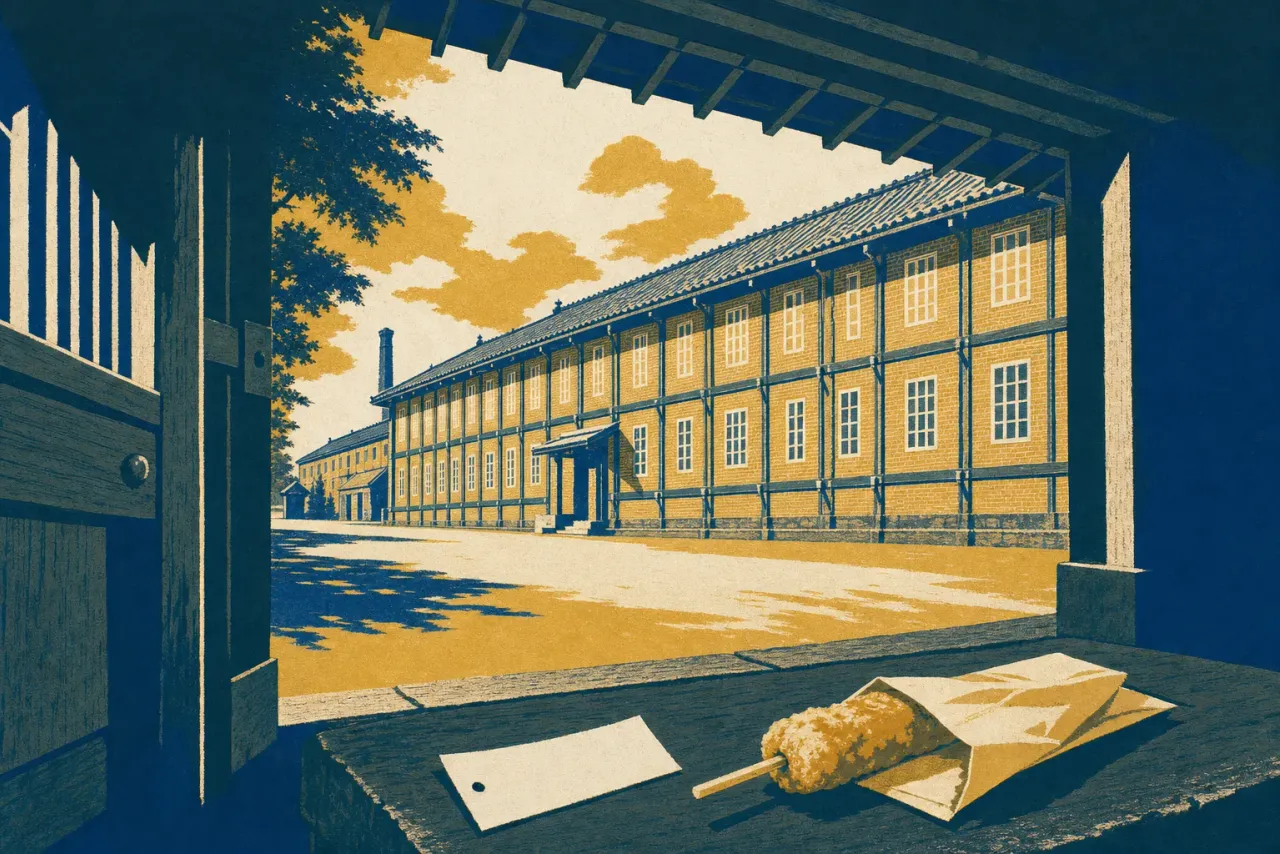
For lunch, take a stool at Takada Shokudo, an old diner whose curry rice is billed as the dish the mill girls loved, a food story with genuine roots here. Or grab a stick of horumon-age, the town's fried chikuwa snack, from a butcher's counter on the walk back to the station.
Then, if you have the car and the season, save Arafune for the end. Stand beside the chamber walls in the warm months and feel the draft coming out of the mountain, cold in midsummer. Everything else on this itinerary is architecture built to manage air. This is the place where the mountain did it for free.