Ninety-Five Minutes from Tokyo: A Half-Day at Japan's First Silk Factory
Every few minutes at Takasaki Station, someone taps a Suica card at the Joshin Dentetsu gates and nothing happens. The JR side of the station reads IC cards fine. The small private railway that continues to Tomioka does not. Joshin Dentetsu takes cash only, your Japan Rail Pass stopped working one gate back, and the next train may be 30 minutes away. Arrive with yen in your wallet and the rest of the day runs like clockwork. Arrive without, and you spend your buffer hunting an ATM.
That gate is the one real obstacle between Tokyo and Japan's first mechanized silk factory. Everything else is easy: about 95 minutes of travel each way, a site you can cover in under two hours, and an afternoon snack that costs pocket change at a butcher's counter. As World Heritage day trips go, this is among the most doable in the country, provided you know a handful of specific things before leaving your hotel.
The 95-minute math
Take the Joetsu or Hokuriku Shinkansen from Tokyo Station to Takasaki. It's about 50 minutes, and any rail pass covering JR East handles this leg. At Takasaki, follow signs to the Joshin Dentetsu platform and ask at the ticket window for the Tomioka Silk Mill round-trip discount ticket: 2,200 yen for adults, 840 yen for children, as of 2026. It bundles the 1,620 yen round-trip fare with the 1,000 yen mill admission, saving you 420 yen, and it permits one stopover in each direction, which matters later. The vending machines sell the same bundle in a plain format, so the queue at the staffed window buys you only the commemorative ticket design, which is either worth it or isn't. Joshu-Tomioka Station sells the ticket as well.
The Joshin line runs roughly two trains an hour toward Shimonita. Your stop is Joshu-Tomioka, written 上州富岡, and the prefix is not decorative. Plain "Tomioka" matches an unrelated town in Fukushima, among other places, so if you're navigating by phone, type the full name. The ride takes 35 to 40 minutes.
From Joshu-Tomioka Station, the mill is a 10-to-15-minute walk. A multilingual signboard outside the station points the way, and the route passes cafes, souvenir shops, and the butcher you'll want on the way back. Total from Tokyo Station: about 95 minutes of actual travel, plus whatever the transfer costs you. Leave Tokyo at 8:00 and you're inside the gates before 10:00 with the day still young.
One more task before you board anything: download the mill's official audio-guide app on hotel Wi-Fi. The paid guided tour on site costs 200 yen as of 2026 and runs about 40 minutes, but it's delivered in Japanese. The app is free, takes about 30 minutes, and exists in English as well as French, Chinese, Korean, and Japanese. It is the real English interpretation of the site, and you pay your own data charges if you download it standing at the gate.
What 1,000 yen buys inside
The mill is open 9:00 to 17:00, with last entry at 16:30 and only three scheduled closure days a year, December 29 through 31; unannounced maintenance closures happen occasionally, so check the official news page before you commit the day. Admission is 1,000 yen for adults as of 2026, dropping to 250 yen for high school and university students and 150 yen for younger kids. Unlike the railway, the ticket office here takes cards, IC cards, and PayPay, though the guided-tour fee itself is cash only.
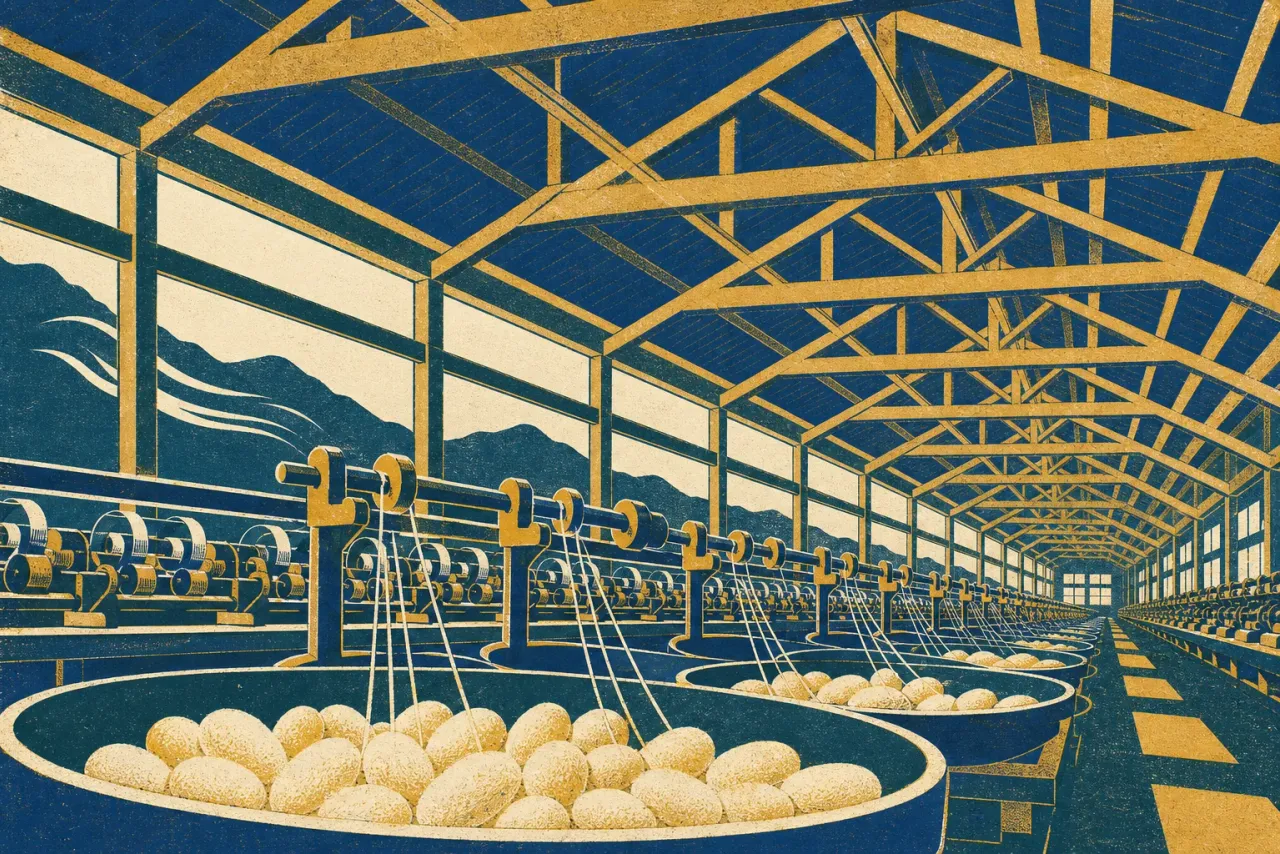
What you're paying to see is the factory the Meiji government built in 1872 to rescue the reputation of Japanese silk. Late-Edo export demand had flooded the market with poor-grade product, so the state hired a French engineer named Paul Brunat and imported 300 French reeling machines; the result was the largest mechanized silk-reeling plant then existing anywhere in the world. Workers trained here carried the methods across the country, and Japan became the world's largest raw-silk producer for more than half of the twentieth century. The plant itself kept operating until 1987 under Katakura Silk, which preserved it so carefully that over 100 structures survive.
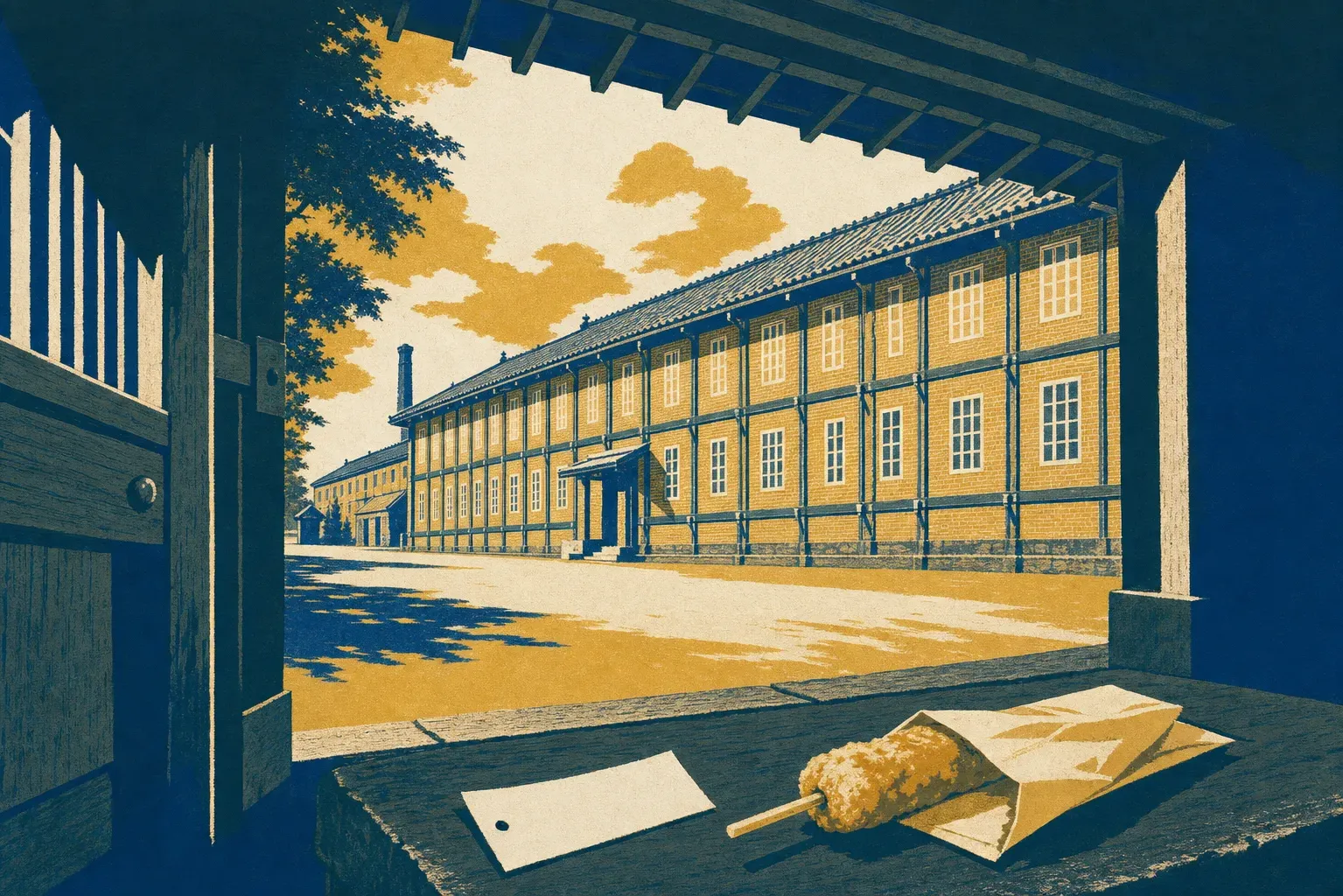
Three buildings are National Treasures, and you can enter all of them. The East Cocoon Storage is roughly 104 meters of timber-framed brick; look for the keystone over its central arch, carved "Meiji 5" for 1872, which is the photograph everyone takes. The Silk-Reeling Workshop runs about 140 meters, its truss roof leaving the entire floor free of columns, which is exactly what made a 300-machine hall possible in 1872. The West Cocoon Storage, the East's twin, reopened in 2020 after a six-year restoration with a glass exhibition room set inside the historic shell.
Two expectations to calibrate. First, the reeling machines on display date from the mill's final working years in the 1980s, not from Brunat's era. This is an architecture-and-history site, not a live demonstration, and visitors who arrive expecting spinning silk leave puzzled. Second, the 37.5-meter chimney from 1939, the landmark of every postcard, is wrapped in preservation scaffolding through fiscal 2026, with the repair contract running to March 2027. Your photos will include scaffold. The mill stays fully open regardless.
Budget one to two hours for the standard circuit. Photography for personal use is unrestricted, which is unusual for a National Treasure, so nobody needs to ask permission. Most of the remaining buildings, including Brunat's residence and the old dormitories, are exterior-viewing only, and the rope lines are firm because the brickwork is under active conservation.
The afternoon, solved
Walking back toward the station, stop at a prepared-food counter for horumon-age, Tomioka's own street snack. The name means fried offal. The reality is chikuwa fish cake, split lengthwise, breaded in panko, deep-fried on a stick, and painted with sauce. The dish did begin as actual pork offal at a shop called Kawai Shoten, but chilled offal fat set hard and unpleasant, so fish cake with a similar look took over. You'll find it in supermarkets and butcher shops rather than restaurants; Okaketsu Meat Shop near the mill fries it to order, so give it a minute before biting.
If you have more afternoon than appetite, use the stopover your discount ticket allows. Konnyaku Park in neighboring Kanra Town runs a free factory tour with a free konnyaku buffet attached, a cheerful monument to Gunma growing more konjac than any other prefecture. It's a short taxi ride from Joshu-Fukushima Station on the same Joshin line, open 9:00 to 18:00 every day with last admission at 17:00. One caveat if this is your Saturday: the production lines generally don't run at weekends, so the viewing walkway looks out on idle machinery. Time the tour for a weekday if the factory itself is the draw. The buffet runs regardless.
Or simply head home. A 10:00 arrival at the mill, two hours inside, lunch and a horumon-age in town, the 35-minute local, the 50-minute Shinkansen: you're back at Tokyo Station by mid-afternoon with the evening intact. Just check the departure board at Joshu-Tomioka before you linger over coffee. Two trains an hour means a missed one costs you 30 quiet minutes on a small-town platform, which is either a penalty or, depending on your mood by then, the point.