You Cannot See the Keyhole from the Ground: A Half-Day Plan for Osaka's Ancient Tombs
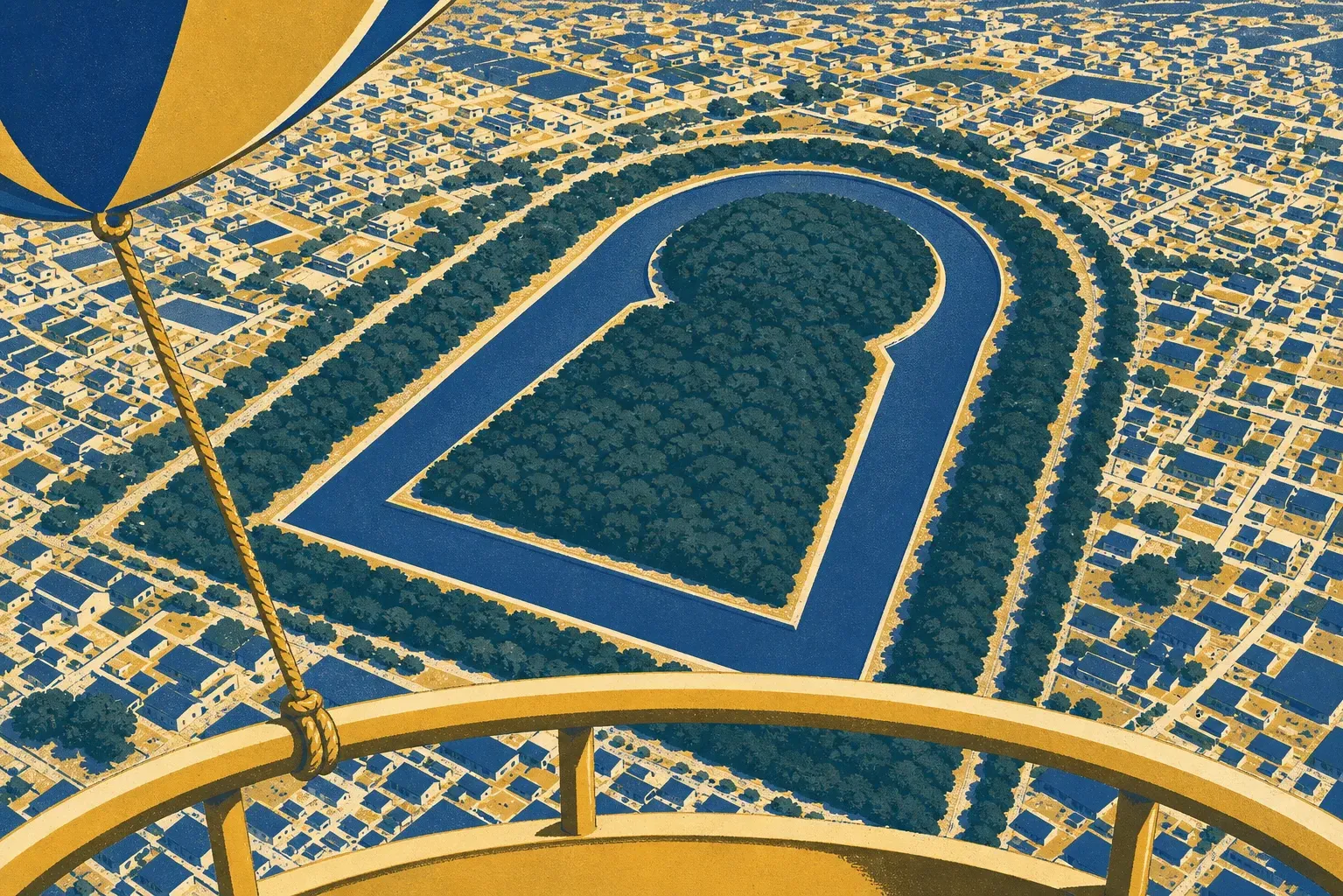
The photograph that brought you here was taken from an airplane. Every guidebook cover and UNESCO page shows the same image: a green keyhole longer than four soccer fields, floating in rings of water. Stand on a sidewalk in Sakai, on the southern edge of Osaka, and Japan's largest tomb is a wooded hill behind a moat and a fence. Japan-guide, a site not given to drama, puts it flatly: the big tombs "are difficult to fully appreciate unless viewed from a high vantage point." Walking the perimeter path around this one mound takes about an hour, and at no point in that hour does a keyhole appear.
So the honest answer to the first-timer's question, is it worth half a day, is yes, provided you build the half day around solving the visibility problem. Plan for that, and Mozu becomes one of the stranger, better city walks in Kansai. Wander in cold and you will circle a fence, check your phone to confirm you are in the right place, and leave puzzled.
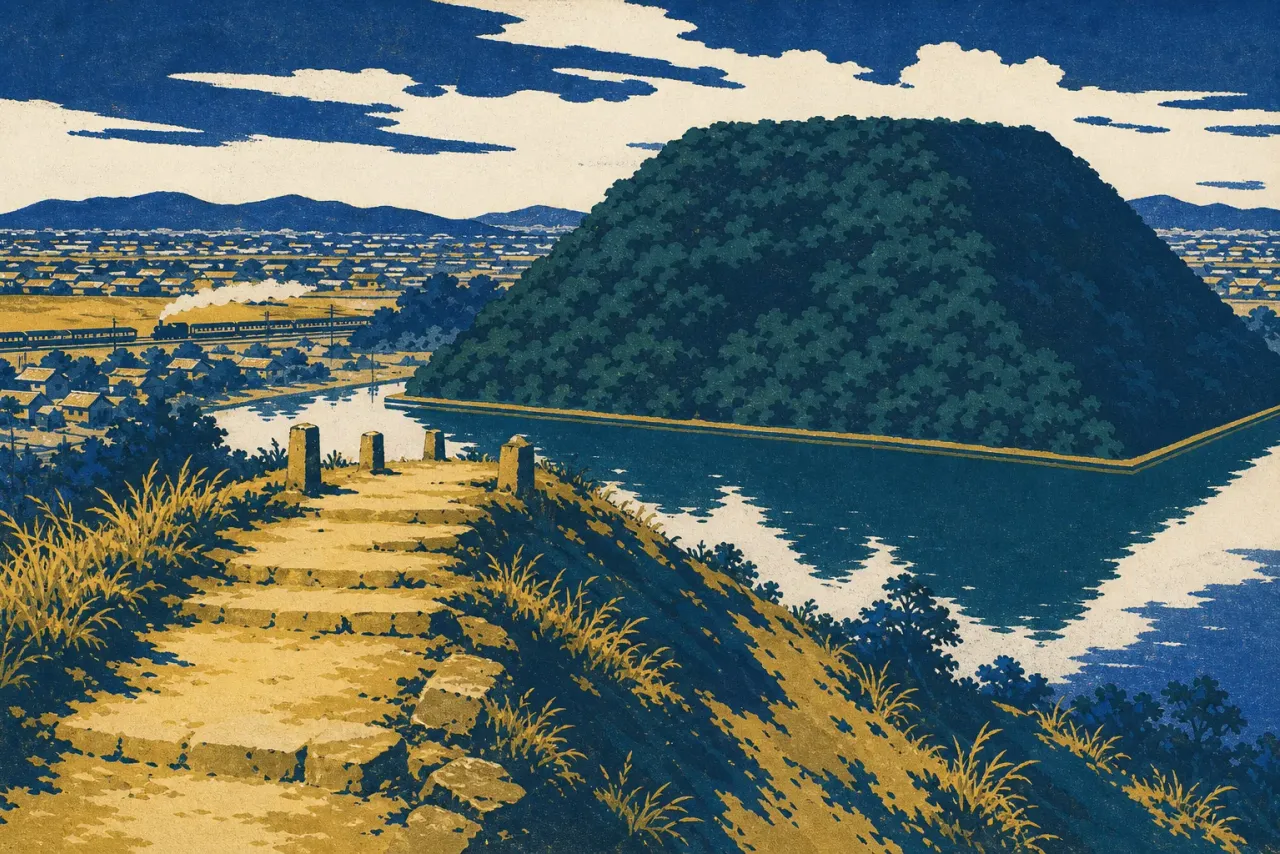
Some context for what you're circling. Nintoku-tennō-ryō Kofun, also called Daisen Kofun, is 486 meters long and 35.8 meters high, roughly 1.4 million cubic meters of hand-piled earth wrapped in three moats. In 2019 UNESCO inscribed it and its neighbors as the Mozu-Furuichi Kofun Group: 49 tombs in 45 components covering 166.66 hectares, chosen from roughly 160,000 kofun across Japan to represent the late fourth through late fifth centuries, the peak of tomb construction. The inscription cites criteria (iii) and (iv), which translate roughly as: this culture is gone and these mounds are its best surviving testimony, and nobody else on earth built burial mounds quite this way. One more thing the aerial photo hides: the tombs were never green. They were finished in pale cobblestones, with thousands of terracotta haniwa cylinders standing in rows along the terraces. The forest is an accident of centuries — neglect, then imperial closure. Keep that in mind when the "wooded island" finally resolves below you.
Three ways to see the keyhole, ranked
First, the free one most people miss: MI-TE Sakai, the 21st-floor observation lobby of Sakai City Hall, 80 meters up and five minutes from Sakai-higashi Station on the Nankai Koya Line. Open daily, no ticket. One caution: the operator lists hours of 9:00 to 21:00 while japan-guide says 9:00 to 19:00, so if you are counting on a dusk view, confirm the closing time that morning.
Next, the one to use before any walking: the Mozu Mounded Tombs Visitor Center in Daisen Park, free, open 9:00 to 18:00, closed only over the New Year break. Its theater projects an 8K aerial film across the wall and the floor under your feet, which is the closest most of us will ever get to the airplane. Ten minutes in that room reorganizes everything you see for the rest of the day.
The paid option is the Osaka Sakai Balloon, tethered helium, rising to 100 meters from Daisen Park. The full experience takes about 30 minutes, and the gondola runs from 10:00 with last reception in the late afternoon; posted closing times vary slightly by source, so confirm on the day. Adults pay 4,200 yen at the gate or 4,000 yen booked online (2026 prices), and there are no refunds once you have paid, except when the operator cancels for weather. Wind does cancel it; the website posts live operating status. My advice: the film plus MI-TE solves the visibility problem for free, so treat the balloon as the open-air splurge, not the plan.
The half day, station by station
Start at Mozu Station on the JR Hanwa Line. From Tennoji, a rapid train reaches Sakaishi in seven minutes and a local covers the last two stops, Mikunigaoka then Mozu, in four more; the fare is 240 yen (2026), and the Japan Rail Pass is valid. The Visitor Center sits five minutes away on foot. Leave your bag there (paid storage, 500 yen small, 700 yen large in 2026), and consider a rental bicycle if you want more than the core sites, since the cluster spreads across roughly four kilometers by four; bring photo ID for the rental desk. Watch the film before anything else.
Then walk to the haisho, the worship place facing Nintoku-ryō. White gravel and a torii, under an Imperial Household Agency signboard. This is the closest sanctioned approach, and it is an active imperial ritual site rather than a viewpoint: no smoking, no animals apart from assistance dogs. Entry onto the mound itself is not permitted. What you actually see is the inner moat and a wall of trees. Stand there anyway. In 1872 a stone coffin chamber in the front section was opened, a sword and gilt-bronze armor were recorded, and everything was reburied. Since then the mound has given up little more than Sue-ware pottery jars, recovered in 1955 and in later investigations. The fence, in other words, is not an inconvenience; it is the exhibit.
Daisen Park absorbs the middle of the afternoon. Sakai City Museum inside it (9:30 to 17:15, last entry 16:30, closed Mondays, 200 yen for adults in 2026) holds the reconstructed stone coffin that stands in for everything the tombs refuse to show; 45 minutes covers it. Nearby, the Shin-an tea house serves seated matcha for 600 yen (raised from 500 yen in June 2026) with a wagashi shaped like the keyhole, tea service 10:00 to 16:00. Eating a small sugar model of a fifth-century mausoleum sounds like a gimmick. It is also the only moment all day when the famous silhouette sits in front of you, whole, at arm's length.
Finish at altitude. Sakai-higashi is a 20-to-30-minute walk north of the park, or a short train hop, and the elevator to MI-TE Sakai's 21st floor costs nothing. Go as the light drops. From 80 meters the geometry finally declares itself: the round rear mound, the flared front terrace, the moats catching the last of the sky.
The Monday trap, and one download
Check the calendar before you commit the day. The museum, the Japanese Garden, the Shin-an tea house and the Shimano Bicycle Museum all close on Mondays. The Visitor Center and the City Hall lobby do not, so a Monday visit still works, just thinner: film, worship point, park, view.
Remember, too, that this is not a park with tombs in it; it is a neighborhood with tombs in it. The lanes between the mounds are residential streets. Carry your trash out, keep your voice down near the haisho, and skip the car entirely; the local councils explicitly ask visitors not to drive, and the narrow streets around the mounds justify the request.
Last thing, and do it before you board at Tennoji: download the official app, "Mozu-Furuichi Kofun Group World Heritage Tour Navigation," released in October 2025 by the council of governments that runs the site. It carries all 49 tombs, eight suggested routes, audio commentary and digital stamps, in English, Japanese, Korean and Chinese. The platform at Mozu Station will show you no keyhole at all. With the app open and the film already in your head, you will know exactly why, and exactly where to stand next.