Nine Bowls of Mochi and a Tray of Soba: Eating Your Way Through Hiraizumi and Ichinoseki
At 5:30 on a weekday evening, the street below Chūson-ji is a row of lowered shutters. The soba shops closed at 3. The mochi restaurants held on until 4 or 5, then followed. Hiraizumi, which ruled northern Japan in the twelfth century and built a funeral hall sheathed entirely in gold, does not do much dinner. Nearly every restaurant in the sightseeing district shuts between 3 and 6 p.m., and in winter many add irregular days off on top of that.
Guidebooks treat this as the clinching argument for the day trip: temples by early afternoon, back on the Shinkansen by dark. I think it proves the opposite, once you know what Hiraizumi and neighboring Ichinoseki actually eat. This corner of Iwate keeps one of the least expected food traditions in Japan, working through it takes more than one sitting, and the centerpiece meal is a lunch eight minutes away by local train.
Mochi arrives in courses, and it isn't sweet
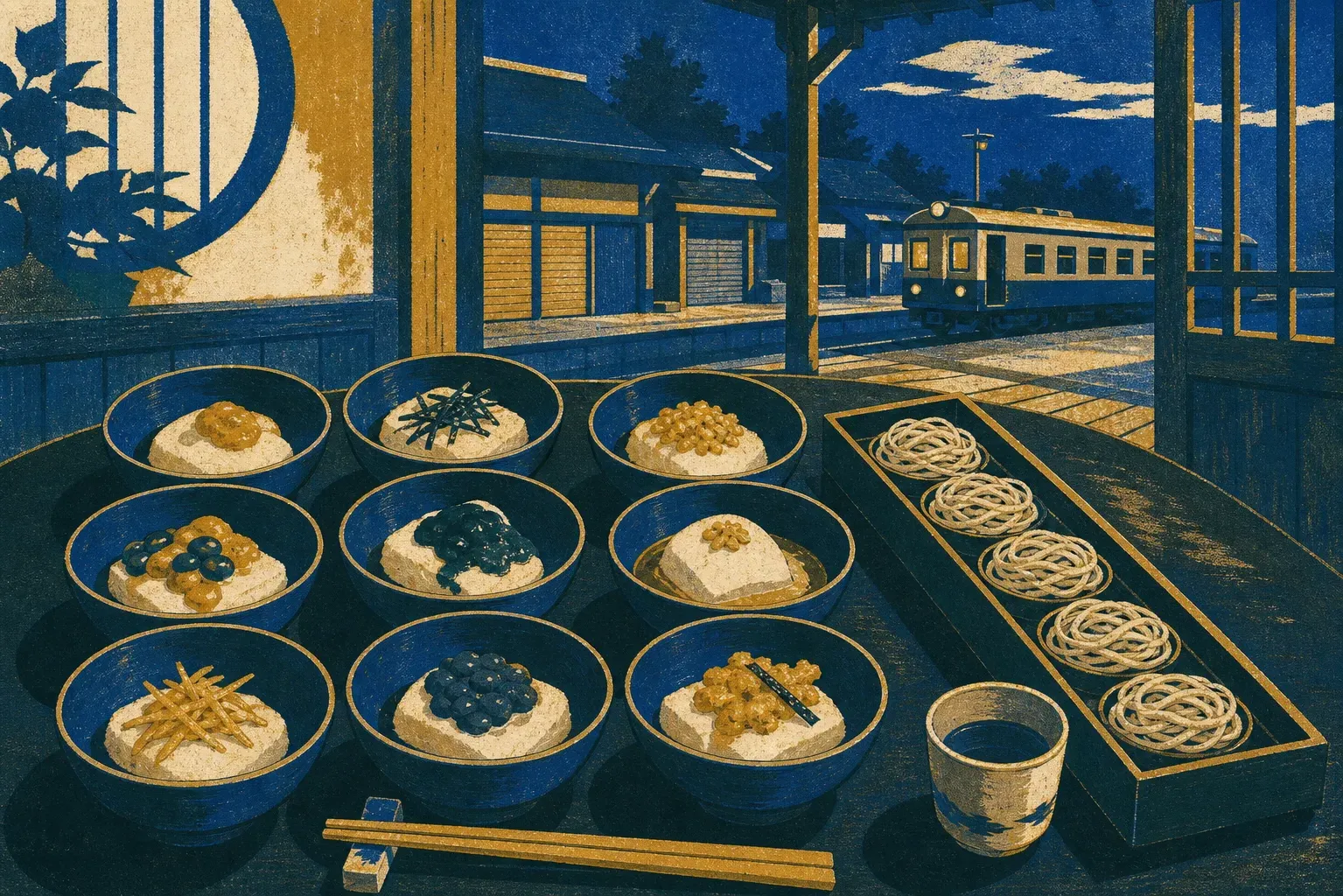
Start with the fact that reorganizes everything else: around Ichinoseki and Hiraizumi, mochi is savory, formal, and served in numbers. Elsewhere in Japan, pounded rice mostly means dessert. Here it is the centerpiece of mochi honzen, a ceremonial multi-bowl meal in which small dishes of mochi arrive under different toppings and you eat your way across the tray. Weddings called for one spread and funerals for another; the turns of the farm calendar had their own.
None of this is a museum piece. Sekinoichi Shuzō in Ichinoseki runs a mochi honzen experience that opens with a half-hour explanation of the ritual before anyone picks up chopsticks, and the region's lunch menus offer mochi sets as casually as ramen shops offer gyoza. Order one and you find out how far the idea stretches: bowl after small bowl, each dressed differently, far more meal than confection.
A tray of soba you eat one mouthful at a time
Wanko soba belongs to Iwate generally, but the famous version is Morioka's, where a server stands at your shoulder and refills your bowl the instant you empty it, a relay race with a running count. Hiraizumi does it differently. The local form is moridashi-shiki: the small bowls come to the table already filled, arranged on a tray, and you work through them at whatever pace you like, each bowl a single mouthful. No shouting, no tally, no theater. It is the contemplative version, which suits a town whose main attractions are a Pure Land garden and a mausoleum.
Bashōkan, at Suzusawa 3-1 in central Hiraizumi, claims to have originated the style. The soba is house-made sarashina, and the shop says its tsuyu recipe has been carried for over a century. Hours run roughly 10 a.m. to 3 p.m., closed Thursdays; reserve by phone at 0191-46-5155 if your day depends on it.
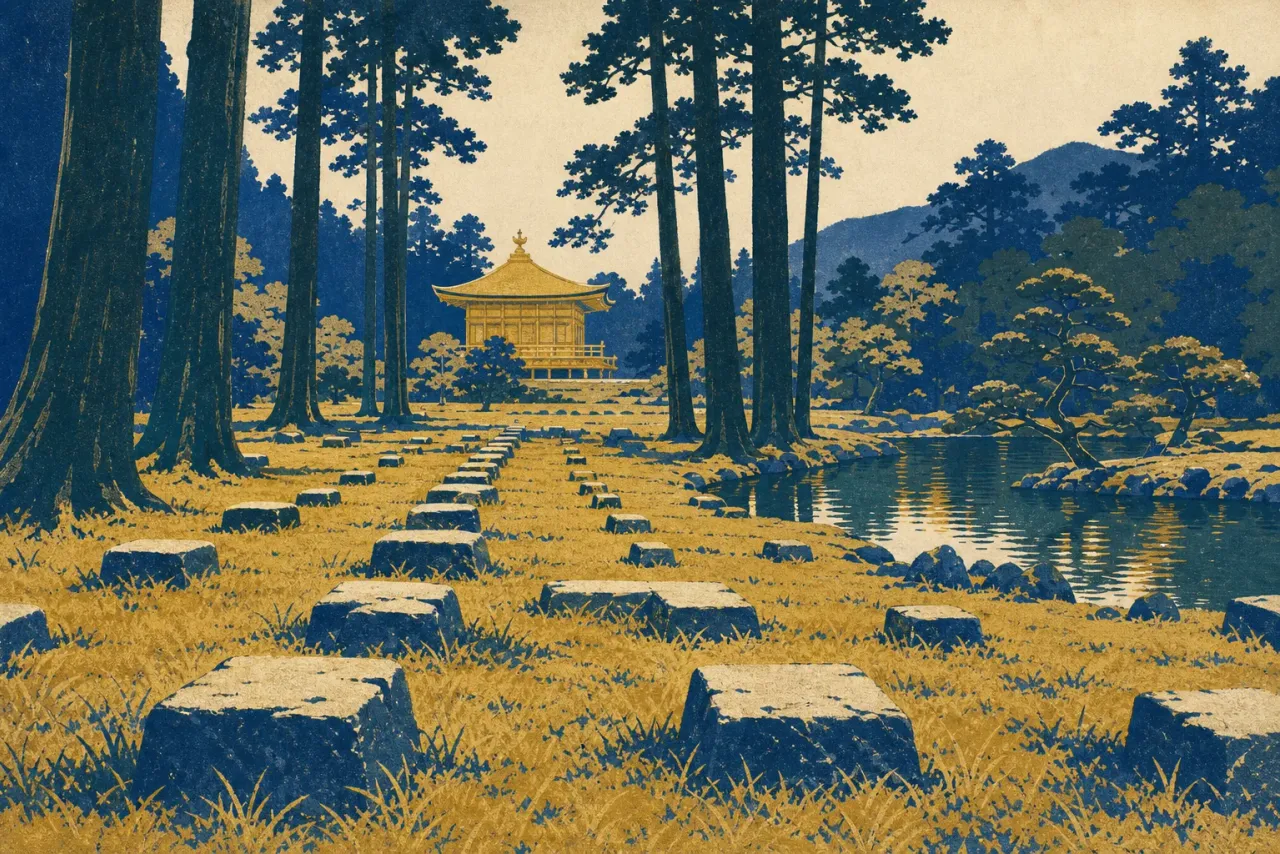
Its relative, Ekimae Bashōkan, sits one minute from Hiraizumi Station (10:00 to 15:00, 0191-46-5555) and offers the single most useful perk in town: free luggage storage for rail travelers who eat there. This matters more than it sounds. Chūson-ji has no coin lockers anywhere on its grounds, and the climb up the cedar-lined Tsukimizaka slope is not something to attempt with a rolling suitcase. Eat a tray of soba, leave the bag, and see the Golden Hall (admission 1,000 yen as of 2026) unencumbered.
Lunch is a logistics problem; solve it in advance
Hiraizumi's World Heritage components are scattered across the town, and the food follows the same pattern. Up the hill inside the Chūson-ji grounds, Kanzantei serves soba from about 10:00 to 16:00. It is the only food at the top, which is worth knowing before hunger hits at the Konjikidō ticket gate. Down at Mōtsū-ji, the one rest house inside the walls is Shōfūan, and it deals in sweets rather than meals: dango or warabimochi with matcha for 700 yen, soba-tea pudding for 500 yen, amazake, shaved ice in summer. It is also the counter that sells Ennen-cha, the herbal tea Mōtsū-ji blends and sells nowhere else.
For a single sitting that covers the whole regional repertoire, head for Yume-no-Kaze at Hanadate 11-2. It is the one restaurant in town serving all three local specialties: mochi sets (the menu's headliner is the Fujiwara Three Generations mochi set, 藤原三代お餅膳, named for the three Ōshū Fujiwara lords), moridashi-style wanko soba, and hattō, the hand-torn wheat-dough dumplings simmered in broth that fed this region's farm households for generations. Open 10:00 to 18:00, no reservation needed, cash or PayPay only. Those two extra afternoon hours make it the town's best late-lunch insurance, though winter closures can be irregular, so a phone call in January is not paranoia.
The nine bowls are a lunch, eight minutes away
Back to the shutters. Hiraizumi's evening list is short but not empty. Sōhonten Izumibashi-an, a washoku restaurant open 11:00 to 20:00 and closed Mondays, is the one most visitors find; the tourism association's own directory adds a few more, including Cafe Sekimiya, which reopens for an evening service from 17:30 to 21:00 and closes Sundays, Sakura until 19:00 (closed Thursdays), and cafe & bar Kohaku until 19:00. What shuts early is the temple-adjacent belt of soba and mochi shops, and that is where nearly everything worth eating for lunch happens to be.
Which brings up the trap in most itineraries. Ichinoseki, one stop and eight minutes south, is the Shinkansen junction, and ten minutes' walk from its station stands Sekinoichi Shuzō, a sake brewery founded in 1918 that brews with Nanbu-tōji craftsmen, the guild this region is known for. In 1995 the family launched Iwate Kura Beer, now an award-winning craft brewery in its own right. Its brewery restaurant serves Ichinoseki mochi with nine different toppings, the honzen tradition translated for a table of curious travelers, alongside local cooking and the house beer. But it is a lunch house: 11:00 to 15:00, closed Tuesdays and Wednesdays, and the kitchen asks for reservations two to three business days out on 0191-21-1144. Turn up at seven in the evening expecting the nine bowls and you will find the restaurant dark, even though the brewery shop and its museum of more than 1,600 brewing tools keep working almost every day of the year.
Build the day around a late lunch in Ichinoseki, then, not a dinner. For the evening meal, the station side of Ichinoseki is where the izakaya and hotel restaurants are, and a ryokan dinner in Hiraizumi itself is the other honest answer.
Keep an eye out on menus for Maesawa beef, the premium wagyu raised in Ōshū just north of Hiraizumi. It shows up on both sides of the eight-minute divide, and it is the local answer to anyone in your party who has reached their mochi limit.
So, overnight or day trip? If the brewery lunch decides it, sleep in Ichinoseki, where business hotels cluster at the station and Sekinoichi is a ten-minute walk away when the restaurant opens at eleven. If quiet decides it, sleep in Hiraizumi itself. The town has only a handful of inns, but the reward is specific: a soak at Yūkyū no Yu, the local hot spring (from 700 yen as of 2026, closed the first and third Tuesdays), an evening street with nobody on it, and Chūson-ji's gates at 8:30 the next morning, a full coach-tour cycle ahead of the crowds. Climb Tsukimizaka before breakfast and you will have the Golden Hall nearly to yourself, with yesterday's nine bowls still settling the question of whether the town deserved your evening.