The Golden Hall and the Vanished City: How to Read Hiraizumi in Half a Day
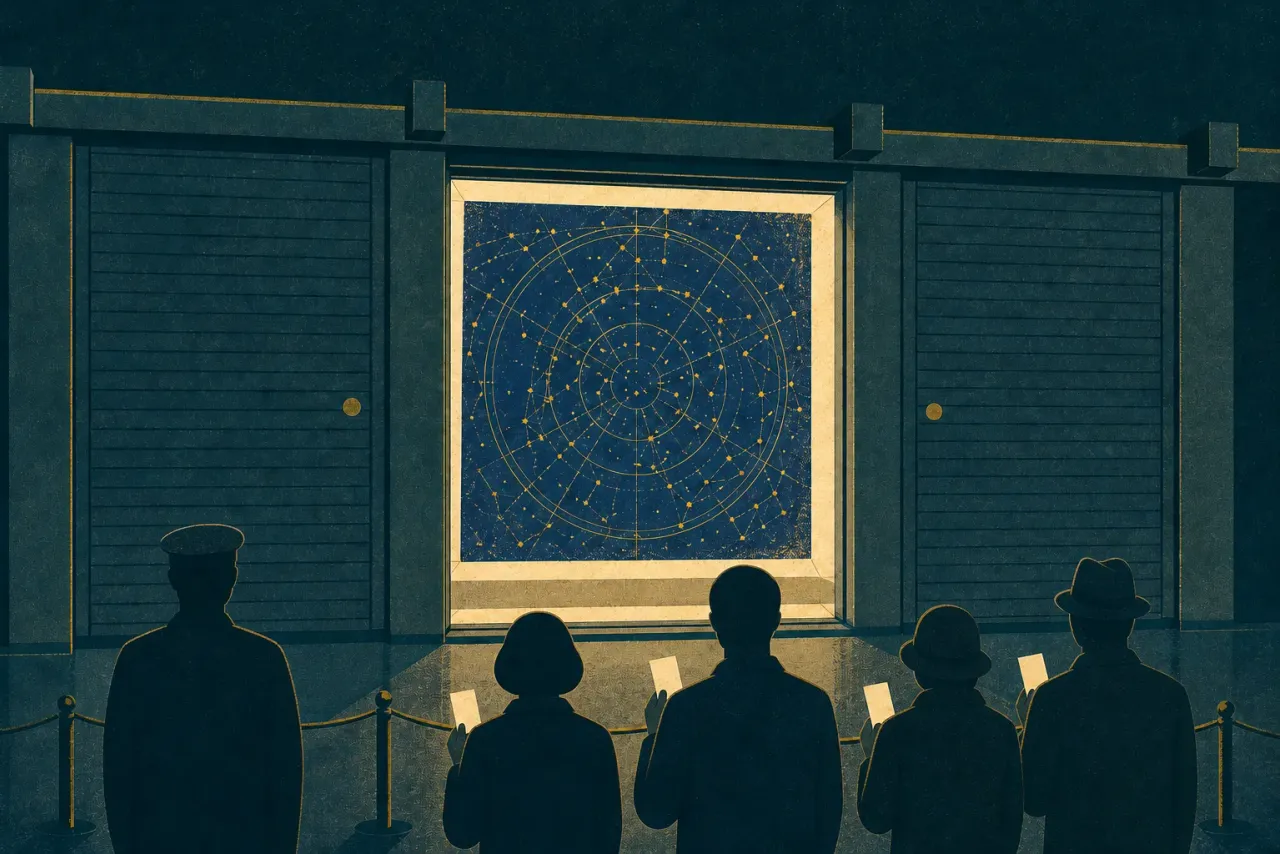
Your first look at the Konjikidō may feel like a letdown. The building Japan designated National Treasure No. 1 for architecture sits inside a plain protective hall, behind glass, in dim conservation light, and photography is banned. You get it for perhaps ten minutes before the next group files in. Back down the hill, the rest of Hiraizumi's World Heritage turns out to be, mostly, lawns with foundation stones in them.
Hiraizumi repays exactly what you bring to it. Arrive cold and it is a gold box plus some fields. Arrive knowing the story, and walk it in the right order, and in half a day you can read something no other place in Japan preserves: a whole twelfth-century city laid out as a working diagram of paradise.
The story is short. In 1105, after successive wars had bled northern Japan, a warlord named Fujiwara no Kiyohira began building Chūson-ji, in his own recorded vow, to console the souls of all the dead "without distinction between friend and enemy." The temple still quotes this on its website, and it reads less like piety than a peace treaty with the dead: a promise to build a Buddha-land in the north instead of another army. For about a century Kiyohira and his heirs ruled the northeast from Hiraizumi, funded by local gold, and spent that gold making the town a physical model of Amida's Western Pure Land. The end came quickly: Minamoto no Yoritomo destroyed the clan in 1189, and a fire in 1337 took nearly all of Chūson-ji's forty halls and three hundred monks' quarters. What survives is exact: one founding-era building, one intact garden, one ground plan. That is your half day, in ascending order of subtlety.
First a warning, because this is where day trips fail. The Run-Run loop bus that every older guidebook mentions runs only on weekends and holidays in 2026, and only between April 11 and November 29 (¥200 a ride, ¥550 for a day pass). On a weekday your real options are the rental bikes beside Hiraizumi Station (¥700 for four hours or ¥1,300 for the day as of 2026; closed in winter) or the roughly hourly route bus linking Ichinoseki, Hiraizumi Station and Chūson-ji. Failing both, the town is walkable. From Tokyo the math is friendly either way: 130 to 150 minutes on the Tohoku Shinkansen to Ichinoseki, then eight minutes on a local train.
Start at the garden, not the gold
Mōtsū-ji is a 700-meter, seven-minute walk from the station (¥700 as of 2026; 08:30–17:00, closing 16:30 from November 5). Every original building burned centuries ago, and the standing halls are modern reconstructions. What survives is the thing the buildings were arranged around: the finest Heian-period Pure Land garden left in Japan, essentially intact after nine hundred years, dual-designated a Special Historic Site and a Special Place of Scenic Beauty.
The payoff is the 500-meter circuit of the Ōizumi-ga-ike pond. Take it slowly and count the vocabulary as you go: the yarimizu, a shallow feeder stream paved with stones; the pebble beach curving into the water; the rocky peninsula; the island offshore. None of this is decorative whim. These are the canonical components of a garden built to reproduce Amida's paradise on earth, written out in full where elsewhere in Japan the tradition survives only in pieces. You are learning the alphabet the entire town was spelled in. Forty-five minutes is enough.
The gold box is a tomb
Chūson-ji's hill is twenty to thirty minutes on foot from the station, and the approach, the Tsukimizaka slope, is part of the experience: a genuine climb under cedars planted by the Date domain in the Edo period, now approaching three hundred years old. The Golden Hall is at the top, not the bottom. Admission is ¥1,000 as of 2026 and covers the Konjikidō, the Sankōzō treasure hall, the Kyōzō sutra repository and the hall that formerly sheltered the Konjikidō. The temple sells tickets until ten minutes before closing (08:30–17:00, or 16:30 from November 4) and means it. Allow one to two hours. There are no lockers on the grounds, so shed your bag at the station before the climb.
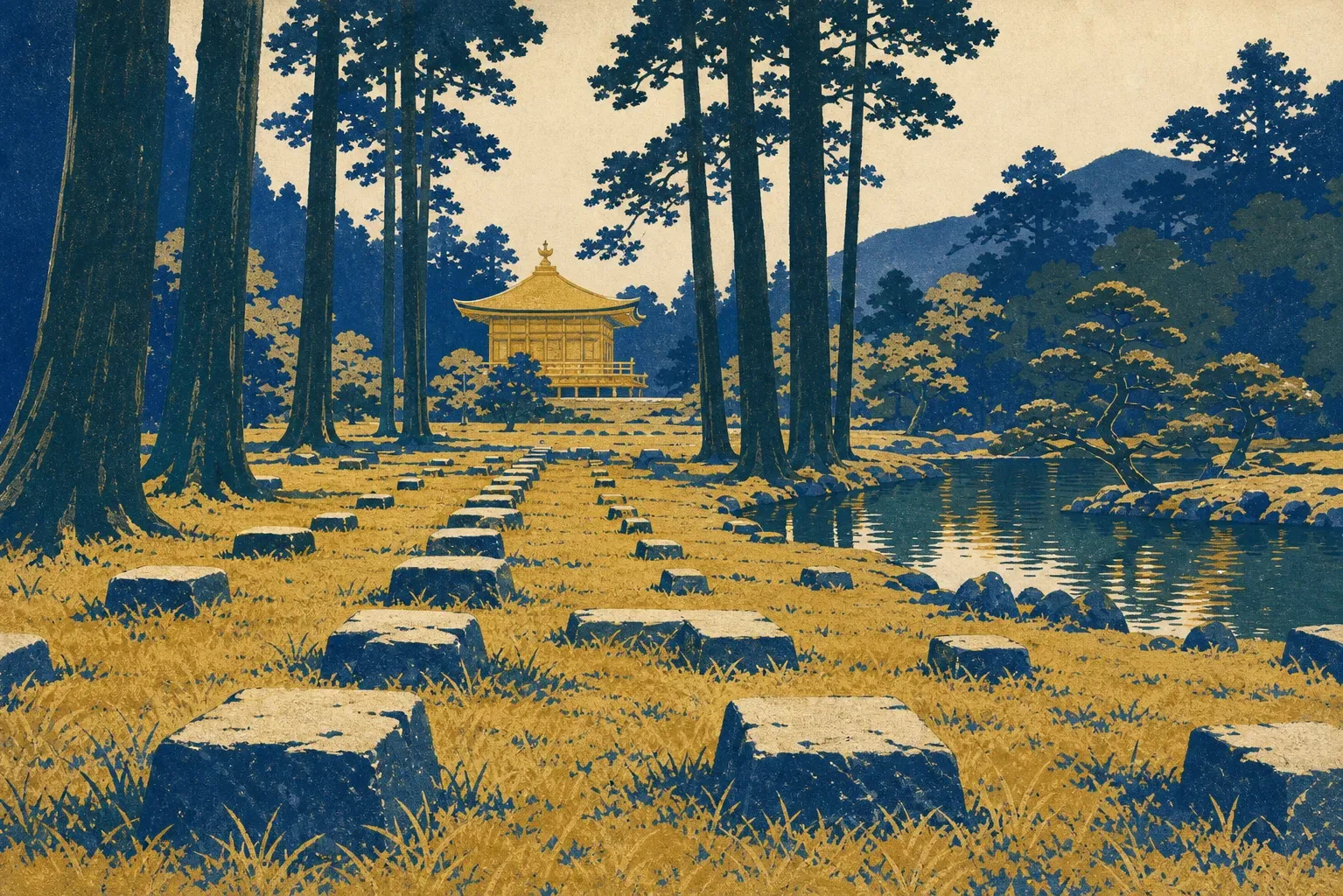
Now, what you are actually looking at. The Konjikidō was raised in 1124 and is the only structure in town surviving from the founding era. It is gilded inside and out, inlaid with mother-of-pearl cut from southern-sea shell, with ivory and precious stones worked into the altars. The icon arrangement exists nowhere else in Japan: an Amida triad flanked by six Jizō and two guardian devas. Beneath the three altar platforms lie the mummified remains of the four Fujiwara lords in gold-fitted coffins, the fourth represented only by his head. This is not a reliquary or a display piece; it is a working dynastic mausoleum with its founders still in residence. The photography ban stops feeling like a rule and starts feeling like manners.
That 1337 fire explains everything else on the hill and everything below it. Aside from the Konjikidō and the Kyōzō, which predates it by sixteen years, every building you see in Hiraizumi is later reconstruction, and the remaining World Heritage components are archaeology. Which is why the next stop is not optional.
The field that explains the town
Before the ruins, spend twenty minutes at the free Cultural Heritage Center (09:00–17:00, last entry 16:30) or the Guidance Center (¥320 as of 2026), whose models and excavated finds put the vanished buildings back on their foundations. Skip this step and the afternoon is grass.
Then go stand at Muryōkō-in. Here the third lord, Hidehira, built a copy of the Phoenix Hall of Byōdō-in in Uji, except with larger pillars and longer wings — Kyoto, outdone on purpose. Only the pond outline and foundation stones remain. But the design's best idea never burned: the hall's central axis points due west at Mount Kinkeisan, the small cone-shaped hill where the clan buried sutras, so that the setting sun went down behind the sacred mountain directly behind the hall's Amida. Come in late afternoon and the empty field turns into an instrument that still works. The sky does the gilding now.
Kinkeisan itself, sitting almost exactly midway between Chūson-ji and Mōtsū-ji, was the fixed point the whole town was surveyed against. You don't need to climb it. You need to notice how often you can see it.
End at Takadachi Gikeidō (¥300 as of 2026; open 08:30–16:30 and closed for winter from November 21 to March 14). The small hall on this bluff above the Kitakami River memorializes Minamoto no Yoshitsune, the fugitive general the Fujiwara sheltered and then betrayed and killed in 1189, the act that brought Yoritomo north that same year and finished the city. Five hundred years later, in 1689, Matsuo Bashō stood here and wrote the most famous lines of his northern journey: summer grass, all that remains of warriors' dreams. The river below is broad and slow. The grass, in season, is exactly as advertised.