One Bicycle, Nineteen Ruins: How to See Japan's Newest World Heritage Site in a Single Day
Somewhere in Japan there are wallets still holding a ¥700 combination ticket to three Asuka sites. It carries no printed expiry date. It looks perfectly valid. It died on March 31, 2026, and the gate staff at Ishibutai will politely turn it away. That, in miniature, is visiting Asuka this year: the place just became Japan's newest World Heritage site, and many of the practical details printed before 2026 are now wrong.
The inscription came through at 10:45 on the morning of July 26, 2026, at the World Heritage Committee session in Busan. "Ancient Capitals of Asuka and Fujiwara": nineteen component parts centered on a farming village of 4,967 people in the southern Nara Basin, with outliers in neighboring Kashihara and Sakurai. This is where Japan became a state. Between 588 and 710, the palaces stopped moving with each new emperor, the first Buddhist temples went up, and imperial tombs shrank into the octagonal form reserved for sovereigns, all before the capital moved north to Nara. Most of the evidence is still underground. What survives above ground ranges from a 77-ton megalith to a mown lawn with foundation markers, which is why the gap between a great day here and a baffling one is almost entirely a matter of logistics.
So: you have one day between Kyoto and Nara. From either city the train takes about an hour; from Kintetsu Nara you change at Yamato-Saidaiji and again at Kashiharajingū-mae, about ¥700 in base fare. The sites sit within roughly three kilometers of Asuka Station, spread through working rice paddies. The day works. It works on a bicycle.
Rent the bike before anything else
There is a bus, the Kame loop, and its one-day pass is cheap at ¥750 (2026). The catch is frequency: about one departure an hour outside peak season, every 30 minutes at best during it. Miss one and you owe the timetable a full hour, which on a five-hour itinerary is fatal.
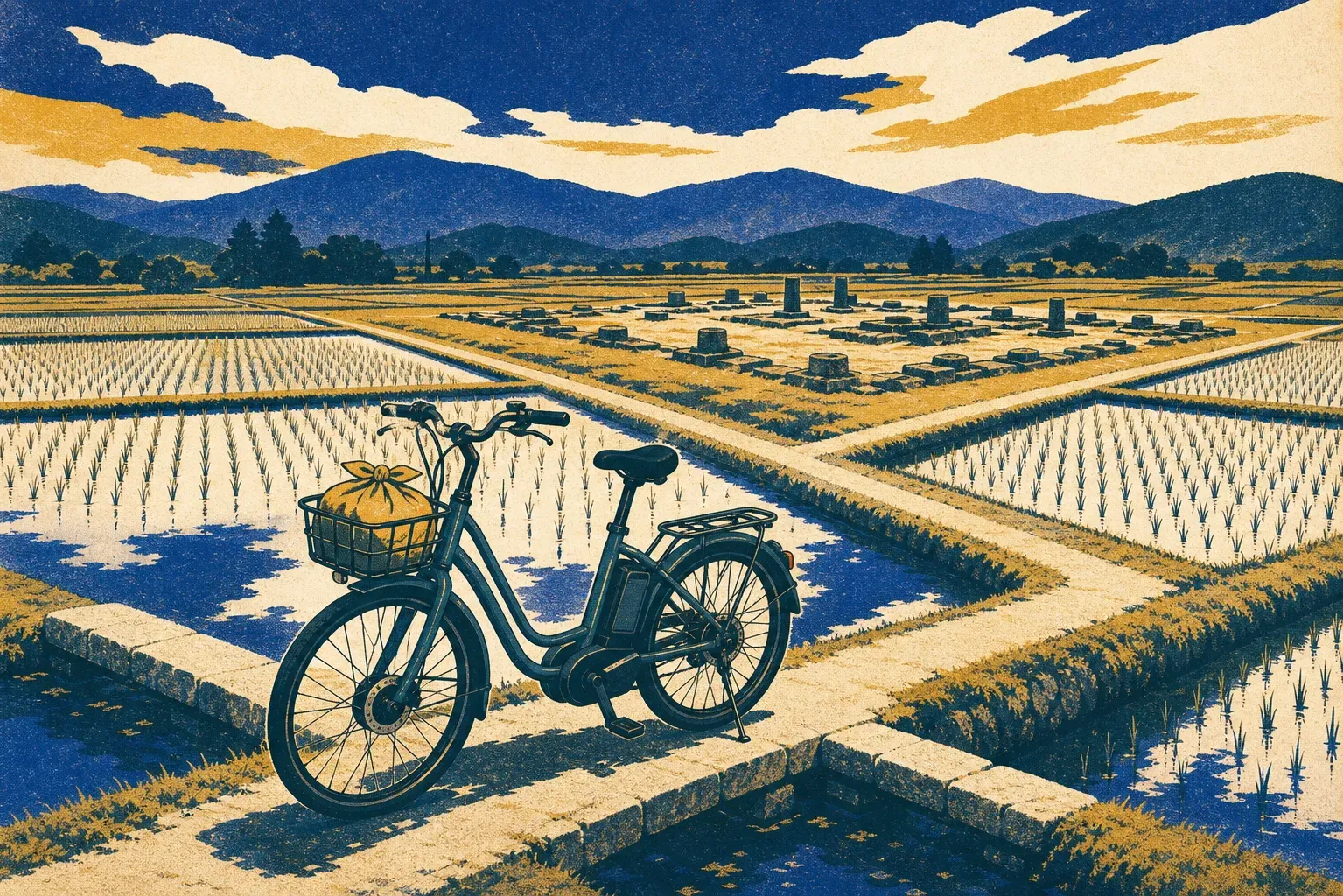
Three rental shops cluster at Asuka Station, all open 9:00 to 17:00: Asuka Rental Cycle, Rental Cycle Himawari, and Rental Cycle Man'yō. Prices vary by shop — a standard bike runs roughly ¥900 to ¥1,200 for the day and an electric one ¥1,400 to ¥1,700 (2026), with Himawari at the lower end and Asuka Rental Cycle at the upper. Take the electric. The ¥500 premium, consistent across shops, buys forgiveness on the gradual rise toward Ishibutai and means you reach the afternoon stops still curious.
Two errands before you pedal off. First, Asuka-bito no Yakata, the information center directly in front of the station, open 8:30 to 17:00: leave your luggage (¥500 a bag) and spend ¥120 (2026 price) on the Asuka Kingdom Passport, a pocket guidebook with discount coupons for eight sites including Ishibutai and Asuka-dera. Second, adjust your mental map. The park's main orientation center next to Takamatsuzuka, the Asuka Historical National Government Park Pavilion, closed on April 1, 2026 for a rebuild and will not reopen until around 2030. Older guides still send people there. Don't go.
And do not, in 2026, rent a car instead. The Takamatsuzuka car park closes on September 1 and stays shut through the rebuild. The free lot at Ishibutai becomes bicycle-and-motorcycle-only from September 19 to November 15, while weekend car parking at the paid Ishibutai lot goes reservation-only at ¥2,000 a day in the same window. Even the Man'yō Culture Museum's lot started charging on August 1. The village is rationing asphalt on purpose, and it asks visitors, in writing, to come by train.
The five-hour loop
The official Digest course by bicycle takes about five hours, and its sequencing is smarter than it looks: hops between stops run two to ten minutes, and it saves the flat, dense cluster of sites for the afternoon.
From the station, ride east to Takamatsuzuka first, about seven minutes on foot if you'd rather walk it. This is the tomb whose murals, found on March 21, 1972 during a survey for a walking path, set off a national archaeology boom. Be clear-eyed about what you'll see. The painted chamber was dismantled in 2006 and 2007 for conservation, so the mound is a restoration and the adjacent mural hall (¥300, 2026) shows full-scale replicas. It still earns 30 minutes, if only to grasp how small the chamber was: barely a meter wide and just over a meter tall, for sixteen painted figures and a ceiling of gold-leaf stars.
Then swing northeast past Kawara-dera, where the small temple Gufuku-ji now stands on the 7th-century foundations, and Tachibana-dera across the fields, the nunnery tied by legend to Prince Shōtoku's birth (¥500 as of April 2026; find the two-faced Nimen-seki stone). From there it's a short climb to Ishibutai.
Ishibutai needs no interpretation. The earth cover is long gone, so the burial chamber of what was likely Soga no Umako's tomb stands fully exposed: some thirty megaliths totaling about 2,300 tons, the ceiling stone alone around 77. Admission is ¥500 under the fee schedule revised April 1, 2026, or ¥650 combined with the turtle-shaped stone basin at Sakafuneishi, sold at either gate.
Eat lunch here, and plan it, because Asuka punishes improvisation. Kame-soba Ichigen-an, which serves hand-cut soba in a turtle-shaped bowl, opens Friday through Sunday only. Branciera Ishibutai Terrace does its Yamato-beef lunch on weekends and holidays only. Café Kotodama's lunch is limited-quantity and the owners want a phone call ahead; Da terra, the Michelin-listed Italian place near Kawara-dera, is reservation-only. The dependable option is Yumeichi Chaya, the farm restaurant beside Ishibutai's gate, open from 11:00, where the kodaimai gozen pairs purple heirloom rice with gore-dōfu, a wobbling kuzu-and-soy-milk dish you will not meet elsewhere.
The afternoon is the state-formation half. Asuka Palace Site, where four successive palaces rose on the same ground and the Isshi Incident of 645 played out. The Pond Garden next door, arguably the oldest ancestor of every Japanese garden you've ever walked. Sakafuneishi's carved ritual stones. Asuka-dera, Japan's first full-scale Buddhist temple, completed in 596 (¥500, 2026). The Water Clock Site, where formal timekeeping in Japan began in 660. Finally the octagonal joint tomb of Emperor Temmu and Empress Jitō, aligned deliberately with the main avenue of the Fujiwara capital, then an easy ride back before the 17:00 bike return.
If five hours is more than you have, the shorter Oku-Asuka course runs about three and a half, trading the palace cluster for the Inabuchi terraced rice fields and the Tobiishi stepping stones that appear in the Man'yōshū. In early autumn the terraces run red with spider lilies. That is also the most crowded stretch of the year; the September-to-November parking controls exist for a reason.
The calendar and the fine print
Do not come on a Monday. The Asuka Historical Museum and the Man'yō Culture Museum both close that day, and the mural halls take off the second Monday of April, July, November, and February. Know, too, that Kitora's actual paintings are shown only in a few multi-week windows each year, free but by advance application, capped at about 340 people a day; the White Tiger is out through August 30, 2026, and the autumn window runs September 19 to October 18. Every other day of the year, what's on display is a replica.
Last thing. Asuka is the only village in Japan protected in its entirety, under a law passed in 1980, and it publishes a ten-point code of things to mind while you are here: stay out of the fields, keep off the ruins, carry no fragment away. Item six was written for you specifically: cyclists must not spread across the road. (The village's better-known "Ten Promises" is the companion pledge, made by residents and businesses rather than asked of visitors.) These lanes between the paddies are how 4,967 people get to work. Ride single file, and have the bike back by five.